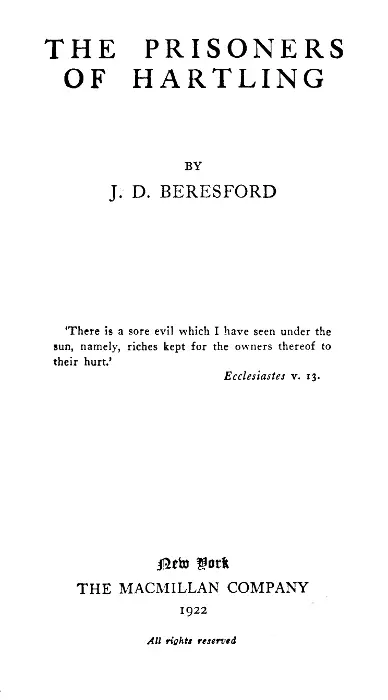
The Prisoners of Hartling
J. D. (John Davys) Beresford
THE CLASSIC COLLECTION · 1917
"The Wonder" by J. D. Beresford is a novel written in the early 20th century. The story explores themes of intelligence, abnormality, and the societal perceptions surrounding them, primarily through the lens of a remarkable child named Victor Stott. The narrative follows Ginger Stott, an ambitious cricketer whose life takes unexpected turns due to the extraordinary nature of his son. The opening of the book introduces us to a scene on a train where an unnamed narrator observes a woman with an unusual infant. The child's appearance captivates the attention of other passengers, leading to a mix of fascination and repulsion. As the narrator grapples with his own disdain for what he perceives as a “freak,” we learn that the child has not spoken or cried in his one year of life. The conversation touches on the mother’s protective behavior and the reactions of those around her, establishing the tension between normalcy and the extraordinary. This encounter hints at the complexity of Victor Stott's character and sets the stage for the exploration of his unique childhood and the challenges faced by his family.
Introduction adapted from the source catalogue; source summaries may be automatically generated.
Free to read · English · 60,640 words · No account needed
MAKE TIME FOR A GOOD BOOK
On by default. Untick to stop anonymous reading totals. Each page counts after 10 seconds in view. How this works.
Anonymous counting is on unless you have switched it off.
"There! kettle's boilin', come in and 'ave your tea," equivocated the
diplomatic Ellen.
During the progress of the meal, the child still sat quietly in his father's chair, his little hands resting on his knees, his eyes wide open, their gaze abstracted, as usual, from all earthly concerns.
But after tea Stott was heroic. He had reached the limit of his endurance. One of his deep-seated habits was being broken, and with it snapped his habit of acquiescence. He rose to his feet and faced his son with determination, and Stott had a bull-dog quality about him that was not easily defeated.
"Look 'ere! Get out!" he said. "That's my chair!"
The child very deliberately withdrew his attention from infinity and regarded the dogged face and set jaw of his father. Stott returned the stare for the fraction of a second, and then his eyes wavered and dropped, but he maintained his resolution.
"You got to get out," he said, "or I'll make you."
Ellen Mary gripped the edge of the table, but she made no attempt to
interfere.
There was a tense, strained silence. Then Stott began to breathe heavily. He lifted his long arms for a moment and raised his eyes, he even made a tentative step towards the usurped throne.
The child sat calm, motionless; his eyes were fixed upon his father's face with a sublime, undeviating confidence.
Stott's arms fell to his sides again, he shuffled his feet. One more effort he made, a sudden, vicious jerk, as though he would do the thing quickly and be finished with it; then he shivered, his resolution broke, and he shambled evasively to the door.
"God damn," he muttered. At the door he turned for an instant, swore again in the same words, and went out into the night.
To Stott, moodily pacing the Common, this thing was incomprehensible, some horrible infraction of the law of normal life, something to be condemned; altered, if possible. It was unprecedented, and it was, therefore, wrong, unnatural, diabolic, a violation of the sound principles which uphold human society.
To Ellen Mary it was merely a miracle, the foreshadowing of greater miracles to come. And to her was manifested, also, a minor miracle, for when his father had gone, the child looked at his mother and gave out his first recorded utterance.
"'Oo is God?" he said.
Ellen Mary tried to explain, but before she had stammered out many words, her son abstracted his gaze, climbed down out of the chair, and intimated with his usual grunt that he desired his bath and his bed.
Your reading position is saved on this browser. Take it to another device with a library code. Reading pages adapt to text, rather than matching a printed edition.
J. D. (John Davys) Beresford
BEHIND THE BOOK
This eBook is for the use of anyone anywhere in the United States and most other parts of the world at no cost and with almost no restrictions whatsoever. You may copy it, give it away or re-use it under the terms of the Project Gutenberg License included with this eBook or online at www.gutenberg.org. If you are not located in the United States, you will have to check the laws of the country where you are located before using this eBook. Read the source licence.
The original source file, including credits and licence, is retained by this library. Request an original-format copy at no charge. Please include the book title and Project Gutenberg identifier #27188.
KEEP YOUR CURIOSITY GOING
Coulson Kernahan

Maurice Baring
Frances Wright
Cécile Tormay

Frederic Jesup Stimson

W. H. P. (William Henry Pope) Jarvis