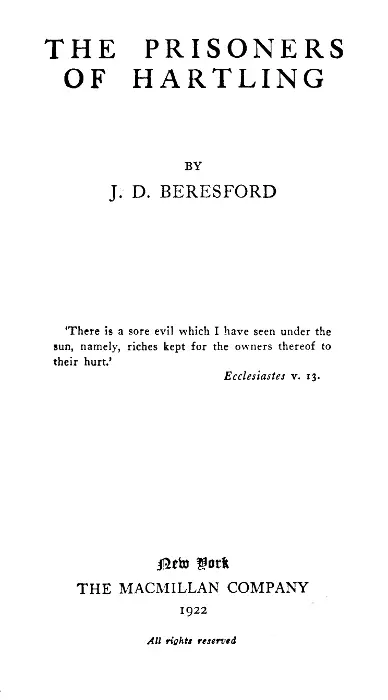
The Prisoners of Hartling
J. D. (John Davys) Beresford
THE CLASSIC COLLECTION · 1917
"The Wonder" by J. D. Beresford is a novel written in the early 20th century. The story explores themes of intelligence, abnormality, and the societal perceptions surrounding them, primarily through the lens of a remarkable child named Victor Stott. The narrative follows Ginger Stott, an ambitious cricketer whose life takes unexpected turns due to the extraordinary nature of his son. The opening of the book introduces us to a scene on a train where an unnamed narrator observes a woman with an unusual infant. The child's appearance captivates the attention of other passengers, leading to a mix of fascination and repulsion. As the narrator grapples with his own disdain for what he perceives as a “freak,” we learn that the child has not spoken or cried in his one year of life. The conversation touches on the mother’s protective behavior and the reactions of those around her, establishing the tension between normalcy and the extraordinary. This encounter hints at the complexity of Victor Stott's character and sets the stage for the exploration of his unique childhood and the challenges faced by his family.
Introduction adapted from the source catalogue; source summaries may be automatically generated.
Free to read · English · 60,640 words · No account needed
MAKE TIME FOR A GOOD BOOK
On by default. Untick to stop anonymous reading totals. Each page counts after 10 seconds in view. How this works.
Anonymous counting is on unless you have switched it off.
O'Connell sat down by the cot, listened to the child's breathing and heart-beat, lifted and let fall again the lax wrist, turned back the eyelid, revealing only the white of the upturned eyeball, and then composed himself to await the natural waking of the child, if it were asleep--always a matter of uncertainty.
The nurse stood near him, silent, but she looked away from the cot.
"Hydrocephalus!" murmured O'Connell, staring at his tiny patient, "hydrocephalus, without a doubt. Eh? nurse!"
"Yes, perhaps! I don't know, doctor."
"Oh, not a doubt of it, not a doubt," repeated O'Connell, and then came a flicker of the child's eyelids and a weak crumpling of the tiny hand.
O'Connell caught his breath and clawed at his beard. "Hydrocephalus," he muttered with set jaw and drawn eyebrows.
The tiny hand straightened with a movement that suggested the recovery of crushed grass, the mouth opened in a microscopic yawn, and then the eyelids were slowly raised and a steady unwavering stare of profoundest intelligence met O'Connell's gaze.
He clenched his hands, shifted in his chair, and then rose abruptly and
turned to the window.
"I--it won't be necessary for me to come again, nurse," he said curtly; "they are both doing perfectly well."
"Not come again?" There was dismay in the nurse's question.
"No! No! It's unnecessary ..." He broke off, and made for the door without another glance in the direction of the cot.
Nurse followed him downstairs.
"If I'm wanted--you can easily send for me," said O'Connell, as he went out. As he moved away he dragged at his beard and murmured: "Hydrocephalus, not a doubt of it."
Following his departure, Mrs. Reade heard curious and most unwonted laughter, and cautiously blundered downstairs to investigate. She found the nurse in an advanced condition of hysteria, laughing, gurgling, weeping, and intermittently crying in a shrill voice: "Oh! Lord have mercy; Lord ha' mercy!"
"Now, see you 'ere, my dear," said Mrs. Reade, when nurse had been recovered to a red-eyed sanity, "it's time she was told. I've never 'eld with keepin' it from 'er, myself, and I've 'ad more experience than many...." Mrs. Reade argued with abundant recourse to parenthesis.
"Is she strog edough?" asked the nurse, still with tears in her voice; "cad she bear the sight of hib?" She blew her nose vigorously, and then continued with greater clearness: "I'm afraid it may turn her head."
Out of her deep store of wisdom, Mrs. Reade produced a fact which she elaborated and confirmed by apt illustration, adducing more particularly the instance of Mrs. Harrison's third. "She's 'is mother," was the essence of her argument, a fact of deep and strange significance.
Your reading position is saved on this browser. Take it to another device with a library code. Reading pages adapt to text, rather than matching a printed edition.
J. D. (John Davys) Beresford
BEHIND THE BOOK
This eBook is for the use of anyone anywhere in the United States and most other parts of the world at no cost and with almost no restrictions whatsoever. You may copy it, give it away or re-use it under the terms of the Project Gutenberg License included with this eBook or online at www.gutenberg.org. If you are not located in the United States, you will have to check the laws of the country where you are located before using this eBook. Read the source licence.
The original source file, including credits and licence, is retained by this library. Request an original-format copy at no charge. Please include the book title and Project Gutenberg identifier #27188.
KEEP YOUR CURIOSITY GOING
Coulson Kernahan

Maurice Baring
Frances Wright
Cécile Tormay

Frederic Jesup Stimson

W. H. P. (William Henry Pope) Jarvis