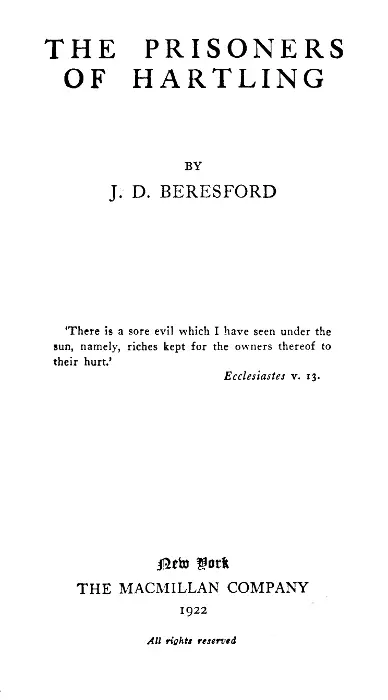
The Prisoners of Hartling
J. D. (John Davys) Beresford
THE CLASSIC COLLECTION · 1917
"The Wonder" by J. D. Beresford is a novel written in the early 20th century. The story explores themes of intelligence, abnormality, and the societal perceptions surrounding them, primarily through the lens of a remarkable child named Victor Stott. The narrative follows Ginger Stott, an ambitious cricketer whose life takes unexpected turns due to the extraordinary nature of his son. The opening of the book introduces us to a scene on a train where an unnamed narrator observes a woman with an unusual infant. The child's appearance captivates the attention of other passengers, leading to a mix of fascination and repulsion. As the narrator grapples with his own disdain for what he perceives as a “freak,” we learn that the child has not spoken or cried in his one year of life. The conversation touches on the mother’s protective behavior and the reactions of those around her, establishing the tension between normalcy and the extraordinary. This encounter hints at the complexity of Victor Stott's character and sets the stage for the exploration of his unique childhood and the challenges faced by his family.
Introduction adapted from the source catalogue; source summaries may be automatically generated.
Free to read · English · 60,640 words · No account needed
MAKE TIME FOR A GOOD BOOK
On by default. Untick to stop anonymous reading totals. Each page counts after 10 seconds in view. How this works.
Anonymous counting is on unless you have switched it off.
The description is journalistic, but I do not know that I could improve upon the detail of it. I can see those queer, freckled, hairy arms of his as I write--the combination of colours in them produced an effect that was almost orange. It struck one as unusual....
Surrey had the choice of innings, and decided to bat, despite the fact that the wicket was drying after rain, under the influence of a steady south-west wind and occasional bursts of sunshine. Would any captain in Stott's second year have dared to take first innings under such conditions? The question is farcical now, but not a single member of the Hampdenshire Eleven had the least conception that the Surrey captain was deliberately throwing away his chances on that eventful day.
Wallis and I were sitting together in the reporters' box. There were only four of us; two specials,--Wallis and myself,--a news-agency reporter, and a local man.
"Stott takes first over," remarked Wallis, sharpening his pencil and arranging his watch and score-sheet--he was very meticulous in his methods. "They've put him to bowl against the wind. He's medium right, isn't he?"
"Haven't the least idea," I said. "He volunteered no information; Hampdenshire have been keeping him dark."
Wallis sneered. "Think they've got a find, eh?" he said. "We'll wait and see what he can do against first-class batting."
We did not have to wait long.
As usual, Thorpe and Harrison were first wicket for Surrey, and Thorpe
took the first ball.
It bowled him. It made his wicket look as untidy as any wicket I have ever seen. The off stump was out of the ground, and the other two were markedly divergent.
"Damn it, I wasn't ready for him," we heard Thorpe say in the professionals' room. Thorpe always had some excuse, but on this occasion it was justified.
C. V. Punshon was the next comer, and he got his first ball through the slips for four, but Wallis looked at me with a raised eyebrow.
"Punshon didn't know a lot about that," he said, and then he added, "I say, what a queer delivery the chap has. He stands and shoots 'em out. It's uncanny. He's a kind of human catapult." He made a note of the phrase on his pad.
Punshon succeeded in hitting the next ball, also, but it simply ran up his bat into the hands of short slip.
"Well, that's a sitter, if you like," said Wallis. "What's the matter
with 'em?"
I was beginning to grow enthusiastic.
"Look here, Wallis," I said, "this chap's going to break records."
Wallis was still doubtful.
He was convinced before the innings was over.
Your reading position is saved on this browser. Take it to another device with a library code. Reading pages adapt to text, rather than matching a printed edition.
J. D. (John Davys) Beresford
BEHIND THE BOOK
This eBook is for the use of anyone anywhere in the United States and most other parts of the world at no cost and with almost no restrictions whatsoever. You may copy it, give it away or re-use it under the terms of the Project Gutenberg License included with this eBook or online at www.gutenberg.org. If you are not located in the United States, you will have to check the laws of the country where you are located before using this eBook. Read the source licence.
The original source file, including credits and licence, is retained by this library. Request an original-format copy at no charge. Please include the book title and Project Gutenberg identifier #27188.
KEEP YOUR CURIOSITY GOING
Coulson Kernahan

Maurice Baring
Frances Wright
Cécile Tormay

Frederic Jesup Stimson

W. H. P. (William Henry Pope) Jarvis