THE CLASSIC COLLECTION✦An outlaw’s diary: the CommuneCLASSIC FREE BOOKS
An outlaw’s diary: the Commune
Cécile Tormay
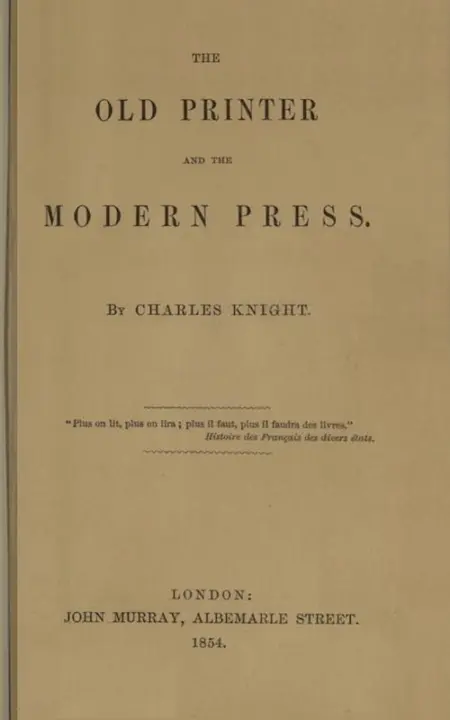
THE CLASSIC COLLECTION · 1854
"The Old Printer and the Modern Press" by Charles Knight is a historical account written in the mid-19th century. The work explores the life of William Caxton, the first English printer, highlighting his contributions to the dissemination of knowledge through the printed word. The narrative reflects on various themes, including the evolution of the English language, the cultural landscape before and after the introduction of printing, and the socio-economic changes triggered by this revolutionary technology. At the start of the narrative, the context surrounding Caxton’s early life is established, particularly focusing on the Weald of Kent where he grew up. The text discusses the linguistic environment of the time, noting the transition from French to English in education, and the scarcity of books before the advent of printing. Knight paints a vivid picture of Caxton's formative years, illustrating the societal isolation and linguistic variations in his rural upbringing. The opening portion sets the stage for understanding Caxton’s later accomplishments and the profound impact of printing on English literature, culture, and society.
Introduction adapted from the source catalogue; source summaries may be automatically generated.
Free to read · English · 88,831 words · No account needed
MAKE TIME FOR A GOOD BOOK
On by default. Untick to stop anonymous reading totals. Each page counts after 10 seconds in view. How this works.
Anonymous counting is on unless you have switched it off.
The Mercer's Apprentice—His Book-knowledge—Commerce in Books—Schools in London—City Apprentices—City Pageants—Spread of English Language— English Writers—Chaucer—Gower—Lydgate—The Minstrels—National Literature.
In a book which Caxton printed in 1483, 'The Booke callyd Cathon,' he says in his prologue or preface, "Unto the noble, ancient, and renowned city, the city of London in England, I, William Caxton, citizen and conjury [sworn fellow] of the same, and of the fraternity and fellowship of the Mercery, owe of right my service and good will; and of very duty am bounden naturally to assist, aid, and counsel, as farforth as I can to my power, as to my mother of whom I have received my nurture and living; and shall pray for the good prosperity and policy of the same during my life. For as me seemeth it is of great need, by cause I have known it in my young age much more wealthy, prosperous, and richer than it is at this day; and the cause is, that there is almost none that intendeth to the common weal, but only every man for his singular profit." It is the usual habit of the aged to look back upon the days of their youth as a period of higher prosperity and more exalted virtue, public and private, than they witness in their declining years. This is in most cases merely the mind's own colouring of the picture. But it is very possible that London, in the first year of Richard III., when Caxton wrote this preface, was really less prosperous, and its citizens less devoted to the public good, than half a century earlier, when Caxton was a blithe apprentice within its walls. The country had passed through the terrible convulsion of the wars of the Roses; and it is the nature of civil wars, especially, not only to waste the substance and destroy the means of existence of every man, but to render all men selfish, grasping at temporary good, suspicious, faithless. The master of Caxton was Robert Large, a member of the Mercers' Company, who was one of the Sheriffs in 1430, and Lord Mayor in 1439-40. The date of Caxton's apprenticeship has not been ascertained; but it is considered by several of his biographers to have commenced about 1428. At this period, the sixth of Henry VI., a law was on the statute-book, and rigorously enforced, whose object was to prevent the sons of labourers in husbandry, and indeed of the poorer classes of the yeomanry, from rising out of the condition in which they were born, by participating in the higher gains of trade and handicraft. A law of the seventh of Henry IV., about two-and-twenty years before this conjectural period of Caxton's apprenticeship, recites that, according to ancient statutes, those who labour at the plough or cart, or other service of husbandry, till at the age of twelve years, should continue to abide at such labour, and not to be put to any mystery or handicraft;—notwithstanding which statutes, says the law of Henry IV., country people whose fathers and mothers have no land or rent are put apprentices to divers crafts within the cities and boroughs, so that there is great scarcity of labourers and other servants of husbandry. The law then declares, "That no man nor woman, of what estate or condition they be, shall put their son or daughtor, of whatsoever age he or she be, to serve as apprentice to no craft or other labour within any city or borough in the realm, except he have land or rent to the value of twenty shillings by the year at least, but they shall be put to other labours as their estates doth require, upon pain of one year's imprisonment." This iniquitous law was necessarily as demoralizing and as injurious to the national prosperity as the institution of castes in India. Yet, by a most extraordinary blindness to cause and consequence, the makers of the law provided in the most direct way for its overthrow; for the statute goes on to say, that, although the husbandry labourer is always to be a labourer, "every man or woman, of what estate or condition they be, shall be free to set their son or daughter to take learning at any manner school that pleaseth them within the realm." The citizens of London, much to their honour, procured a repeal of this act in the eighth of Henry VI., about the period when Caxton was apprenticed. The probability is, that he would not have been affected by the exclusive character of this law; for his master was a rich and distinguished mercer—a member of that association which has always had pre-eminence amongst the livery companies of London. The dignified gravity, the prudence, and the prosperity of the citizens of that day have been well described by Chaucer:—
Your reading position is saved on this browser. Take it to another device with a library code. Reading pages adapt to text, rather than matching a printed edition.
BEHIND THE BOOK
This eBook is for the use of anyone anywhere in the United States and most other parts of the world at no cost and with almost no restrictions whatsoever. You may copy it, give it away or re-use it under the terms of the Project Gutenberg License included with this eBook or online at www.gutenberg.org. If you are not located in the United States, you will have to check the laws of the country where you are located before using this eBook. Read the source licence.
The original source file, including credits and licence, is retained by this library. Request an original-format copy at no charge. Please include the book title and Project Gutenberg identifier #59966.
KEEP YOUR CURIOSITY GOING
Cécile Tormay

Moritz Busch
John L. Ransom
Frances Wright
Cécile Tormay

Mabel Potter Daggett