THE CLASSIC COLLECTION✦An outlaw’s diary: the CommuneCLASSIC FREE BOOKS
An outlaw’s diary: the Commune
Cécile Tormay
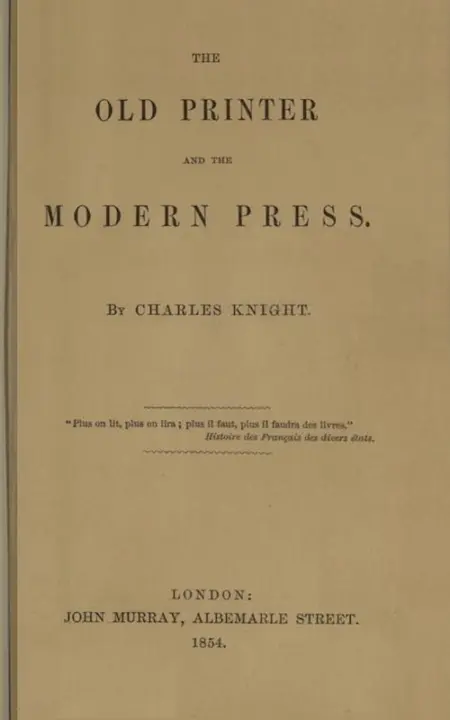
THE CLASSIC COLLECTION · 1854
"The Old Printer and the Modern Press" by Charles Knight is a historical account written in the mid-19th century. The work explores the life of William Caxton, the first English printer, highlighting his contributions to the dissemination of knowledge through the printed word. The narrative reflects on various themes, including the evolution of the English language, the cultural landscape before and after the introduction of printing, and the socio-economic changes triggered by this revolutionary technology. At the start of the narrative, the context surrounding Caxton’s early life is established, particularly focusing on the Weald of Kent where he grew up. The text discusses the linguistic environment of the time, noting the transition from French to English in education, and the scarcity of books before the advent of printing. Knight paints a vivid picture of Caxton's formative years, illustrating the societal isolation and linguistic variations in his rural upbringing. The opening portion sets the stage for understanding Caxton’s later accomplishments and the profound impact of printing on English literature, culture, and society.
Introduction adapted from the source catalogue; source summaries may be automatically generated.
Free to read · English · 88,831 words · No account needed
MAKE TIME FOR A GOOD BOOK
On by default. Untick to stop anonymous reading totals. Each page counts after 10 seconds in view. How this works.
Anonymous counting is on unless you have switched it off.
Periodical Literature—Prices of Books; 18th Century—Two classes of Buyers—The Magazines—Collections of the Poets—The Circulating Library— Cheap Book-Clubs.
On the 8th of February, 1696, our friend John Dunton completed the nineteenth volume of 'The Athenian Mercury, resolving all the most nice and curious questions proposed by the ingenious.' This penny tract, published twice a-week, consisted of a single leaf. "The ingenious" ceased to question, and "The Athenian Society," as the bookseller called his scribes, ceased to answer, after six years of this oracular labour. There came an irruption of the barbarians, in the shape of "nine newspapers every week." John proposed to resume his task "as soon as the glut of news is a little over." The countryman waiting for the river to roll by was not more mistaken. In 1709 there was one daily paper in London; twelve, three times a-week; and three, twice a-week. Amongst those of three times a-week was 'The Tatler,' which commenced April 12, 1709. The early Tatlers had their regular foreign intelligence. They were as much newspapers as 'The Flying Post' and 'The Postboy.' But Isaac Bickerstaff, Esq., very soon discontinued the information which he derived from letters from the Hague and advices from Berlin. He had something of a more original character to offer his readers. The state of popular enlightenment at this period has been described by Johnson in his Life of Addison:—"That general knowledge which now circulates in common talk was in his time rarely to be found. Men not professing learning were not ashamed of ignorance; and in the female world any acquaintance with books was distinguished only to be censured." Steele and Addison had to form the taste of the new generation that they were addressing. They knew that there was a large class craving amusement, who might at the same time be refined and instructed without the pretensions of "the budge doctors of the stoic fur." They meddled little with politics. They left the furious discussions about Church and State to papers with an earnest political purpose, of which Charles Leslie, a violent Tory, thus spoke in his 'Rehearsals:'—"The greatest part of the people do not read books; most of them cannot read at all: but they will gather together about one that can read, and listen to an Observator or Review, as I have seen them, in the streets." The Tatler has been described as a great success; but we may measure that success by that of the more popular Spectator. In No. 555 of that work Steele says,—"The tax on each half-sheet has brought into the Stamp-Office, one week with another, above 20l. a-week, arising from the single paper, notwithstanding it at first reduced it to less than half the number that was usually printed before the tax was laid." The tax being a halfpenny, this would only show a daily circulation of 1600, and of about 3000 when it was unstamped. But the sale in volumes, according to the same statement, was as high as 9000 of each volume. This fact gives us a higher notion of the popularity of these charming papers, and of the consequent extent of general reading, than any other circumstance in the literary history of that period. But even the comparatively small daily sale was of importance, as showing that the great middle class was beginning to seek something better than could be found in the coarse and meagre news-sheets. The annals of 'The Gentlemen's Society at Spalding' record that in April, 1709, some residents there heard of the Tatlers, and ordered them to be sent to the coffee-house in the Abbey-yard:—"They were accordingly had, and read there every postday, generally aloud to the company, who could sit and talk over the subject afterwards." The narrative goes on to say that "in March, 1711, the Spectator came out, which was received and read here as the Tatler had been." Such are the beginnings of popular knowledge. What the Tatler and Spectator were to the gentlemen of Spalding, the Penny Magazine and Chambers' Journal were to many a mechanic a hundred and twenty years after. One of this class has recorded the influence of such works, which addressed a far larger number than could be addressed at the beginning of the eighteenth century:—"The Penny Magazine was published. I borrowed the first volume, and determined to make an effort to possess myself with the second. Accordingly, with January, 1833, I determined to discontinue the use of sugar in my tea, hoping that my family would not then feel the sacrifice necessary to buy the book.... I looked as anxiously for the issue of the monthly part as I did for the means of getting a living."[27] It is this spirit in the great mechanical class of this country that, in spite of some popular reading that is corrupting, and much that is frivolous, will ultimately raise and purify even the meanest sheet of our cheap literature, and compel those who have the responsibility of addressing large masses of the people to understand that an influential portion do feel that the acquirement of knowledge is worth some sacrifice.
Your reading position is saved on this browser. Take it to another device with a library code. Reading pages adapt to text, rather than matching a printed edition.
BEHIND THE BOOK
This eBook is for the use of anyone anywhere in the United States and most other parts of the world at no cost and with almost no restrictions whatsoever. You may copy it, give it away or re-use it under the terms of the Project Gutenberg License included with this eBook or online at www.gutenberg.org. If you are not located in the United States, you will have to check the laws of the country where you are located before using this eBook. Read the source licence.
The original source file, including credits and licence, is retained by this library. Request an original-format copy at no charge. Please include the book title and Project Gutenberg identifier #59966.
KEEP YOUR CURIOSITY GOING
Cécile Tormay

Moritz Busch
John L. Ransom
Frances Wright
Cécile Tormay

Mabel Potter Daggett