THE CLASSIC COLLECTION✦An outlaw’s diary: the CommuneCLASSIC FREE BOOKS
An outlaw’s diary: the Commune
Cécile Tormay
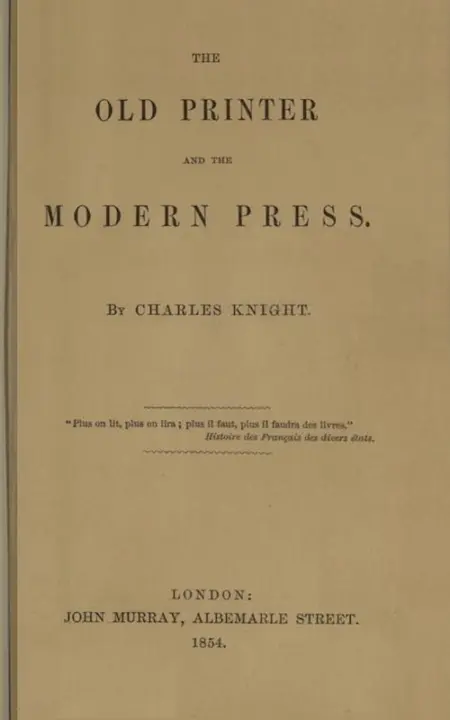
THE CLASSIC COLLECTION · 1854
"The Old Printer and the Modern Press" by Charles Knight is a historical account written in the mid-19th century. The work explores the life of William Caxton, the first English printer, highlighting his contributions to the dissemination of knowledge through the printed word. The narrative reflects on various themes, including the evolution of the English language, the cultural landscape before and after the introduction of printing, and the socio-economic changes triggered by this revolutionary technology. At the start of the narrative, the context surrounding Caxton’s early life is established, particularly focusing on the Weald of Kent where he grew up. The text discusses the linguistic environment of the time, noting the transition from French to English in education, and the scarcity of books before the advent of printing. Knight paints a vivid picture of Caxton's formative years, illustrating the societal isolation and linguistic variations in his rural upbringing. The opening portion sets the stage for understanding Caxton’s later accomplishments and the profound impact of printing on English literature, culture, and society.
Introduction adapted from the source catalogue; source summaries may be automatically generated.
Free to read · English · 88,831 words · No account needed
MAKE TIME FOR A GOOD BOOK
On by default. Untick to stop anonymous reading totals. Each page counts after 10 seconds in view. How this works.
Anonymous counting is on unless you have switched it off.
Degrees of Readers—General Improvement—Newspaper Press—Newspaper Press National—Agricultural Readers—General desire for Amusement—Supply of real Knowledge.
Our readers can scarcely have failed to make for themselves the deduction which naturally arises out of this survey of the progress of popular literature—that there always have been, still are, and always will be, various classes of readers and purchasers; and that the invariable progress of knowledge and intelligence—from the learned to the rich, from the rich to the middle classes, from the middle classes to the multitude—has produced as invariably a corresponding change in the number of books published, their quality, and their price. As the rich began to gather knowledge, books ceased to be wholly adapted to the learned or professional student; as the burgesses began to employ their leisure in reading, books ceased to be dependent upon courtly influence; as the multitude acquired the rudiments of instruction, books became less conventional, and began to adapt themselves to all classes. But it cannot, without a judicial blindness, be assumed that we are arrived at that state in which there are no degrees of intellectual advancement. It is said, to use the language of the most popular journal of our day, that the masses "do not yet feel the assurance that, if they go in thousands to the counters of the great publishing houses, as they congregate around the more plebeian shops, they will get the exact article they want, or what they consider value for their money." Here is the point. The masses, who are yet more imperfectly educated than some of their own class, and most of the class above them, would not consider, as they have never yet considered, solid and instructive reading "value for their money." Unquestionably "books to please the million must not only be good but attractive." The chief popular labour of the last quarter of a century has been to convert the ponderous ores of learning into the fine gold of knowledge. The multitude have been reached in many directions; and the influences of "good but attractive" books have penetrated where the books themselves have not yet had a direct influence. But the multitude stand precisely in the same relation to works of instruction, even the most attractive, as they do to Mechanics' Institutes and Athenæums. In Manchester and its dependencies, in 1851, there were 3447 members of these Institutions, and 1793 pupils in classes.[35] But the great mass of the youth of both sexes in Manchester were frequenting the Casinos. Here they neither drank, nor danced, nor gambled: they listened to recitations and comic songs at a penny an hour. They wanted mere amusement, and they found it. It is the same with the great bulk of the readers of cheap books. "It is most worthy of note," says the writer just mentioned, whose anxiety for cheap literature we honour and appreciate, "that, when there has been no doubt of the substantial value of the commodity issued from the Row or Albemarle Street, the sale of the books has been by no means equivocal." Certainly not. Macaulay and Layard have found large numbers of purchasers, and will find them, in their cheap form. But are these purchasers what are called, in the same breath, "the multitude"—"the needy"? Not at all. Even the most successful of the periodical works above a penny—'Chambers' Journal,' 'Household Words,'—reach only the advanced guard of this class. Mr. Dickens collected around him at Birmingham such an audience as never before waited upon an author. He read his beautiful, humanizing 'Christmas Carol' to two thousand working-men. They felt every point—they laughed, or they grew serious, with understanding. But are we to suppose that the whole mass of the mechanical classes—men, women, and children—throughout the kingdom, would rush by millions to buy 'The Christmas Carol' at a penny or two—at a price that would compensate in fame what was wanting in profit? Its sterling merit—its nature, its simplicity, its purity, its quiet humour—require a far higher amount of taste and cultivation to appreciate than the immaturity of mind to which the coarseness and imbecility of the penny journals are acceptable. An author of less popular acceptation published a poem at a farthing, but we never heard that he employed a steam-press in its production. The multitude have their own weekly literature, and we have seen what it is. Are the novels of the author of 'Pelham' to be speedily found in every cottage of the farm-labourer, and in every garret of the Lancashire cotton-spinner? The time may come, but it is not as yet. If a despotic government, in the desire to disseminate knowledge, were to follow the example which our free Government has set with regard to the 'School-books published by authority of the Commissioners of National Education in Ireland,' they might produce sound popular literature as cheap again as the most adventurous of publishers. But if they left competition free to what they considered unsound knowledge—if they permitted the lowest-priced Fiction, however bad or indifferent, to circulate without their unequal competition—we believe the free-traders would beat the monopolists in point of numbers; and it would be found an easier task, even with every commercial disadvantage of price, to "tickle and excite the palate" than "strengthen the constitution."
Your reading position is saved on this browser. Take it to another device with a library code. Reading pages adapt to text, rather than matching a printed edition.
BEHIND THE BOOK
This eBook is for the use of anyone anywhere in the United States and most other parts of the world at no cost and with almost no restrictions whatsoever. You may copy it, give it away or re-use it under the terms of the Project Gutenberg License included with this eBook or online at www.gutenberg.org. If you are not located in the United States, you will have to check the laws of the country where you are located before using this eBook. Read the source licence.
The original source file, including credits and licence, is retained by this library. Request an original-format copy at no charge. Please include the book title and Project Gutenberg identifier #59966.
KEEP YOUR CURIOSITY GOING
Cécile Tormay

Moritz Busch
John L. Ransom
Frances Wright
Cécile Tormay

Mabel Potter Daggett