THE CLASSIC COLLECTION✦An outlaw’s diary: the CommuneCLASSIC FREE BOOKS
An outlaw’s diary: the Commune
Cécile Tormay
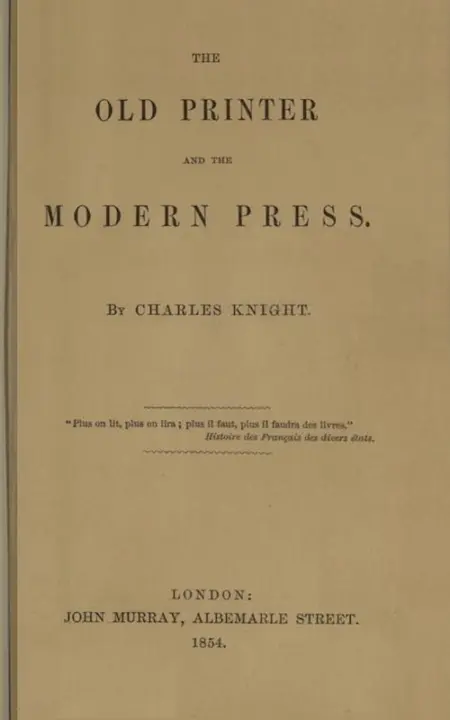
THE CLASSIC COLLECTION · 1854
"The Old Printer and the Modern Press" by Charles Knight is a historical account written in the mid-19th century. The work explores the life of William Caxton, the first English printer, highlighting his contributions to the dissemination of knowledge through the printed word. The narrative reflects on various themes, including the evolution of the English language, the cultural landscape before and after the introduction of printing, and the socio-economic changes triggered by this revolutionary technology. At the start of the narrative, the context surrounding Caxton’s early life is established, particularly focusing on the Weald of Kent where he grew up. The text discusses the linguistic environment of the time, noting the transition from French to English in education, and the scarcity of books before the advent of printing. Knight paints a vivid picture of Caxton's formative years, illustrating the societal isolation and linguistic variations in his rural upbringing. The opening portion sets the stage for understanding Caxton’s later accomplishments and the profound impact of printing on English literature, culture, and society.
Introduction adapted from the source catalogue; source summaries may be automatically generated.
Free to read · English · 88,831 words · No account needed
MAKE TIME FOR A GOOD BOOK
On by default. Untick to stop anonymous reading totals. Each page counts after 10 seconds in view. How this works.
Anonymous counting is on unless you have switched it off.
"A Merchant was there with a forkéd beard;
In motley, and high on horse he sat,
And on his head a Flaundrish beaver hat.
His bootes claspéd fair and fetisly;[1]
His reasons spake he full solemnély,
Sounding alway the increase of his winning:
He would the sea were kept[2] for any thing,
Betwixen Middleburgh and Orewell.
Well could he in exchanges shieldies[3] sell,
This worthy man full well his wit beset;[4]
There wiste no wight that he was in debt,
So stedfastly did he his governance
With his bargains, and with his chevisance.[5]"
When we look at William Caxton as the apprentice to a London mercer, his position does not at first sight appear very favourable to that cultivation of a literary taste, and that love of books, which was originally the solace, and afterwards the business, of his life. Yet a closer insight into the mercantile arrangements of those days will show us that he could not have been more favourably placed for attaining some practical acquaintance with books, in the way of his ordinary occupation. When books were so costly and so inaccessible to the great body of the people, there was necessarily no special trade of bookselling. There were indeed stationers, who had books for sale, or more probably executed orders for transcribing books. Their occupation is thus described by Mr. Hallam, in his 'Literature of Europe:'—"These dealers were denominated stationarii, perhaps from the open stalls at which they carried on their business, though statio is a general word for a shop, in low Latin. They appear by the old statutes of the university of Paris, and by those of Bologna, to have sold books upon commission; and are sometimes, though not uniformly, distinguished from the librarii; a word which, having originally been confined to the copyists of books, was afterwards applied to those who traded in them. They sold parchment and other materials of writing, which, with us, though, as far as I know, nowhere else, have retained the name of stationery, and naturally exercised the kindred occupations of binding and decorating. They probably employed transcribers." The mercer in those days was not a dealer in small wares generally, as at an earlier period; nor was his trade confined to silken goods—such an one as Shakspere describes, "Master Threepile, the mercer," who had thrown a man into prison for "some four suits of peach-coloured satin." The mercer of the fifteenth century was essentially a merchant. The mercers in the time of Edward III. were the great wool-dealers of the country. They were the merchants of the Staple, in the early days of our woollen manufacture; and the merchant adventurers of a later period were principally of their body. In their traffic with other lands, and especially with the Low Countries, they were the agents by which valuable manuscripts found their way into England; and in this respect they were something like the great merchant princes of Italy, whose ships not unfrequently contained a cargo of Indian spices and of Greek manuscripts. John Bagford, who wrote a slight Life of Caxton about 1714, which is in manuscript in the British Museum, says, "Kings, queens, and noblemen had their particular merchants, who, when they were ready for their voyage into foreign parts, sent their servants to know what they wanted, and among the rest of their choice many times books were demanded, and there to buy them in those parts where they were going." Caxton tells us in the 'Book of Good Manners,' which he translated from the French and printed in 1487, that the original French work was delivered to him by a "special friend, a mercer of London, named William Praat." This commerce of books could not have been very great; but it might have been so far carried on by Robert Large, the wealthy master of Caxton, that a lad of ability might thus possess opportunities for improvement which were denied to the great body of his fellow-apprentices. At this particular period there appear to have been but few opportunities even for the sons of parents of some substance to obtain the rudiments of knowledge. There is a petition presented to parliament in the twenty-fifth year of Henry VI., 1446, which exhorts the Commons "to consider the great number of grammar-schools that sometime were in divers parts of this realm, besides those that were in London, and how few there are in these days." The petitioners, who are four clergymen of the city, go on to say that London is the common concourse of this land, and that many persons, for lack of schoolmasters in their own country, resort there to be informed of grammar; and then they proceed thus: "Wherefore it were expedient that in London were a sufficient number of schools and good informers in grammar; and not, for the singular avail of two or three persons, grievously to hurt the multitude of young people of all this land. For where there is great number of learners and few teachers, and all the learners be compelled to go to the few teachers, and to none others, the masters wax rich of money, and the learners poorer in cunning, as experience openly showeth, against all virtue and order of weal public." These benevolent clergymen accomplished the object of their petition, which was that in each of their parishes they might "ordain, create, establish, and set a person sufficiently learned in grammar to hold and exercise a school in the same science of grammar, and there to teach to all that will learn." One of the schools thus established exists to this day, in connexion with the Mercers' Company, and is commonly known as the Mercers' School. We are a little anticipating the period of our narrative, for this petition belongs to Caxton's mature life; but we mention it as an evidence of the extreme difficulty which must have existed in those days for the children of the middle classes to obtain the rudiments of knowledge. It is evident that Caxton belonged to the more fortunate portion, upon whom the blessings of education fell like prizes in a lottery. The evil has not been wholly corrected even during four centuries; but it is devoutly to be hoped that the time is not far distant when, to use the words of the benevolent clergymen who knew the value of knowledge at that comparatively dark period, there shall be in every place a school, and a competent person "there to teach to all that will learn."
Your reading position is saved on this browser. Take it to another device with a library code. Reading pages adapt to text, rather than matching a printed edition.
BEHIND THE BOOK
This eBook is for the use of anyone anywhere in the United States and most other parts of the world at no cost and with almost no restrictions whatsoever. You may copy it, give it away or re-use it under the terms of the Project Gutenberg License included with this eBook or online at www.gutenberg.org. If you are not located in the United States, you will have to check the laws of the country where you are located before using this eBook. Read the source licence.
The original source file, including credits and licence, is retained by this library. Request an original-format copy at no charge. Please include the book title and Project Gutenberg identifier #59966.
KEEP YOUR CURIOSITY GOING
Cécile Tormay

Moritz Busch
John L. Ransom
Frances Wright
Cécile Tormay

Mabel Potter Daggett