THE CLASSIC COLLECTION✦An outlaw’s diary: the CommuneCLASSIC FREE BOOKS
An outlaw’s diary: the Commune
Cécile Tormay
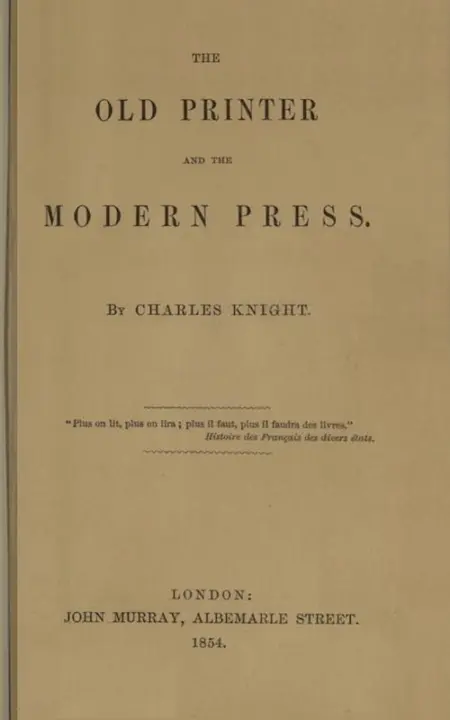
THE CLASSIC COLLECTION · 1854
"The Old Printer and the Modern Press" by Charles Knight is a historical account written in the mid-19th century. The work explores the life of William Caxton, the first English printer, highlighting his contributions to the dissemination of knowledge through the printed word. The narrative reflects on various themes, including the evolution of the English language, the cultural landscape before and after the introduction of printing, and the socio-economic changes triggered by this revolutionary technology. At the start of the narrative, the context surrounding Caxton’s early life is established, particularly focusing on the Weald of Kent where he grew up. The text discusses the linguistic environment of the time, noting the transition from French to English in education, and the scarcity of books before the advent of printing. Knight paints a vivid picture of Caxton's formative years, illustrating the societal isolation and linguistic variations in his rural upbringing. The opening portion sets the stage for understanding Caxton’s later accomplishments and the profound impact of printing on English literature, culture, and society.
Introduction adapted from the source catalogue; source summaries may be automatically generated.
Free to read · English · 88,831 words · No account needed
MAKE TIME FOR A GOOD BOOK
On by default. Untick to stop anonymous reading totals. Each page counts after 10 seconds in view. How this works.
Anonymous counting is on unless you have switched it off.
But, even in the days before printing, there was a small book-trade; and schemes were devised for making books of some general use. In Paris, in the middle of the 14th century, the booksellers were commanded to keep books for hire; and, in a register of the University of Paris, Chevillier found a list of the books so circulated, and the price of reading each. The hire of a Bible was ten sous. That the ecclesiastics and lawyers constituted the great bulk of readers, and that the addition of a book, even to the private library of a student, was a rare occurrence, is evident from the absolute necessity for manuscript books being dear. If the number of readers had increased—if there had been more candidates for the learned professions—if the nobility had discovered the shame of their ignorance—if learning had made its way to the franklin's hall—manuscript books could never have been cheap. But from the hour when a first large expense of transferring the letters, syllables, words, and sentences of a manuscript to moveable type was ascertained to be the means of multiplying copies to the extent of any demand, then the greater the demand the greater the cheapness.
If the nobles, the higher gentry, and even the lawyers and ecclesiastics, were indifferently provided with books, we cannot expect that the yeomen had any books whatever. The merchants and citizens were probably somewhat better provided. The labourers, who were scarcely yet fully established in their freedom from bondage to one lord, were probably, as a class, wholly unable to use books at all. Shakspere, in all likelihood, did not much exaggerate the feelings of ignorant men, who at the same time were oppressed men, when he put these words in the mouth of Jack Cade when addressing Lord Say: "Thou hast most traitorously corrupted the youth of the realm, in erecting a grammar-school: and whereas, before, our forefathers had no other books but the score and the tally, thou hast caused printing to be used; and, contrary to the king, his crown and dignity, thou hast built a paper-mill." The poet has a little deranged the exact order of events, as poets are justified in doing, who look at history not with chronological accuracy, but with a broad view of the connexion between events and principles. The insurrection of Cade preceded the introduction of printing and paper-mills into England. Although during four centuries we have yet to lament that the people have not had the full benefit which the art of printing is calculated to bestow upon them, we may be sure that during its progress the general amelioration of society has been certain, though gradual. There can no longer be any necessary exclusiveness in the possession of books, and in the advantages which the knowledge of books is calculated to bestow on all men. The late Mr. Southey, a just and liberal thinker, but, like many others of ardent feelings, sometimes mistaken and oftener misrepresented, has truly pointed out the difference between the state of society when William Caxton was raised up to do his work amongst us and the present state. The following is an extract from his 'Colloquies on the Progress and Prospects of Society:' "One of the first effects of printing was to make proud men look upon learning as disgraced, by being thus brought within reach of the common people. Till that time learning, such as it was, had been confined to courts and convents, the low birth of the clergy being overlooked, because they were privileged by their order. But when laymen in humble life were enabled to procure books, the pride of aristocracy took an absurd course, insomuch that at one time it was deemed derogatory for a nobleman if he could read or write. Even scholars themselves complained that the reputation of learning, and the respect due to it, and its rewards, were lowered when it was thrown open to all men; and it was seriously proposed to prohibit the printing of any book that could be afforded for sale below the price of three soldi. This base and invidious feeling was perhaps never so directly avowed in other countries as in Italy, the land where literature was first restored; and yet in this more liberal island ignorance was for some generations considered to be a mark of distinction by which a man of gentle birth chose, not unfrequently, to make it apparent that he was no more obliged to live by the toil of his brain, than by the sweat of his brow. The same changes in society, which rendered it no longer possible for this class of men to pass their lives in idleness, have completely put an end to this barbarous pride. It is as obsolete as the fashion of long finger-nails, which in some parts of the East are still the distinctive mark of those who labour not with their hands. All classes are now brought within the reach of your current literature,—that literature which, like a moral atmosphere, is, as it were, the medium of intellectual life, and on the quality of which, according as it may be salubrious or noxious, the health of the public mind depends."
Your reading position is saved on this browser. Take it to another device with a library code. Reading pages adapt to text, rather than matching a printed edition.
BEHIND THE BOOK
This eBook is for the use of anyone anywhere in the United States and most other parts of the world at no cost and with almost no restrictions whatsoever. You may copy it, give it away or re-use it under the terms of the Project Gutenberg License included with this eBook or online at www.gutenberg.org. If you are not located in the United States, you will have to check the laws of the country where you are located before using this eBook. Read the source licence.
The original source file, including credits and licence, is retained by this library. Request an original-format copy at no charge. Please include the book title and Project Gutenberg identifier #59966.
KEEP YOUR CURIOSITY GOING
Cécile Tormay

Moritz Busch
John L. Ransom
Frances Wright
Cécile Tormay

Mabel Potter Daggett