THE CLASSIC COLLECTION✦An outlaw’s diary: the CommuneCLASSIC FREE BOOKS
An outlaw’s diary: the Commune
Cécile Tormay
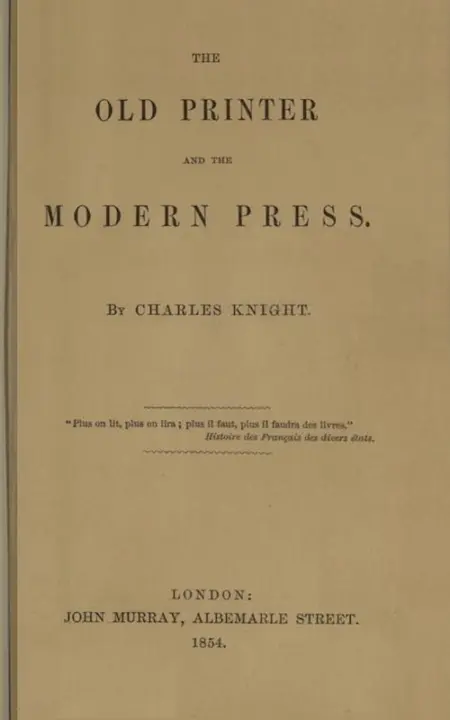
THE CLASSIC COLLECTION · 1854
"The Old Printer and the Modern Press" by Charles Knight is a historical account written in the mid-19th century. The work explores the life of William Caxton, the first English printer, highlighting his contributions to the dissemination of knowledge through the printed word. The narrative reflects on various themes, including the evolution of the English language, the cultural landscape before and after the introduction of printing, and the socio-economic changes triggered by this revolutionary technology. At the start of the narrative, the context surrounding Caxton’s early life is established, particularly focusing on the Weald of Kent where he grew up. The text discusses the linguistic environment of the time, noting the transition from French to English in education, and the scarcity of books before the advent of printing. Knight paints a vivid picture of Caxton's formative years, illustrating the societal isolation and linguistic variations in his rural upbringing. The opening portion sets the stage for understanding Caxton’s later accomplishments and the profound impact of printing on English literature, culture, and society.
Introduction adapted from the source catalogue; source summaries may be automatically generated.
Free to read · English · 88,831 words · No account needed
MAKE TIME FOR A GOOD BOOK
On by default. Untick to stop anonymous reading totals. Each page counts after 10 seconds in view. How this works.
Anonymous counting is on unless you have switched it off.
We have abundant evidence, whatever be the scarcity of books as compared with the growth of scholarship, that the ecclesiastics laboured most diligently to multiply books for their own establishments. In every great abbey there was a room called the Scriptorium, where boys and novices were constantly employed in multiplying the service-books of the choir, and the less valuable books for the library; whilst the monks themselves laboured in their cells upon bibles and missals. Equal pains were taken in providing books for those who received a liberal education in collegiate establishments. Warton says, "At the foundation of Winchester College, one or more transcribers were hired and employed by the founder to make books for the library. They transcribed and took their commons within the college, as appears by computations of expenses on their account now remaining." But there are several indications that even kings and nobles had not the advantages of scholars by profession; and, possessing few books of their own, had sometimes to borrow of their more favoured subjects. We find it recorded that the Prior of Christ Church, Canterbury, had lent to King Henry V. the works of St. Gregory, and he complains that after the king's death the book had been detained by the Prior of Shene. The same king had borrowed from the Lady Westmoreland two books that had not been returned, and a petition is still extant in which she begs his successors in authority to let her have them back again. Lewis XI. of France wishing to borrow a book from the Faculty of Medicine at Paris, they would not allow the king to have it till he had deposited a quantity of valuable plate in pledge, and given a joint bond with one of his nobles for its due return. The books that were to be found in the palaces of the great, a little while before the invention of printing, were for the most part highly illuminated manuscripts, and bound in the most expensive style. In the wardrobe accounts of King Edward IV. we find that Piers Bauduyn is paid for "binding, gilding, and dressing" of two books, twenty shillings each, and of four books, sixteen shillings each. Now twenty shillings in those days would have bought an ox. But the cost of this binding and garnishing does not stop here; for there were delivered to the binder six yards of velvet, six yards of silk, laces, tassels, copper and gilt clasps, and gilt nails. The price of velvet and silk in those days was enormous. We may reasonably conclude that these royal books were as much for show as for use. One of the books thus garnished by Edward IV.'s binder is called 'Le Bible Historiaux' (The Historical Bible), and there are several copies of the same book in manuscript in the British Museum. In one of them the following paragraph is written in French: "This book was taken from the King of France at the battle of Poitiers; and the good Count of Salisbury, William Mountague, bought it for a hundred marks, and gave it to his lady Elizabeth, the good Countess.... Which book the said Countess assigned to her executors to sell for forty livres." We learn from another source that the great not only procured books by purchase, but employed transcribers to make them for their libraries. We find, from the manuscript account of the expenses of Sir John Howard, afterwards Duke of Norfolk, that in 1467 Thomas Lympnor, that is, Thomas the Limner, of Bury, was paid the sum of fifty shillings and twopence for a book which he had transcribed and ornamented, including the vellum and binding. The Limner's bill is made up of a number of items,—for whole vignettes, and half vignettes, and capital letters, and flourishing, and plain writing. This curious account is printed in the 'Paston Letters.' A letter of Sir John Paston, who is writing to his mother in 1474, shows how scarce money was in those days for the purchase of luxuries like books. He says, "As for the books that were Sir James's (the Priest's), if it like you that I may have them, I am not able to buy them, but somewhat would I give, and the remainder, with a good devout heart, by my troth, I will pray for his soul.... If any of them are claimed hereafter, in faith I will restore it." The custom of borrowing books and not returning them was as old, we see, as the days of the Red and White Roses. John Paston left an inventory of his books, eleven in number, although some of the eleven contained various little tracts bound together. One of the items in this catalogue is, "A Book of Troilus, which William B—— hath had near ten years, and lent it to Dame Wingfeld, and there I saw it."
Your reading position is saved on this browser. Take it to another device with a library code. Reading pages adapt to text, rather than matching a printed edition.
BEHIND THE BOOK
This eBook is for the use of anyone anywhere in the United States and most other parts of the world at no cost and with almost no restrictions whatsoever. You may copy it, give it away or re-use it under the terms of the Project Gutenberg License included with this eBook or online at www.gutenberg.org. If you are not located in the United States, you will have to check the laws of the country where you are located before using this eBook. Read the source licence.
The original source file, including credits and licence, is retained by this library. Request an original-format copy at no charge. Please include the book title and Project Gutenberg identifier #59966.
KEEP YOUR CURIOSITY GOING
Cécile Tormay

Moritz Busch
John L. Ransom
Frances Wright
Cécile Tormay

Mabel Potter Daggett