THE CLASSIC COLLECTION✦An outlaw’s diary: the CommuneCLASSIC FREE BOOKS
An outlaw’s diary: the Commune
Cécile Tormay
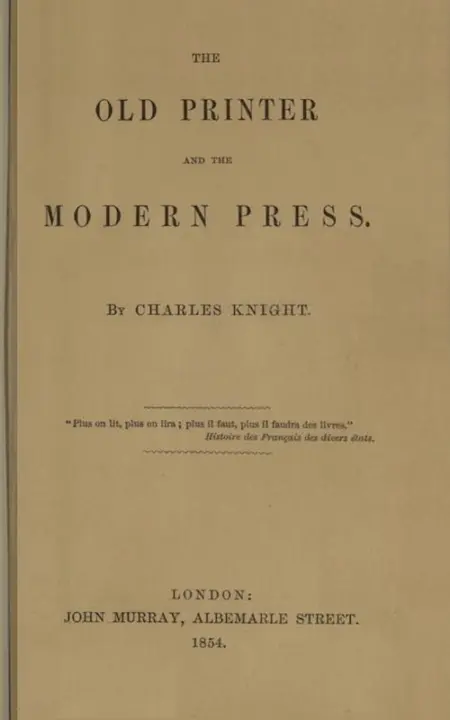
THE CLASSIC COLLECTION · 1854
"The Old Printer and the Modern Press" by Charles Knight is a historical account written in the mid-19th century. The work explores the life of William Caxton, the first English printer, highlighting his contributions to the dissemination of knowledge through the printed word. The narrative reflects on various themes, including the evolution of the English language, the cultural landscape before and after the introduction of printing, and the socio-economic changes triggered by this revolutionary technology. At the start of the narrative, the context surrounding Caxton’s early life is established, particularly focusing on the Weald of Kent where he grew up. The text discusses the linguistic environment of the time, noting the transition from French to English in education, and the scarcity of books before the advent of printing. Knight paints a vivid picture of Caxton's formative years, illustrating the societal isolation and linguistic variations in his rural upbringing. The opening portion sets the stage for understanding Caxton’s later accomplishments and the profound impact of printing on English literature, culture, and society.
Introduction adapted from the source catalogue; source summaries may be automatically generated.
Free to read · English · 88,831 words · No account needed
MAKE TIME FOR A GOOD BOOK
On by default. Untick to stop anonymous reading totals. Each page counts after 10 seconds in view. How this works.
Anonymous counting is on unless you have switched it off.
We shall find it, we think, a more agreeable, as well as more instructive course, to look at the general subject of the supply of books in connexion with the orders of people who were to use them, rather than presenting a number of scattered facts, to exhibit the relative prices and scarcity of books in what are called the middle ages. We will first take the clergy, the scholars of those days. The mode in which books were multiplied by transcribers in the monasteries is clearly described by Richard de Bury, bishop of Durham, in his 'Philobiblon,' a treatise on the love of books, written by him in Latin in 1344:—"As it is necessary for a state to provide military arms, and prepare plentiful stores of provisions for soldiers who are about to fight, so it is evidently worth the labour of the church militant to fortify itself against the attacks of pagans and heretics with a multitude of sound books. But because everything that is serviceable to mortals suffers the waste of mortality through lapse of time, it is necessary for volumes corroded by age to be restored by renovated successors, that perpetuity, repugnant to the nature of the individual, may be conceded to the species. Hence it is that Ecclesiastes significantly says, in the 12th chapter, 'There is no end of making many books.' For as the bodies of books suffer continual detriment from a combined mixture of contraries in their composition, so a remedy is found out by the prudence of clerks, by which a holy book paying the debt of nature may obtain an hereditary substitute, and a seed may be raised up like to the most holy deceased, and that saying of Ecclesiasticus, chapter 30, be verified, 'The father is dead, and as it were not dead, for he hath left behind him a son like unto himself.'" The invention of paper, about a century and a half before Richard de Bury wrote, and its general employment instead of vellum for manuscripts in ordinary use, was a great step towards the multiplication of books. Transcribers necessarily became more numerous; but for a long period they wholly belonged to the monastic orders, and the books were essentially for the use of the clergy. Richard de Bury says, with the most supreme contempt for all others, whatever be their rank, "Laymen, to whom it matters not whether they look at a book turned wrong side upwards or spread before them in its natural order, are altogether unworthy of any communion with books." But even to the privileged classes he is not sparing of his reproach as to the misuse of books. He reprobates the unwashed hands, the dirty nails, the greasy elbows leaning upon the volume, the munching of fruit and cheese over the open leaves, which were the marks of careless and idle readers. With a solemn reverence for a book at which we may smile, but with a smile of respect, he says, "Let there be a mature decorum in opening and closing of volumes, that they may neither be unclasped with precipitous haste, nor thrown aside after inspection without being duly closed." The good bishop bestowed certain portions of his valuable library upon a company of scholars residing in a Hall at Oxford; and one of his chapters is entitled 'A provident arrangement by which books may be lent to strangers,' meaning, by strangers, students of Oxford not belonging to that Hall. One of these arrangements is as follows:—"Five of the scholars dwelling in the aforesaid Hall are to be appointed by the master of the same Hall, to whom the custody of the books is to be deputed. Of which five, three, and in no case fewer, shall be competent to lend any books for inspection and use only; but for copying and transcribing we will not allow any book to pass without the walls of the house. Therefore, when any scholar, whether secular or religious, whom we have deemed qualified for the present favour, shall demand the loan of a book, the keepers must carefully consider whether they have a duplicate of that book; and if so, they may lend it to him, taking a security which in their opinion shall exceed in value the book delivered." Anthony Wood, who in the seventeenth century wrote the lives of eminent Oxford men, speaks of this library which was given to Durham College (now Trinity College) as containing more books than all the bishops of England had then in their custody. He adds, "After they had been received they were for many years kept in chests, under the custody of several scholars deputed for that purpose." In the time of Henry IV. a library was built in that college, and then, says Wood, "the said books were put into pews, or studies, and chained to them." The statutes of St. Mary's College, Oxford, in the reign of Henry VI., are quoted by Warton, in his 'History of English Poetry,' as furnishing a remarkable instance of the inconveniences and impediments to study which must have been produced by a scarcity of books: "Let no scholar occupy a book in the library above one hour, or two hours at most, so that others shall be hindered from the use of the same." This certainly shows the scarcity of books; but not such a scarcity as at an early period of the Church, when one book was given out by the librarian to each of a religious fraternity at the beginning of Lent, to be read diligently during the year, and to be returned, the following Lent. The original practice of keeping the books in chests would seem to indicate that they could not be very frequently changed by the readers; and the subsequent plan of chaining them to the desks gives the notion that, like many other things tempting by their rarity, they could not be safely trusted in the hands of those who might rather covet the possession than the use. It was a very common thing to write in the first leaf of a book, "Cursed be he who shall steal or tear out the leaves, or in any way injure this book."
Your reading position is saved on this browser. Take it to another device with a library code. Reading pages adapt to text, rather than matching a printed edition.
BEHIND THE BOOK
This eBook is for the use of anyone anywhere in the United States and most other parts of the world at no cost and with almost no restrictions whatsoever. You may copy it, give it away or re-use it under the terms of the Project Gutenberg License included with this eBook or online at www.gutenberg.org. If you are not located in the United States, you will have to check the laws of the country where you are located before using this eBook. Read the source licence.
The original source file, including credits and licence, is retained by this library. Request an original-format copy at no charge. Please include the book title and Project Gutenberg identifier #59966.
KEEP YOUR CURIOSITY GOING
Cécile Tormay

Moritz Busch
John L. Ransom
Frances Wright
Cécile Tormay

Mabel Potter Daggett