THE CLASSIC COLLECTION✦An outlaw’s diary: the CommuneCLASSIC FREE BOOKS
An outlaw’s diary: the Commune
Cécile Tormay
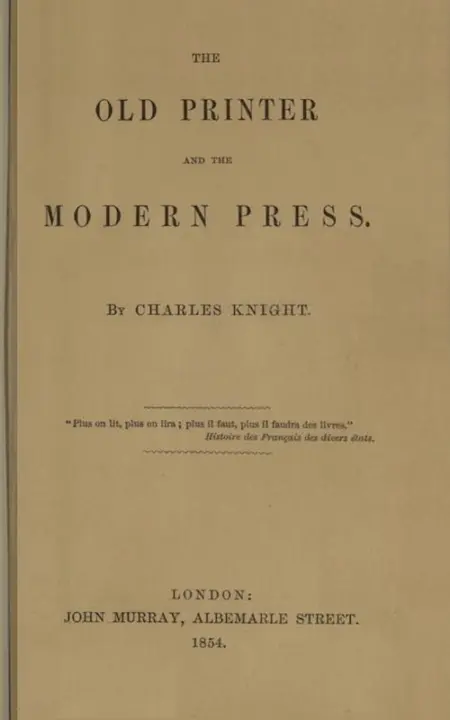
THE CLASSIC COLLECTION · 1854
"The Old Printer and the Modern Press" by Charles Knight is a historical account written in the mid-19th century. The work explores the life of William Caxton, the first English printer, highlighting his contributions to the dissemination of knowledge through the printed word. The narrative reflects on various themes, including the evolution of the English language, the cultural landscape before and after the introduction of printing, and the socio-economic changes triggered by this revolutionary technology. At the start of the narrative, the context surrounding Caxton’s early life is established, particularly focusing on the Weald of Kent where he grew up. The text discusses the linguistic environment of the time, noting the transition from French to English in education, and the scarcity of books before the advent of printing. Knight paints a vivid picture of Caxton's formative years, illustrating the societal isolation and linguistic variations in his rural upbringing. The opening portion sets the stage for understanding Caxton’s later accomplishments and the profound impact of printing on English literature, culture, and society.
Introduction adapted from the source catalogue; source summaries may be automatically generated.
Free to read · English · 88,831 words · No account needed
MAKE TIME FOR A GOOD BOOK
On by default. Untick to stop anonymous reading totals. Each page counts after 10 seconds in view. How this works.
Anonymous counting is on unless you have switched it off.
Some time before the period of Caxton's boyhood, a great change had taken place in the general system of education in England. In the time of Edward III., about half a century before the period of which we speak, the children in the grammar-schools were not taught English at all. It was the policy of the first Norman kings, long continued by their successors, to get rid of the old English or Saxon language altogether; and to make the people familiar with the Norman French, the language of the conquerors. The new statutes of the realm were written in French; so were the decisions of the judges, and the commentaries on the laws in general. Ralph Higden, in a sort of chronicle which Caxton printed, says, "Children in schools, against the usage and manner of all other nations, be compelled for to leave their own language, and for to construe their lessons and their things in French; and so they have since Normans came first into England. Also gentlemen be taught for to speak French from the time that they rocked in their cradle, and can speak and play with a child's brooch [stick or other toy], and uplandish men [countrymen] will liken themselves to gentlemen, and delight with great business for to speak French, to be told of." John de Trevisa, the translator of Higden's 'Polychronicon,' writing some forty years later, "This manner was much used before the Great Plague, and is since some deal changed; for Sir John Cornewaile, a master of grammar, changed the teaching in grammar-schools, and construction in French; and other schoolmasters use the same way now, in the year of our Lord 1385, the ninth year of King Richard II., and leave all French in schools, and use all construction in English. Wherein they have advantage one way:—that is, that they learn the sooner their grammar; and in another, disadvantage, for now they learn no French, which is hurt for them that shall pass the sea." It was this change of system, operating upon his early instruction, which caused Caxton, as a translator, to be so diffident of his own capacity to render faithfully what was before him out of French into English. Indeed from his earliest youth to the close of his literary career, the English language was constantly varying, through the introduction of new words and phrases; and there was a marked distinction between the courtly dialect and that of the commonalty. We have seen how he speaks of the broad and rude English of his native Weald. But towards the close of his life, in a book printed by him in 1490, he mentions the difficulty he had in pleasing "some gentlemen, which late blamed me, saying, that in my translations I had over curious terms, which could not be understood of common people, and desired me to use old and homely terms in my translations. And fain would I satisfy every man; and so to do, took an old book and read therein; and certainly the English was so rude and broad that I could not well understand it. And also my Lord Abbot of Westminster did show to me late certain evidences written in old English, for to reduce it into our English now used, and certainly it was written in such wise that it was more like to Dutch than English; I could not reduce nor bring it to be understood. And certainly our language now used varieth far from that which was used and spoken when I was born: for we Englishmen be born under the domination of the moon, which is never stedfast, but ever wavering, waxing one season, and waneth and decreaseth another season; and that common English that is spoken in one shire varieth from another. Insomuch that in my days happened that certain merchants were in a ship in Thames, for to have sailed over the sea into Zealand, and for lack of wind they tarried at Foreland, and went to land for to refresh them; and one of them named Sheffelde, a mercer, came into an house and asked for meat, and especially he asked after eggs; and the good wife answered, that she could speak no French; and the merchant was angry, for he also could speak no French, but would have had eggs, and she understood him not. And then at last, another said that he would have eyren; then the good wife said that she understood him well. Lo, what should a man in these days now write, eggs or eyren? certainly it is hard to please every man, by cause of diversity and change of language. For in these days, every man that is in any reputation in his country will utter his communication and matters in such manners and terms that few men shall understand them. And some honest and good clerks have been with me, and desired me to write the most curious terms that I could find. And thus between plain, rude, and curious, I stand abashed; but in my judgment, the common terms that be daily used be lighter [easier] to be understood than the old and ancient English." In these days, when the same language with very slight variations is spoken from one end of the land to the other, it is difficult to imagine a state of things such as Caxton describes, in which the "common English which is spoken in one shire varieth from another," and there was a marked distinction between plain terms and curious terms. Easy and rapid communication, and above all the circulation of books, newspapers, and other periodical works, all free from provincial expressions, have made the "over curious terms which could not be understood of common people" more familiar to them than the "old and homely terms" which their forefathers used in their several counties, according to the restricted meanings which they retained in their local use. When there were no books amongst the community in general, there could be no universality of language. Of this want of books we may properly exhibit some details, chiefly to show one of the most remarkable differences which the lapse of four centuries has produced in our country.
Your reading position is saved on this browser. Take it to another device with a library code. Reading pages adapt to text, rather than matching a printed edition.
BEHIND THE BOOK
This eBook is for the use of anyone anywhere in the United States and most other parts of the world at no cost and with almost no restrictions whatsoever. You may copy it, give it away or re-use it under the terms of the Project Gutenberg License included with this eBook or online at www.gutenberg.org. If you are not located in the United States, you will have to check the laws of the country where you are located before using this eBook. Read the source licence.
The original source file, including credits and licence, is retained by this library. Request an original-format copy at no charge. Please include the book title and Project Gutenberg identifier #59966.
KEEP YOUR CURIOSITY GOING
Cécile Tormay

Moritz Busch
John L. Ransom
Frances Wright
Cécile Tormay

Mabel Potter Daggett