
Last letters from the living dead man
David Patterson (Spirit) Hatch
THE CLASSIC COLLECTION · 1891
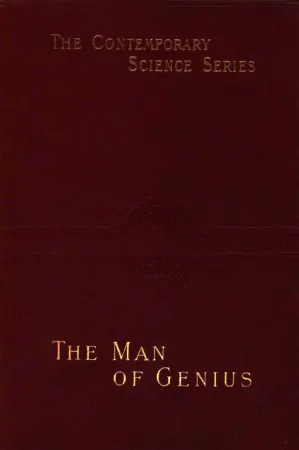
"The Man of Genius" by Cesare Lombroso is a scientific publication written in the late 19th century. The book delves into the complex relationship between genius and madness, exploring the characteristics of individuals considered genius and how these traits intersect with patterns of mental illness. Lombroso examines historical figures and provides a foundational analysis of genius through a lens of physiological and psychological phenomena. The opening of the work sets the stage for an exploration of genius by referencing significant historical thoughts on the topic, from Aristotle to more contemporary thinkers. Lombroso reflects on his evolving views about genius relating to degradation and neurosis, suggesting that exceptional intellectual capabilities often stem from psychological anomalies. He lays out an argument that associates genius with various signs of degeneration, prompting readers to reconsider what defines genius and how societal perceptions may have historically conflated brilliance with madness. This thought-provoking introduction invites further examination of the intertwining nature of genius, mental health, and societal recognition.
Introduction adapted from the source catalogue; source summaries may be automatically generated.
Free to read · English · 130,716 words · No account needed
MAKE TIME FOR A GOOD BOOK
On by default. Untick to stop anonymous reading totals. Each page counts after 10 seconds in view. How this works.
Anonymous counting is on unless you have switched it off.
[160] “A une Heure du Matin,” in Petits Poèmes en Prose.
[161] Bufalini, Vita di Concato, 1884.
[162] Revue Philosophique, 1886.
[163] Littré, A. Comte et la Phil. Posit., 1863.
[164] W. de Fonvielle, Comment se font les Miracles, 1879.
[165] De Vita propria, ch. 45.
[166] Byron said, also, that intermittent fevers came at last to be agreeable to him, on account of the pleasant sensation that followed the cessation of pain.
[167] “One day I thought I heard very sweet harmonies in a dream. I awoke, and I found I had resolved the question of fevers: why some are lethal and others not--a question which had troubled me for twenty-five years” (De Somniis, c. iv.).
“In a dream there came to me the suggestion to write this book, divided into exactly twenty-one parts; and I experienced such pleasure in my condition and in the subtlety of these reasonings as I had never experienced before” (De Subtilitate, lib. xviii. p. 915).
[168] “Jewels in sleep are symbolical of sons, of unexpected things, of joy also; because in Italian gioire means ‘to enjoy’ (De Somniis, cap. 21; De Subtilitate, p. 338).
[169] Buttrini, Girolamo Cardano, Savona, 1884.
[170] Bertolotti (I Testamenti di Cardano, 1888) has shown that this legend has no foundation.
[171] “I shall live in the midst of my torments, and among the cares that are my just furies, wild and wandering; I shall fear dark and solitary shades, which will bring before me my first fault; and I shall have in horror and disgust the face of the sun which discovered my misfortunes; I shall fear myself, and, for ever fleeing from myself, I shall never escape.”
[172] Brewster’s Memoirs of Sir I. Newton, vol. ii. p. 100.
[173] Brewster’s Memoirs of Sir I. Newton, vol. ii. p. 94.
[174] Dialogues, i.
[175] Dialogues, ii.
[176] Bugeault, Étude sur l’état mental de Rousseau, 1876, p. 123.
[177] Revue Philosophique, 1883.
[178] Schurz, Lenaus Werke, vol. i. p. 275.
[179] Kecskemetky, S. Széchénys staatsmänn. Laufbahn, &c., Pesth,
1866.
[180] Costanzo, Follia anomale, Palermo, 1876.
[181] Gwinner, Schopenhauers Leben, 1878; Ribot, La Philosophie de Schopenhauer, 1885; Carl von Sedlitz, Schopenhauer vom Medizinischen Standpunkt, Dorpat, 1872.
[182] Gwinner, p. 26.
[183] Memorabilien, ii. p. 332.
[184] Parerga, ii. p. 38.
[185] Pensiero e Meteore in Biblioteca Scientifica Internazionale, Milan, 1878; Azione degli Astri e delle Meteore sulla mente Umana, Milan, 1871.
[186] Quetelet, Physique Sociale, Book iv. ch. i.
[187] Mantegazza, op. cit.
[188] E. Neville, Maine de Biran, Sa Vie, &c., p. 129, 1854.
[189] Revue Bleue, 1888, No. 9.
[190] Viaggio in Sicilia, vol. vii.
[191] Epistolario, 1878.
[192] Nature, Nov. 1883.
[193] Réveillé-Parise, Physiologie des hommes livrés aux travaux de l’esprit, pp. 352-355.
[194] Giussani, Vita, &c., p. 188.
[195] Epistolario, p. 395.
[196] Lebin, Sur l’époque de la composition de la Vita Nuova, p. 28.
[197] Life and Letters, vol. i. p. 51.
[198] Stopfer, Vie de Sterne, Paris, 1870.
[199] Goethe, Aus Meinem Leben.
[200] Zanolini, Rossini, 1876.
[201] Clément, Les Musiciens Célèbres, Paris, 1878.
[202] Alborghetti, Vita di Donizetti, 1876.
Your reading position is saved on this browser. Take it to another device with a library code. Reading pages adapt to text, rather than matching a printed edition.
BEHIND THE BOOK
This eBook is for the use of anyone anywhere in the United States and most other parts of the world at no cost and with almost no restrictions whatsoever. You may copy it, give it away or re-use it under the terms of the Project Gutenberg License included with this eBook or online at www.gutenberg.org. If you are not located in the United States, you will have to check the laws of the country where you are located before using this eBook. Read the source licence.
The original source file, including credits and licence, is retained by this library. Request an original-format copy at no charge. Please include the book title and Project Gutenberg identifier #50539.
KEEP YOUR CURIOSITY GOING
David Patterson (Spirit) Hatch
Coulson Kernahan

Ralph Waldo Emerson
Frances Wright

Edwin Abbott Abbott

Joseph Droz