
Last letters from the living dead man
David Patterson (Spirit) Hatch
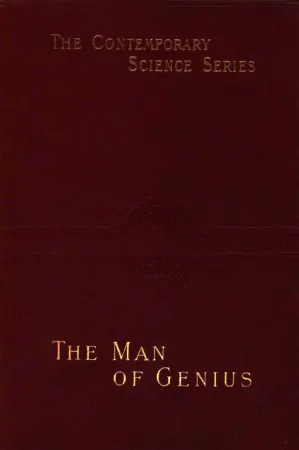
THE CLASSIC COLLECTION · 1891
"The Man of Genius" by Cesare Lombroso is a scientific publication written in the late 19th century. The book delves into the complex relationship between genius and madness, exploring the characteristics of individuals considered genius and how these traits intersect with patterns of mental illness. Lombroso examines historical figures and provides a foundational analysis of genius through a lens of physiological and psychological phenomena. The opening of the work sets the stage for an exploration of genius by referencing significant historical thoughts on the topic, from Aristotle to more contemporary thinkers. Lombroso reflects on his evolving views about genius relating to degradation and neurosis, suggesting that exceptional intellectual capabilities often stem from psychological anomalies. He lays out an argument that associates genius with various signs of degeneration, prompting readers to reconsider what defines genius and how societal perceptions may have historically conflated brilliance with madness. This thought-provoking introduction invites further examination of the intertwining nature of genius, mental health, and societal recognition.
Introduction adapted from the source catalogue; source summaries may be automatically generated.
Free to read · English · 130,716 words · No account needed
MAKE TIME FOR A GOOD BOOK
On by default. Untick to stop anonymous reading totals. Each page counts after 10 seconds in view. How this works.
Anonymous counting is on unless you have switched it off.
Resemblance between genius and insanity--Men and women of genius who have been insane--Montanus--Harrington--Haller--Schumann--Gérard de Nerval--Baudelaire--Concato--Mainländer--Comte--Codazzi--Bolyai--Cardan--Tasso--Swift--Newton--Rousseau--Lenau--Széchényi--Hoffmann--Foderà--Schopenhauer--Gogol.
The resemblance between insanity and genius, although it does not show that these two should be confounded, proves at all events that one does not exclude the other in the same subject.
In fact, without speaking of the numerous men of genius who at some period of their lives were subject to hallucinations or insanity, or of those who, like Vico, terminated a great career in dementia, how many great thinkers have shown themselves all their lives subject to monomania or hallucinations!
In recent times insanity has shown itself in Farini, Brougham, Southey, Govone, Gounod, Gutzkow, Monge, Fourcroy, Cowper, Rocchia, Ricci, Fenicia,[149] Engel, Pergolese, Batjusckoff, Mürger, William Collins, Techner, Hölderlen, Von der West, Gallo, Spedalieri, Bellingeri, Salieri, Johannes Müller, Lenz, Barbara, Fuseli, Petermann, the caricaturist Cham, Hamilton, Poe, Uhlrich.
In France, remarks Martini, many young and original poets have died insane.[150] Such also seems to have been the fate of Briffault, and of Laurent attacked by a veritable mania of calumny.[151] Among women Günderode, Stieglitz (who both committed suicide with great deliberation), Brachmann, L. E. Landon lived and died insane.[152]
Montanus, a victim to solitude and a disordered imagination, was convinced that he had become a grain of wheat. He refused to move for fear of being swallowed by birds.[153] Harrington is said to have imagined that diseases took the form of bees and flies, and for this reason he retired to a cabin armed with a broom to disperse them. Haller believed that he was persecuted by men and damned by God on account of the vileness of his soul and his heretical works. He could only soothe his excessive terror by enormous doses of opium and by converse with priests.[154] Ampère burnt a treatise on the future of chemistry believing he had written it by Satanic suggestion. The great Dutch artist, Van Goes, thought he was possessed. Carlo Dolce, a prey to religious monomania, vowed only to paint religious pictures. He devoted his pencil to Madonnas, though his Madonna, indeed, is the portrait of Balduini. On his wedding-day he alone was missing; after some hours he was found prostrated before the altar of the Annunciation. Nathaniel Lee, the dramatist, composed thirteen tragedies during the course of his disease; one day a feeble dramatic colleague told him that it was easy to write like a madman. “It is not easy to write like a madman,” he replied, “but it is very easy to write like a fool.” Thomas Lloyd, who wrote excellent verse, was a strange mixture of malice, pride, genius, and insanity.[155] If he was not satisfied with his verses he put them in his glass to polish them, as he said. Everything that he came across, even coal, paper, and tobacco, he was accustomed to mix with his food for hygienic reasons; the carbon purified it, stone imparted mineral virtues, &c. Charles Lamb in early life had an attack of insanity which was hereditary in his family; writing of this to Coleridge, he said: “At some future time I will amuse you with an account, as full as my memory will permit, of the strange turns my frenzy took. I look back upon it at times with a gloomy kind of envy, for, while it lasted, I had many, many hours of pure happiness. Dream not, Coleridge, of having tasted all the grandeur and wildness of fancy till you have gone mad. All now seems to me vapid, or comparatively so.”
Your reading position is saved on this browser. Take it to another device with a library code. Reading pages adapt to text, rather than matching a printed edition.
BEHIND THE BOOK
This eBook is for the use of anyone anywhere in the United States and most other parts of the world at no cost and with almost no restrictions whatsoever. You may copy it, give it away or re-use it under the terms of the Project Gutenberg License included with this eBook or online at www.gutenberg.org. If you are not located in the United States, you will have to check the laws of the country where you are located before using this eBook. Read the source licence.
The original source file, including credits and licence, is retained by this library. Request an original-format copy at no charge. Please include the book title and Project Gutenberg identifier #50539.
KEEP YOUR CURIOSITY GOING
David Patterson (Spirit) Hatch
Coulson Kernahan

Ralph Waldo Emerson
Frances Wright

Edwin Abbott Abbott

Joseph Droz