
Last letters from the living dead man
David Patterson (Spirit) Hatch
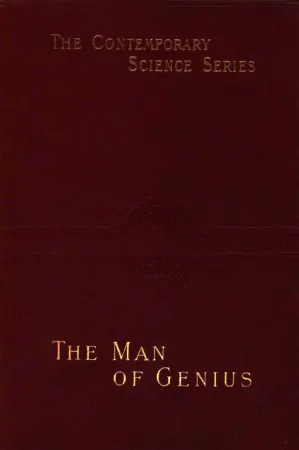
THE CLASSIC COLLECTION · 1891
"The Man of Genius" by Cesare Lombroso is a scientific publication written in the late 19th century. The book delves into the complex relationship between genius and madness, exploring the characteristics of individuals considered genius and how these traits intersect with patterns of mental illness. Lombroso examines historical figures and provides a foundational analysis of genius through a lens of physiological and psychological phenomena. The opening of the work sets the stage for an exploration of genius by referencing significant historical thoughts on the topic, from Aristotle to more contemporary thinkers. Lombroso reflects on his evolving views about genius relating to degradation and neurosis, suggesting that exceptional intellectual capabilities often stem from psychological anomalies. He lays out an argument that associates genius with various signs of degeneration, prompting readers to reconsider what defines genius and how societal perceptions may have historically conflated brilliance with madness. This thought-provoking introduction invites further examination of the intertwining nature of genius, mental health, and societal recognition.
Introduction adapted from the source catalogue; source summaries may be automatically generated.
Free to read · English · 130,716 words · No account needed
MAKE TIME FOR A GOOD BOOK
On by default. Untick to stop anonymous reading totals. Each page counts after 10 seconds in view. How this works.
Anonymous counting is on unless you have switched it off.
[203] D’Este, Memorie su Canova, 1864.
[204] Gotti, Vita di Michelangelo, Florence, 1873.
[205] Milanesi, Lettere di Michelangelo, Florence, 1875.
[206] Amoretti, Memorie storiche sulla vita e gli studi di Leonardo
da Vinci, Milan, 1874.
[207] W. Irving, Columbus, vol. i. p. 819; Roselly de Lorque, Vie
de Colomb., 1857.
[208] According to Secchi (Soleil, 1875) Scheiner preceded Galileo, and was himself preceded by Fabricio, though the discovery of this last was not known until a later date.
[209] Galilei, Opere, vol. i. p. 69.
[210] Arago, Œuvres, 1851.
[211] Hœfer, op. cit.
[212] Herschel, Outlines of Astronomy, 1874.
[213] Arago, Notices Biographiques, 1855.
[214] Atti, Della Vita di Malpighi, 1774.
[215] Hœfer, Histoire de la Chimie, 1869.
[216] Briefe an Schiller.
[217] Gherardi, Rapporti sui Manoscritti di Galvani, 1839.
[218] Schiaparelli, Intorno Alcune Lettere inedite di Lagrange, 1877.
[219] Humboldt, Correspondance, Paris, 1868.
[220] Letters from Humboldt to Varnhagen.
[221] Arago, Notices Biographiques, 1855.
[222] Whewell, History of the Inductive Sciences, 1857.
[223] N. Bianchi, Vita di Matteucci, Florence, 1874.
[224] The catalogue of small planets has been drawn from the Annuaire du Bureau des Longitudes (Paris, 1877-8). The list of comets has been taken from Carl’s Repertorium der Cometen Astronomie (Munich, 1864). It begins with the comet discovered by Hevelius in 1672, and ends with that found by Donati on the 23rd of July, 1864; Gambart’s comets, already separately enumerated, have been excluded. To keep the conditions analogous to those of the small planets, all the comets to which Carl does not assign a discoverer, have been omitted; this includes such as were expected from previous calculations or perceived with the naked eye by the general population. All those that were discovered simultaneously by several observers, unknown to one another, have, however, been included, for it is not a question of priority, but of the psychological moment of the discovery. Three comets discovered in the months of February, May, and December, were found in the southern hemisphere; they must, therefore, with reference to season be registered as for August, November, and June, and have so been counted.
[225] Atti, Della Vita ed opere di Malpighi, Bologna, 1774.
[226] History of Civilisation, i.
[227] Études sur la Selection, &c., Paris, 1881.
[228] Biographie Universelle des Musiciens, Paris, 1868-80.
[229] Histoire des Musiciens Célèbres, Paris, 1878.
[230] Dizionario dei Pittori, 1858.
Naples 216
Rome 127
Venice 124
Milan 95
Bologna 91
Florence 70
Lucca 37
Parma 34
Genoa 30
Turin 27
Verona 24
Brescia 22
Mantua 19
Modena 19
Cremona 17
Palermo 17
Novara 17
Bergamo 16
Bari 16
Ferrara 15
Padua 15
Pisa 13
Reggio 12
Piacenza 11
Siena 10
Ravenna 10
Vicenza 10
Perugia 9
Pesaro 9
Alessandria 8
Treviso 8
Catania 7
Arezzo 6
Lecce 6
Como 5
Ancona 5
Udine 5
Macerata 5
Caserta 4
Livorno 3
Forlì 3
Messina 3
Rovigo 3
Chieti 3
Foggia 2
Cuneo 2
Pavia 2
Massa 2
Teramo 2
Siracusa 2
Ascoli 2
Campobasso 2
Belluno 1
Catanzaro 1
Avellino 1
Potenza 1
Reggio-Calabria 1
Caltanisetta 1
[232] La Scuola Musicale di Napoli, 1883.
[233] See my Pensiero e Meteore, 1872, and Archivio di
Psichiatria, 1880, p. 157.
Your reading position is saved on this browser. Take it to another device with a library code. Reading pages adapt to text, rather than matching a printed edition.
BEHIND THE BOOK
This eBook is for the use of anyone anywhere in the United States and most other parts of the world at no cost and with almost no restrictions whatsoever. You may copy it, give it away or re-use it under the terms of the Project Gutenberg License included with this eBook or online at www.gutenberg.org. If you are not located in the United States, you will have to check the laws of the country where you are located before using this eBook. Read the source licence.
The original source file, including credits and licence, is retained by this library. Request an original-format copy at no charge. Please include the book title and Project Gutenberg identifier #50539.
KEEP YOUR CURIOSITY GOING
David Patterson (Spirit) Hatch
Coulson Kernahan

Ralph Waldo Emerson
Frances Wright

Edwin Abbott Abbott

Joseph Droz