
Last letters from the living dead man
David Patterson (Spirit) Hatch
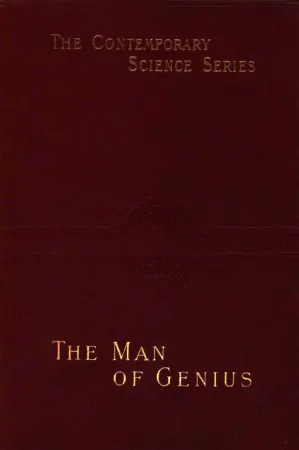
THE CLASSIC COLLECTION · 1891
"The Man of Genius" by Cesare Lombroso is a scientific publication written in the late 19th century. The book delves into the complex relationship between genius and madness, exploring the characteristics of individuals considered genius and how these traits intersect with patterns of mental illness. Lombroso examines historical figures and provides a foundational analysis of genius through a lens of physiological and psychological phenomena. The opening of the work sets the stage for an exploration of genius by referencing significant historical thoughts on the topic, from Aristotle to more contemporary thinkers. Lombroso reflects on his evolving views about genius relating to degradation and neurosis, suggesting that exceptional intellectual capabilities often stem from psychological anomalies. He lays out an argument that associates genius with various signs of degeneration, prompting readers to reconsider what defines genius and how societal perceptions may have historically conflated brilliance with madness. This thought-provoking introduction invites further examination of the intertwining nature of genius, mental health, and societal recognition.
Introduction adapted from the source catalogue; source summaries may be automatically generated.
Free to read · English · 130,716 words · No account needed
MAKE TIME FOR A GOOD BOOK
On by default. Untick to stop anonymous reading totals. Each page counts after 10 seconds in view. How this works.
Anonymous counting is on unless you have switched it off.
Geographical distribution--Profession--Influence of the special form of alienation--Originality--Eccentricity--Symbolism--Obscenity--Criminality and moral insanity--Uselessness--Insanity as a subject--Absurdity--Uniformity--Summary--Music among the insane.
Though the artistic tendency is very pronounced, and might almost be called a general characteristic, in some varieties of insanity, few authors have paid sufficient attention to it.
The only exceptions are Tardieu, who, in his Études Médico-Légales sur la folie, remarks that the drawings of the insane are of great importance from the point of view of forensic medicine; Simon,[311] who, in speaking of drawing among megalomaniacs, observes that the imagination appears in them in inverse proportion to the intellect; and Frigerio, who some time later gave a survey of the subject in an excellent essay, published in the Diario del Manicomio di Pesaro.[312] Since then I have been able to make a completer examination of this subject, thanks to the curious documents supplied to me by MM. Riva, Toselli, Lolli, Frigerio, Tamburini, Maragliano, and Maxime du Camp.
By comparing their observations with my own, I find a total of 108 mental patients with artistic tendencies, of which:--46 were towards painting, 10 sculpture, 11 engraving, 8 music, 5 architecture, 28 poetry.
The prevailing psychopathic forms in these 108 cases were:--In 25, sensorial monomania and that of persecution; 21 dementia, 16 megalomania, 14 acute or intermittent mania, 8 melancholia, 8 general paralysis, 5 moral insanity, 2 epilepsy.
It is evident that those which predominate are the congenital and least readily curable forms (monomania and moral insanity), together with dementia, and those forms which it accompanies, or in which it is latent (megalomania and paralysis).
Let us now consider the special characteristics of these insane artists.
Geographical distribution.--In the districts where the artistic tendency is more marked among the sane, the number of insane artists is also higher. In fact, I have found very few of the latter at Turin, Pavia, or Reggio, while at Perugia, Lucca, and Siena they abound.
Profession.--Only in a few cases could the tendency be explained by profession or habits acquired before the appearance of the disease. We find among the insane artists mentioned above--8 ex-painters or sculptors, 10 ex-architects, carpenters, or cabinet makers; 10 former schoolmasters or priests, 1 telegraphist, 2 students, 6 sailors, soldiers, or officers of engineers.
Among modern painters affected with insanity, we may note Gill, Cham, Chirico, Mancini, and others.
Your reading position is saved on this browser. Take it to another device with a library code. Reading pages adapt to text, rather than matching a printed edition.
BEHIND THE BOOK
This eBook is for the use of anyone anywhere in the United States and most other parts of the world at no cost and with almost no restrictions whatsoever. You may copy it, give it away or re-use it under the terms of the Project Gutenberg License included with this eBook or online at www.gutenberg.org. If you are not located in the United States, you will have to check the laws of the country where you are located before using this eBook. Read the source licence.
The original source file, including credits and licence, is retained by this library. Request an original-format copy at no charge. Please include the book title and Project Gutenberg identifier #50539.
KEEP YOUR CURIOSITY GOING
David Patterson (Spirit) Hatch
Coulson Kernahan

Ralph Waldo Emerson
Frances Wright

Edwin Abbott Abbott

Joseph Droz