
Last letters from the living dead man
David Patterson (Spirit) Hatch
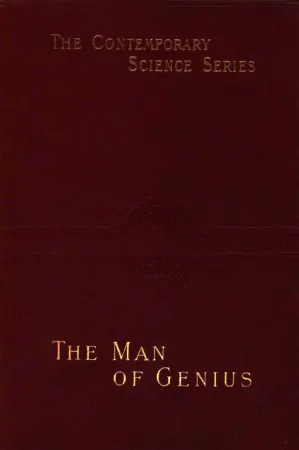
THE CLASSIC COLLECTION · 1891
"The Man of Genius" by Cesare Lombroso is a scientific publication written in the late 19th century. The book delves into the complex relationship between genius and madness, exploring the characteristics of individuals considered genius and how these traits intersect with patterns of mental illness. Lombroso examines historical figures and provides a foundational analysis of genius through a lens of physiological and psychological phenomena. The opening of the work sets the stage for an exploration of genius by referencing significant historical thoughts on the topic, from Aristotle to more contemporary thinkers. Lombroso reflects on his evolving views about genius relating to degradation and neurosis, suggesting that exceptional intellectual capabilities often stem from psychological anomalies. He lays out an argument that associates genius with various signs of degeneration, prompting readers to reconsider what defines genius and how societal perceptions may have historically conflated brilliance with madness. This thought-provoking introduction invites further examination of the intertwining nature of genius, mental health, and societal recognition.
Introduction adapted from the source catalogue; source summaries may be automatically generated.
Free to read · English · 130,716 words · No account needed
MAKE TIME FOR A GOOD BOOK
On by default. Untick to stop anonymous reading totals. Each page counts after 10 seconds in view. How this works.
Anonymous counting is on unless you have switched it off.
Want of character--Pride--Precocity--Alcoholism--Degenerative signs--Obsession--Men of genius in revolutions.
But these characteristics are not confined to insane genius; they are also met with, though far less conspicuously among the great men freest from any suspicion of insanity, those of whom the insane geniuses just mentioned are but the exaggeration and caricature. It is thus that the complete and perfect character, while conspicuously seen in Socrates, Columbus, Cavour, Christ, Galileo, Spinoza, is not to be found in Napoleon, Bacon, Cicero, Seneca, Alcibiades, Alexander, Julius Cæsar, Machiavelli, Carlyle, Frederick II., Dumas, Byron, Comte, Bulwer Lytton, Petrarch, Aretino, Gibbon.
Self-esteem, carried to an almost incredible point, has been noticed in Napoleon, Hegel, Dante, Victor Hugo, Lassalle, Balzac, and Comte; and, as we have already seen, even in men of talent, but not of genius, as Cagnoli, Lucius, Porta, &c.
Precocity, moreover, does not fail to appear in normal men of genius, such as Mozart, Raphael, Michelangelo, Charles XII., Stuart Mill, D’Alembert, Lulli, Cowley, Otway, Prior, Pope, Addison, Burns, Keats, Sheffield, Hugo.
Among these we also find the abuse of alcohol, sexual deficiencies, or excesses followed by sterility, the tendency to vagrancy, and impulsive acts of violence, alternating, or associated, with convulsive movements. Bismarck once said to Beust, “Do you ever feel the wish to break anything as an amusement?” Like Gladstone and the Belgian Malon, he often takes exercise by cutting down trees like a woodman.
We have also found, in some of them, numerous anomalies in the shape of the skull and conformation of the brain. Degenerative symptoms, such as stammering, lefthandedness, precocity, sterility, abound in both, as well as divergences from ancestral character.
There is also seen in them that invasion, or rather possession, by their subject which transforms the creature of the imagination into a true hallucination, or an auto-suggestion. Flaubert says that his characters seized upon him, and pursued him, or that, more correctly speaking, he lived through them. When he described the poisoning of Madame Bovary, he felt the taste of arsenic on his tongue, and showed symptoms of actual poisoning so far as to vomit. Dickens, too, was affected by sorrow and compassion for his characters, as if they had been his own children.[450]
“To my mind,” writes Edmond de Goncourt, “my brother died of over-work, and more especially the elaboration of literary form, the chiselling of phrases, the labour of style. I can still see him taking up again pieces which we had written together, and which, at first, had satisfied us, working at them for hours, for half a day at a time, with an almost angry persistency....
Your reading position is saved on this browser. Take it to another device with a library code. Reading pages adapt to text, rather than matching a printed edition.
BEHIND THE BOOK
This eBook is for the use of anyone anywhere in the United States and most other parts of the world at no cost and with almost no restrictions whatsoever. You may copy it, give it away or re-use it under the terms of the Project Gutenberg License included with this eBook or online at www.gutenberg.org. If you are not located in the United States, you will have to check the laws of the country where you are located before using this eBook. Read the source licence.
The original source file, including credits and licence, is retained by this library. Request an original-format copy at no charge. Please include the book title and Project Gutenberg identifier #50539.
KEEP YOUR CURIOSITY GOING
David Patterson (Spirit) Hatch
Coulson Kernahan

Ralph Waldo Emerson
Frances Wright

Edwin Abbott Abbott

Joseph Droz