
Last letters from the living dead man
David Patterson (Spirit) Hatch
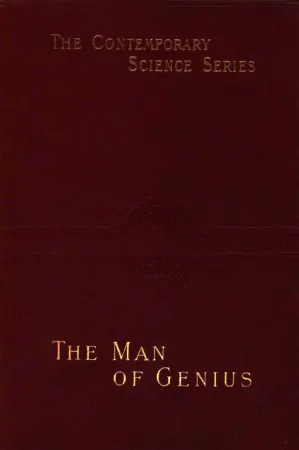
THE CLASSIC COLLECTION · 1891
"The Man of Genius" by Cesare Lombroso is a scientific publication written in the late 19th century. The book delves into the complex relationship between genius and madness, exploring the characteristics of individuals considered genius and how these traits intersect with patterns of mental illness. Lombroso examines historical figures and provides a foundational analysis of genius through a lens of physiological and psychological phenomena. The opening of the work sets the stage for an exploration of genius by referencing significant historical thoughts on the topic, from Aristotle to more contemporary thinkers. Lombroso reflects on his evolving views about genius relating to degradation and neurosis, suggesting that exceptional intellectual capabilities often stem from psychological anomalies. He lays out an argument that associates genius with various signs of degeneration, prompting readers to reconsider what defines genius and how societal perceptions may have historically conflated brilliance with madness. This thought-provoking introduction invites further examination of the intertwining nature of genius, mental health, and societal recognition.
Introduction adapted from the source catalogue; source summaries may be automatically generated.
Free to read · English · 130,716 words · No account needed
MAKE TIME FOR A GOOD BOOK
On by default. Untick to stop anonymous reading totals. Each page counts after 10 seconds in view. How this works.
Anonymous counting is on unless you have switched it off.
Others were weak and sickly in childhood; such were Demosthenes, Bacon, Descartes, Newton, Locke, Adam Smith, Boyle, Pope, Flaxman, Nelson, Haller, Körner, Pascal, Wren, Alfieri, Renan.
Ségur wrote of Voltaire that his leanness recalled his labours, and that his slight bent body was only a thin, transparent veil, through which one seemed to see his soul and genius. Lamennais was “a small, almost imperceptible man, or rather a flame chased from one point of the room to the other by the breath of his own restlessness.”[14]
Physiognomy.--Mind, a celebrated painter of cats, had a cretin-like physiognomy. So also had Socrates, Skoda, Rembrandt, Dostoieffsky, Magliabecchi, Pope, Carlyle, Darwin, and, among modern Italians, Schiaparelli, who holds so high a rank in mathematics.
Cranium and Brain.--Lesions of the head and brain are very frequent among men of genius. The celebrated Australian novelist, Marcus Clarke, when a child, received a blow from a horse’s hoof which crushed his skull.[15] The same is told of Vico, Gratry, Clement VI., Malebranche, and Cornelius, hence called a Lapide. The last three are said to have acquired their genius as a result of the accident, having been unintelligent before. Mention should also be made of the parietal fracture in Fusinieri’s skull;[16] of the cranial asymmetry of Pericles, who was on this account surnamed Squill-head (σκινοκἑφαλος) by the Greek comic writers[17]; of Romagnosi, of Bichat, of Kant,[18] of Chenevix,[19] of Dante, who presented an abnormal development of the left parietal bone, and two osteomata on the frontal bone; the plagiocephaly of Brunacci and of Machiavelli; the
extreme prognathism of Foscolo (68°) and his low cephalic-spinal and cephalic-orbital index;[20] the ultra-dolichocephaly of Fusinieri (index 74), contrasting with the ultra-brachycephaly which is characteristic of the Venetians (82 to 84); the Neanderthaloid skull of Robert Bruce;[21] of Kay Lye,[22] of San Marsay (index 69), and the ultra-dolichocephaly of O’Connell (index 73), which contrasts with the mesocephaly of the Irish; the median occipital fossa of Scarpa;[23] the transverse occipital suture of Kant, his ultra-brachycephaly (88·5), platycephaly (index of height 71·1), the disproportion between the superior portion of his occipital bone, more developed by half, and the inferior or cerebellar portion. It is the same with the smallness of the frontal arch compared to the parietal.
In Volta’s skull[24] I have noted several characters which anthropologists consider to belong to the lower races, such as prominence of the styloid apophyses, simplicity of the coronal suture, traces of the median frontal suture, obtuse facial angle (73°), but especially the remarkable cranial sclerosis, which at places attains a thickness of 16 millemetres; hence the great weight of the skull (753 grammes).
Your reading position is saved on this browser. Take it to another device with a library code. Reading pages adapt to text, rather than matching a printed edition.
BEHIND THE BOOK
This eBook is for the use of anyone anywhere in the United States and most other parts of the world at no cost and with almost no restrictions whatsoever. You may copy it, give it away or re-use it under the terms of the Project Gutenberg License included with this eBook or online at www.gutenberg.org. If you are not located in the United States, you will have to check the laws of the country where you are located before using this eBook. Read the source licence.
The original source file, including credits and licence, is retained by this library. Request an original-format copy at no charge. Please include the book title and Project Gutenberg identifier #50539.
KEEP YOUR CURIOSITY GOING
David Patterson (Spirit) Hatch
Coulson Kernahan

Ralph Waldo Emerson
Frances Wright

Edwin Abbott Abbott

Joseph Droz