
Last letters from the living dead man
David Patterson (Spirit) Hatch
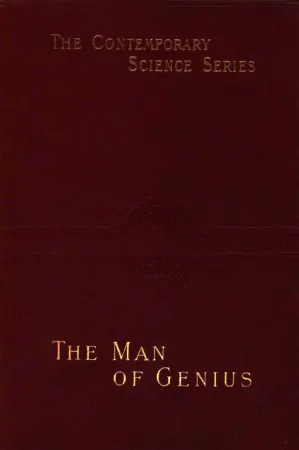
THE CLASSIC COLLECTION · 1891
"The Man of Genius" by Cesare Lombroso is a scientific publication written in the late 19th century. The book delves into the complex relationship between genius and madness, exploring the characteristics of individuals considered genius and how these traits intersect with patterns of mental illness. Lombroso examines historical figures and provides a foundational analysis of genius through a lens of physiological and psychological phenomena. The opening of the work sets the stage for an exploration of genius by referencing significant historical thoughts on the topic, from Aristotle to more contemporary thinkers. Lombroso reflects on his evolving views about genius relating to degradation and neurosis, suggesting that exceptional intellectual capabilities often stem from psychological anomalies. He lays out an argument that associates genius with various signs of degeneration, prompting readers to reconsider what defines genius and how societal perceptions may have historically conflated brilliance with madness. This thought-provoking introduction invites further examination of the intertwining nature of genius, mental health, and societal recognition.
Introduction adapted from the source catalogue; source summaries may be automatically generated.
Free to read · English · 130,716 words · No account needed
MAKE TIME FOR A GOOD BOOK
On by default. Untick to stop anonymous reading totals. Each page counts after 10 seconds in view. How this works.
Anonymous counting is on unless you have switched it off.
Famous for short stature as well as for genius were: Horace (lepidissimum homunculum dicebat Augustus), Philopœmen, Narses, Alexander (Magnus Alexander corpore parvus erat), Aristotle, Plato, Epicurus, Chrysippus, Laertes, Archimedes, Diogenes, Attila, Epictetus, who was accustomed to say, “Who am I? A little man.” Among moderns one may name, Erasmus, Socinus, Linnæus, Lipsius, Gibbon, Spinoza, Haüy, Montaigne, Mezeray, Lalande, Gray, John Hunter (5ft. 2in.), Mozart, Beethoven, Goldsmith, Hogarth, Thomas Moore, Thomas Campbell, Wilberforce, Heine, Meissonnier, Charles Lamb, Beccaria, Maria Edgeworth, Balzac, De Quincey, William Blake (who was scarcely five feet in height), Browning, Ibsen, George Eliot, Thiers, Mrs. Browning, Louis Blanc, Mendelssohn, Swinburne, Van Does (called the Drum, because he was not any taller than a drum), Peter van Laer (called the Puppet). Lulli, Pomponazzi, Baldini, were very short; so also were Nicholas Piccinini, the philosopher Dati, and Baldo, who replied to the sarcasm of Bartholo, “Minuit præsentia fama,” with the words, “Augebit cætera virtus;” and again, Marsilio Ficino, of whom it was said, “Vix ad lumbos viri stabat.” Albertus Magnus was of such small size that the Pope, having allowed him to kiss his foot, commanded him to stand up, under the impression that he was still kneeling. When the coffin of St. Francis Xavier was opened at Goa in 1890, the body was found to be only four and a half feet in length.
Among great men of tall stature I only know Volta, Goethe, Petrarch, Schiller, D’Azeglio, Helmholtz, Foscolo, Charlemagne, Bismarck, Moltke, Monti, Mirabeau, Dumas père, Schopenhauer, Lamartine, Voltaire, Peter the Great, Washington, Dr. Johnson, Sterne, Arago, Flaubert, Carlyle, Tourgueneff, Tennyson, Whitman.
Rickets.--Agesilaus, Tyrtæus, Æsop, Giotto, Aristomenes, Crates, Galba, Brunelleschi, Magliabecchi, Parini, Scarron, Pope, Leopardi, Talleyrand, Scott, Owen, Gibbon, Byron, Dati, Baldini, Moses Mendelssohn, Flaxman, Hooke, were all either rachitic, lame, hunch-backed, or club-footed.
Pallor.--This has been called the colour of great men; “Pulchrum sublimium virorum florem” (S. Gregory, Orationes XIV.). It was ascertained by Marro[12] that this is one of the most frequent signs of degeneration in the morally insane.
Emaciation.--The law of the conservation of energy which rules the whole organic world, explains to us other frequent abnormalities, such as precocious greyness and baldness, leanness of the body, and weakness of sexual and muscular activity, which characterize the insane, and are also frequently found among great thinkers. Lecamus[13] has said that the greatest geniuses have the slenderest bodies. Cæsar feared the lean face of Cassius. Demosthenes, Aristotle, Cicero, Giotto, St. Bernard, Erasmus, Salmasius, Kepler, Sterne, Walter Scott, John Howard, D’Alembert, Fénelon, Boileau, Milton, Pascal, Napoleon, were all extremely thin in the flower of their age.
Your reading position is saved on this browser. Take it to another device with a library code. Reading pages adapt to text, rather than matching a printed edition.
BEHIND THE BOOK
This eBook is for the use of anyone anywhere in the United States and most other parts of the world at no cost and with almost no restrictions whatsoever. You may copy it, give it away or re-use it under the terms of the Project Gutenberg License included with this eBook or online at www.gutenberg.org. If you are not located in the United States, you will have to check the laws of the country where you are located before using this eBook. Read the source licence.
The original source file, including credits and licence, is retained by this library. Request an original-format copy at no charge. Please include the book title and Project Gutenberg identifier #50539.
KEEP YOUR CURIOSITY GOING
David Patterson (Spirit) Hatch
Coulson Kernahan

Ralph Waldo Emerson
Frances Wright

Edwin Abbott Abbott

Joseph Droz