
Last letters from the living dead man
David Patterson (Spirit) Hatch
THE CLASSIC COLLECTION · 1891
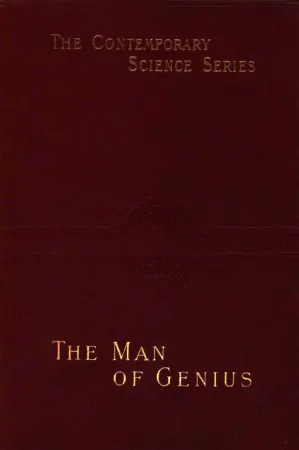
"The Man of Genius" by Cesare Lombroso is a scientific publication written in the late 19th century. The book delves into the complex relationship between genius and madness, exploring the characteristics of individuals considered genius and how these traits intersect with patterns of mental illness. Lombroso examines historical figures and provides a foundational analysis of genius through a lens of physiological and psychological phenomena. The opening of the work sets the stage for an exploration of genius by referencing significant historical thoughts on the topic, from Aristotle to more contemporary thinkers. Lombroso reflects on his evolving views about genius relating to degradation and neurosis, suggesting that exceptional intellectual capabilities often stem from psychological anomalies. He lays out an argument that associates genius with various signs of degeneration, prompting readers to reconsider what defines genius and how societal perceptions may have historically conflated brilliance with madness. This thought-provoking introduction invites further examination of the intertwining nature of genius, mental health, and societal recognition.
Introduction adapted from the source catalogue; source summaries may be automatically generated.
Free to read · English · 130,716 words · No account needed
MAKE TIME FOR A GOOD BOOK
On by default. Untick to stop anonymous reading totals. Each page counts after 10 seconds in view. How this works.
Anonymous counting is on unless you have switched it off.
The researches of other investigators have shown that Manzoni, Petrarch, and Fusinieri had receding foreheads; in Byron, Massacra (at the age of 32), Humboldt, Meckel,[25] Foscolo, Ximenes, and Donizetti there was solidification of the sutures; submicrocephaly in Rasori, Descartes, Foscolo, Tissot, Guido Reni, Hoffmann, and Schumann; sclerosis in Donizetti and Tiedemann who, moreover, presented a bony crest between the sphenoid and the basilar apophysis; hydrocephalus in Milton, Linnæus, Cuvier, Gibbon, &c.
The capacity of the skull in men of genius, as is natural, is above the average, by which it approaches what is found in insanity. (De Quatrefages noted that the greatest degree of macrocephaly was found in a lunatic, the next in a man of genius.) There are numerous exceptions in which it descends below the ordinary average.
It is certain that in Italy, Volta (1,860 c.cm.), Petrarch (1,602 c.cm.), Bordoni (1,681 c.cm.), Brunacci (1,701 c.cm.), St. Ambrose (1,792 c.cm.), and Fusinieri (1,604 c.cm.), all presented great cranial capacity. The same character is found to a still greater degree in Kant (1,740 c.cm.), Thackeray (1,660 c.cm.), Cuvier (1,830 c.cm.), and Tourgueneff (2,012 c.cm.).
Le Bon studied twenty-six skulls of French men of genius, among whom were Boileau, Descartes, and Jourdan.[26] He found that the most celebrated had an average capacity of 1,732 cubic centimetres; while the ancient Parisians offered only 1,559 c.cm. Among the Parisians of to-day scarcely 12 per cent. exceed 1,700 c.cm., a figure surpassed by 73 per cent. of the celebrated men.
But sub-microcephalic skulls may also be found in men of genius. Wagner and Bischoff,[27] examining twelve brains of celebrated Germans, found the capacity very great in eight, very small in four. The latter was the case with Liebig, Döllinger, Hausmann, in whose favour advanced age may be advanced as an excuse; but this reason does not exist for Guido Reni, Gambetta, Harless, Foscolo (1426), Dante (1493), Hermann (1358), Lasker (1300). Shelley’s head was remarkably small.
In the face of all these facts I shall not be taxed with temerity if I conclude that, as genius is often expiated by inferiority in some psychic functions, it is often associated with anomalies in that organ which is the source of its glory.
Your reading position is saved on this browser. Take it to another device with a library code. Reading pages adapt to text, rather than matching a printed edition.
BEHIND THE BOOK
This eBook is for the use of anyone anywhere in the United States and most other parts of the world at no cost and with almost no restrictions whatsoever. You may copy it, give it away or re-use it under the terms of the Project Gutenberg License included with this eBook or online at www.gutenberg.org. If you are not located in the United States, you will have to check the laws of the country where you are located before using this eBook. Read the source licence.
The original source file, including credits and licence, is retained by this library. Request an original-format copy at no charge. Please include the book title and Project Gutenberg identifier #50539.
KEEP YOUR CURIOSITY GOING
David Patterson (Spirit) Hatch
Coulson Kernahan

Ralph Waldo Emerson
Frances Wright

Edwin Abbott Abbott

Joseph Droz