THE CLASSIC COLLECTION✦Black Nick, the hermit of the hills; or, The expiated crime A story of Burgoyne’s surrenderCLASSIC FREE BOOKS
Black Nick, the hermit of the hills; or, The expiated crime A story of Burgoyne’s surrender
Frederick Whittaker
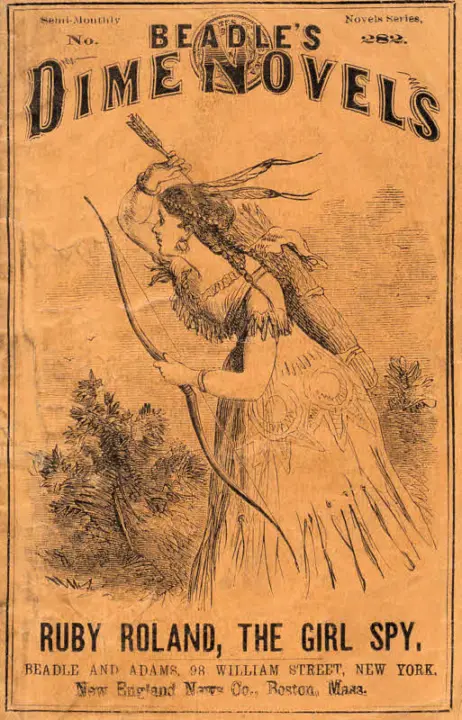
THE CLASSIC COLLECTION · 1873
"Ruby Roland, the Girl Spy; or, Simon Kenton’s Protege" by Frederick Whittaker is a historical novel written in the late 19th century. The story is set in the early period of American frontier life and follows the adventures of Ruby Roland, a young girl with ties to Native American tribes, and Simon Kenton, a famed frontiersman and scout. Together, they navigate the dangers of the wilderness, confront hostile forces, and unveil the greater political tensions of the time. The opening of the novel introduces Simon Kenton, who is initially engaged in a cautious maneuver across the Kentucky River while scouting for dangers, highlighting his experience and instincts as a ranger. As he navigates the treacherous landscape, he unexpectedly encounters another scout, leading to a tense moment of mistaken identity, which underscores the perilous nature of their environment. Shortly after, the narrative introduces Ruby Roland, who asserts her agency and bravery, prompting tension as both she and Kenton face the lurking threats of warfare and treachery. The chapter sets a gripping tone, intertwining themes of survival, identity, and the complexities of relationships in a tumultuous era.
Introduction adapted from the source catalogue; source summaries may be automatically generated.
Free to read · English · 35,021 words · No account needed
MAKE TIME FOR A GOOD BOOK
On by default. Untick to stop anonymous reading totals. Each page counts after 10 seconds in view. How this works.
Anonymous counting is on unless you have switched it off.
“Well, sir,” he said, defiantly, “I said you were no gentleman, to answer a civil question as you did. I repeat it. Now then, name your time and place, and I’ll fight you!”
For a moment the giant looked down at the slender form of this incarnation of pluck, pure and simple, as if he was puzzled. At last he burst into a roar of laughter, for he was a good-natured fellow after all, and said:
“I guess you’re right, arter all, little bantam. I durstn’t fight ye, that I know, for I couldn’t see to hit ye, ef ye stood edgewise. Let’s shake hands. I’m Bill Harrod of Harrodsburg, and by Gosh, I’m sorry I riled ye. Put it there.”
He held out a broad and horny palm, into which Frank insinuated his own diminutive hand, enduring a painful squeeze with great fortitude. Then all four, in perfect harmony, proceeded to the camp, where the senior captain, Joseph Bowman of Virginia, welcomed the little adjutant with great courtesy, and received the latter’s message.
“Colonel Clark’s compliments, gentlemen, and he has gone into camp on Corn Island. The river is fordable here, and he wishes you to bring over your companies and camp with him, when he will announce the object of the expedition, and call for volunteers.”
The news was spread from mouth to mouth with wonderful rapidity, the half-disciplined frontiersmen crowding round their commanders to hear the message, in a manner that would have caused a martinet to despair of their military character.
Nevertheless, Bowman issued the order, like an old officer.
“Git ready to move camp, boys; and look sharp.”
Inside of ten minutes, three companies of mounted riflemen stood by their horses’ heads, silent and obedient, and when Bowman rode into the ford, there was not a single straggler left behind.
The little adjutant crossed in his canoe, and on the further bank they found three more companies, drawn up in front of their camp, all silent and orderly, and anxiously expecting the news, about to be promulgated, of the destination of the expedition.
Colonel Clark was the only mounted man on the island, and he rode up, and greeted his allies with great courtesy.
“You will go into camp at the other end of the island, captain,” he said, to Bowman. “There are too many of the enemy’s Indians about, to trust a camp on shore to their annoyances. Go into camp, dismount your men, and be ready for dress parade at sunset. I will then announce the orders.”
Your reading position is saved on this browser. Take it to another device with a library code. Reading pages adapt to text, rather than matching a printed edition.
BEHIND THE BOOK
This eBook is for the use of anyone anywhere in the United States and most other parts of the world at no cost and with almost no restrictions whatsoever. You may copy it, give it away or re-use it under the terms of the Project Gutenberg License included with this eBook or online at www.gutenberg.org. If you are not located in the United States, you will have to check the laws of the country where you are located before using this eBook. Read the source licence.
The original source file, including credits and licence, is retained by this library. Request an original-format copy at no charge. Please include the book title and Project Gutenberg identifier #56620.
KEEP YOUR CURIOSITY GOING
Cécile Tormay

Moritz Busch
Coulson Kernahan
John L. Ransom

Maurice Baring
Frances Wright