THE CLASSIC COLLECTION✦Black Nick, the hermit of the hills; or, The expiated crime A story of Burgoyne’s surrenderCLASSIC FREE BOOKS
Black Nick, the hermit of the hills; or, The expiated crime A story of Burgoyne’s surrender
Frederick Whittaker
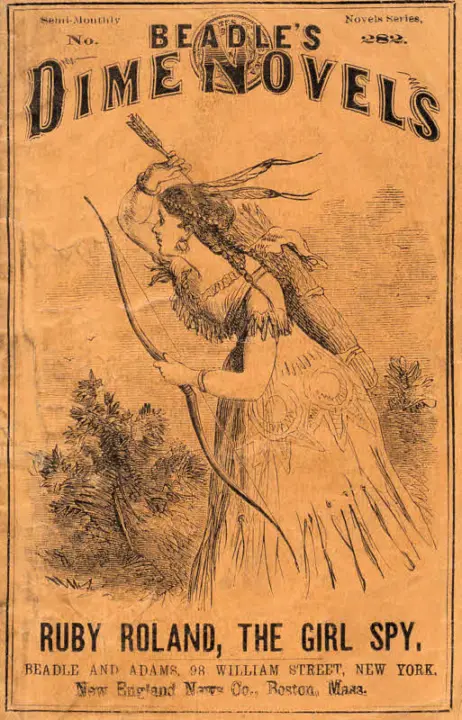
THE CLASSIC COLLECTION · 1873
"Ruby Roland, the Girl Spy; or, Simon Kenton’s Protege" by Frederick Whittaker is a historical novel written in the late 19th century. The story is set in the early period of American frontier life and follows the adventures of Ruby Roland, a young girl with ties to Native American tribes, and Simon Kenton, a famed frontiersman and scout. Together, they navigate the dangers of the wilderness, confront hostile forces, and unveil the greater political tensions of the time. The opening of the novel introduces Simon Kenton, who is initially engaged in a cautious maneuver across the Kentucky River while scouting for dangers, highlighting his experience and instincts as a ranger. As he navigates the treacherous landscape, he unexpectedly encounters another scout, leading to a tense moment of mistaken identity, which underscores the perilous nature of their environment. Shortly after, the narrative introduces Ruby Roland, who asserts her agency and bravery, prompting tension as both she and Kenton face the lurking threats of warfare and treachery. The chapter sets a gripping tone, intertwining themes of survival, identity, and the complexities of relationships in a tumultuous era.
Introduction adapted from the source catalogue; source summaries may be automatically generated.
Free to read · English · 35,021 words · No account needed
MAKE TIME FOR A GOOD BOOK
On by default. Untick to stop anonymous reading totals. Each page counts after 10 seconds in view. How this works.
Anonymous counting is on unless you have switched it off.
In a short time after, the orderly rapped at the door, and on being
told to enter, announced:
“Please, colonel, the adjutant says as how he wants to know ef he’s
released from arrest?”
“Did he dare to ask you that?” inquired Clark, sharply; and as he spoke
his eye flashed.
“Please, sir, they wouldn’t let me see him,” said the man.
“Who wouldn’t let you see him?”
The commander was growing very angry, for he was a strict disciplinarian, and this sounded terrible in his ears.
The orderly hesitated.
“Speak quick, man! Who wouldn’t let you see him?”
“Colonel,” said the rough borderer, who was, after all, only a half disciplined, independent militia-man; “’tain’t my fault, honest; but them Injuns and the young lady was at the door, and the young lady she guv me the message from adjutant; and please, colonel, the boys are all in a crowd around the door, and they cheered her when she spoke, and it’s my belief, sir--”
“That will do,” said Clark, imperiously. “I understand you. There’s mutiny afoot, and you’re afraid. Out of the way.”
Before father Gibault could interfere to check him, the colonel was out of the room and half-way down-stairs. He was in a state of the greatest excitement, and shouted for his horse in a manner strangely unlike his usual quiet way. Two minutes after, he was galloping down the street toward the camp, which, as before, was pitched in front of the disused arsenal occupied by the Indians.
Around the door, as the orderly had said, the whole of the motley force of borderers were clustered; and from the murmurs that reached his ear, it was evident that an unusual excitement was going on.
As the colonel galloped up, a dead silence fell on all; but not a man stirred out of his way, and matters looked quite squally, for the rough backwoodsmen made no scruple of looking with open defiance at their leader.
The tact of Clark was infinite, or he would not have been the successful leader that he was. He saw now that he had made a mistake, and pulled up his horse by the crowd, saying, quietly:
“Stand out of my way, men. I want to enter that building.”
He looked at the door of the arsenal, and there stood beautiful Ruby Roland, with her savage allies round her, stern and impassive, looking straight at him.
Your reading position is saved on this browser. Take it to another device with a library code. Reading pages adapt to text, rather than matching a printed edition.
BEHIND THE BOOK
This eBook is for the use of anyone anywhere in the United States and most other parts of the world at no cost and with almost no restrictions whatsoever. You may copy it, give it away or re-use it under the terms of the Project Gutenberg License included with this eBook or online at www.gutenberg.org. If you are not located in the United States, you will have to check the laws of the country where you are located before using this eBook. Read the source licence.
The original source file, including credits and licence, is retained by this library. Request an original-format copy at no charge. Please include the book title and Project Gutenberg identifier #56620.
KEEP YOUR CURIOSITY GOING
Cécile Tormay

Moritz Busch
Coulson Kernahan
John L. Ransom

Maurice Baring
Frances Wright