THE CLASSIC COLLECTION✦Black Nick, the hermit of the hills; or, The expiated crime A story of Burgoyne’s surrenderCLASSIC FREE BOOKS
Black Nick, the hermit of the hills; or, The expiated crime A story of Burgoyne’s surrender
Frederick Whittaker
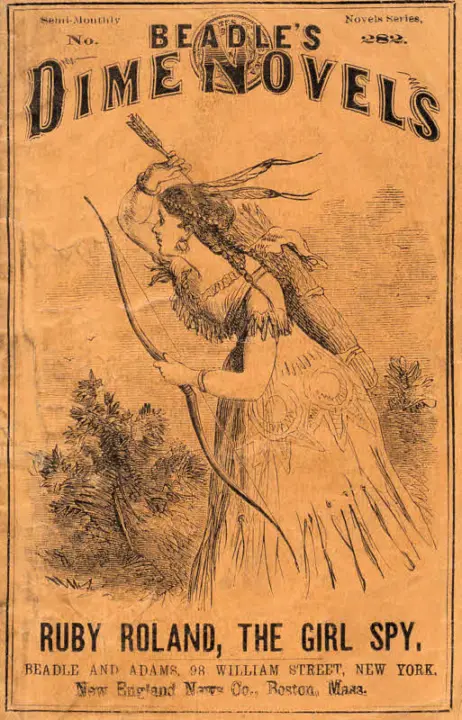
THE CLASSIC COLLECTION · 1873
"Ruby Roland, the Girl Spy; or, Simon Kenton’s Protege" by Frederick Whittaker is a historical novel written in the late 19th century. The story is set in the early period of American frontier life and follows the adventures of Ruby Roland, a young girl with ties to Native American tribes, and Simon Kenton, a famed frontiersman and scout. Together, they navigate the dangers of the wilderness, confront hostile forces, and unveil the greater political tensions of the time. The opening of the novel introduces Simon Kenton, who is initially engaged in a cautious maneuver across the Kentucky River while scouting for dangers, highlighting his experience and instincts as a ranger. As he navigates the treacherous landscape, he unexpectedly encounters another scout, leading to a tense moment of mistaken identity, which underscores the perilous nature of their environment. Shortly after, the narrative introduces Ruby Roland, who asserts her agency and bravery, prompting tension as both she and Kenton face the lurking threats of warfare and treachery. The chapter sets a gripping tone, intertwining themes of survival, identity, and the complexities of relationships in a tumultuous era.
Introduction adapted from the source catalogue; source summaries may be automatically generated.
Free to read · English · 35,021 words · No account needed
MAKE TIME FOR A GOOD BOOK
On by default. Untick to stop anonymous reading totals. Each page counts after 10 seconds in view. How this works.
Anonymous counting is on unless you have switched it off.
The day was hot and sultry, in early summer, about a year afterward, on the broad, shallow stream of the Kanawha River, as a flotilla of large flat-boats, known to the voyageurs as bateaux, was steadily following its way down the stream, assisted by the current, and urged by four or six long sweeps in each boat, pulled by two or three men apiece.
The bateaux were long, broad flat-boats, square at each end, hastily constructed from green plank, on the borders of the river, like nothing but great scows. There were seven of these rude but effective craft, all full of armed men, and holding about two hundred and fifty souls, all told.
Among these was a very small sprinkling of women and children; but the far greater proportion were stout, bronzed backwoodsmen, apt at a fight, and unerring in aim.
The leading boat of the flotilla was distinguished by a little house, or cabin, built in its center, on the summit of which rose a flag-staff, from which drooped a small white flag, bearing the pine-tree and coiled rattle-snake of the infant nation, which had not as yet been replaced by the memorable Stars and Stripes.
By this flag-staff, glass in hand, stood the leader of the expedition, Colonel George Rogers Clark, and by him a lad of about fifteen, slender in figure, of very dark complexion, who wore the same half-military dress as his leader--the hunting-shirt and leggings being fringed with gold lace, and the fur cap faced with a gilt plate of military device. Both wore swords and pistols, with officers’ scarlet sashes around the loins, to indicate authority.
“We shall get to the Ohio in an hour hence, colonel, if we keep up this speed,” remarked the boy officer, as Clark put down the glass with which he had been scanning the river ahead.
“I think so,” said Clark, gravely. “We shall get news there, at all events, Mr. Frank. Have you the morning report yet, sir?”
“Yes, colonel,” replied young Frank, promptly; “there are but three sick in the command, and one of them is a woman.”
Clark frowned, and made an impatient movement.
“These women are always in the way,” he said. “One would think that an expedition of this sort would put them out of conceit to come; but there’s no stopping the willful hussies--and they’re sure to fall sick just when we don’t want them. I wish they’d stay where they belong.”
The boy officer--he was Clark’s adjutant--laughed, as he said:
Your reading position is saved on this browser. Take it to another device with a library code. Reading pages adapt to text, rather than matching a printed edition.
BEHIND THE BOOK
This eBook is for the use of anyone anywhere in the United States and most other parts of the world at no cost and with almost no restrictions whatsoever. You may copy it, give it away or re-use it under the terms of the Project Gutenberg License included with this eBook or online at www.gutenberg.org. If you are not located in the United States, you will have to check the laws of the country where you are located before using this eBook. Read the source licence.
The original source file, including credits and licence, is retained by this library. Request an original-format copy at no charge. Please include the book title and Project Gutenberg identifier #56620.
KEEP YOUR CURIOSITY GOING
Cécile Tormay

Moritz Busch
Coulson Kernahan
John L. Ransom

Maurice Baring
Frances Wright