THE CLASSIC COLLECTION✦Black Nick, the hermit of the hills; or, The expiated crime A story of Burgoyne’s surrenderCLASSIC FREE BOOKS
Black Nick, the hermit of the hills; or, The expiated crime A story of Burgoyne’s surrender
Frederick Whittaker
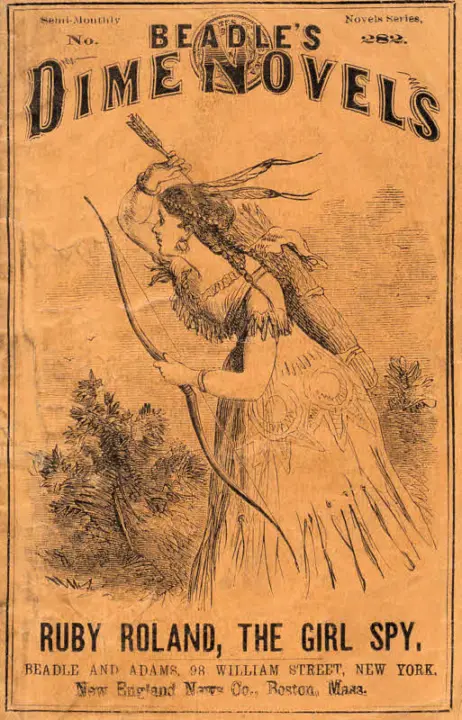
THE CLASSIC COLLECTION · 1873
"Ruby Roland, the Girl Spy; or, Simon Kenton’s Protege" by Frederick Whittaker is a historical novel written in the late 19th century. The story is set in the early period of American frontier life and follows the adventures of Ruby Roland, a young girl with ties to Native American tribes, and Simon Kenton, a famed frontiersman and scout. Together, they navigate the dangers of the wilderness, confront hostile forces, and unveil the greater political tensions of the time. The opening of the novel introduces Simon Kenton, who is initially engaged in a cautious maneuver across the Kentucky River while scouting for dangers, highlighting his experience and instincts as a ranger. As he navigates the treacherous landscape, he unexpectedly encounters another scout, leading to a tense moment of mistaken identity, which underscores the perilous nature of their environment. Shortly after, the narrative introduces Ruby Roland, who asserts her agency and bravery, prompting tension as both she and Kenton face the lurking threats of warfare and treachery. The chapter sets a gripping tone, intertwining themes of survival, identity, and the complexities of relationships in a tumultuous era.
Introduction adapted from the source catalogue; source summaries may be automatically generated.
Free to read · English · 35,021 words · No account needed
MAKE TIME FOR A GOOD BOOK
On by default. Untick to stop anonymous reading totals. Each page counts after 10 seconds in view. How this works.
Anonymous counting is on unless you have switched it off.
The poor curé looked from one to the other, as if doubting whether they were not playing a cruel practical joke on him. The faces of all the officers had been blackened in streaks with gunpowder and water, in a fashion which many of the grimly-humorous backwoodsmen had taken from the Indian war-paint. In dress they were no way superior to their men, and the wearing of swords was all that distinguished them. Such a looking set of ruffians might have frightened any one, much more the poor Frenchmen, whose minds had been industriously filled with horrible stories about the “rebels” by Hamilton’s and Rocheblave’s emissaries.
Clark, whose pity was excited by the evident terror of these feeble old men, came forward kindly enough, and said:
“I am Colonel Clark, of Kentucky, gentlemen, commander of this force. What is your business? Fear nothing. We will not kill you. Speak freely.”
Father Gibault, who seemed to be spokesman, was so much affected by the kind tone, that he faltered:
“God bless you, monsieur! God bless you! You are very kind, and we are
very old.”
Clark waved his hand impatiently.
“Well, well, gentlemen, what is your business? Speak quickly, for I am
busy.”
“Monsieur,” said the priest, earnestly, “we are well aware that your people do not belong to our church, and that you hold its doctrines in derision; but, monsieur, we beg leave to assure you that we are very quiet, harmless people. We know that the fortune of war has thrown us into your hands, and that we must expect to be separated from our happy homes, perhaps never to meet again. But, oh, monsieur, we beg, in the name of humanity, that you will allow us to meet once more, for the last time in our church, to hear one last mass, and to take leave of each other.”
And the five old men, with one accord, broke out weeping in the most
piteous manner, crying:
“Oh, monsieur, for the love of God!” “Pity us!” “Indeed we did not know who you were.” “The commandant told us you were all savages.” “But we know better now.”
As if by one consent, the rough backwoodsmen jumped up and stamped away to the windows, while muttered exclamations of sympathy were heard.
Clark waved his hand for silence, for he had his face under more control than his subordinates, though he too was much affected by the spectacle of old men in tears.
Then he said, in a careless tone:
Your reading position is saved on this browser. Take it to another device with a library code. Reading pages adapt to text, rather than matching a printed edition.
BEHIND THE BOOK
This eBook is for the use of anyone anywhere in the United States and most other parts of the world at no cost and with almost no restrictions whatsoever. You may copy it, give it away or re-use it under the terms of the Project Gutenberg License included with this eBook or online at www.gutenberg.org. If you are not located in the United States, you will have to check the laws of the country where you are located before using this eBook. Read the source licence.
The original source file, including credits and licence, is retained by this library. Request an original-format copy at no charge. Please include the book title and Project Gutenberg identifier #56620.
KEEP YOUR CURIOSITY GOING
Cécile Tormay

Moritz Busch
Coulson Kernahan
John L. Ransom

Maurice Baring
Frances Wright