THE CLASSIC COLLECTION✦Black Nick, the hermit of the hills; or, The expiated crime A story of Burgoyne’s surrenderCLASSIC FREE BOOKS
Black Nick, the hermit of the hills; or, The expiated crime A story of Burgoyne’s surrender
Frederick Whittaker
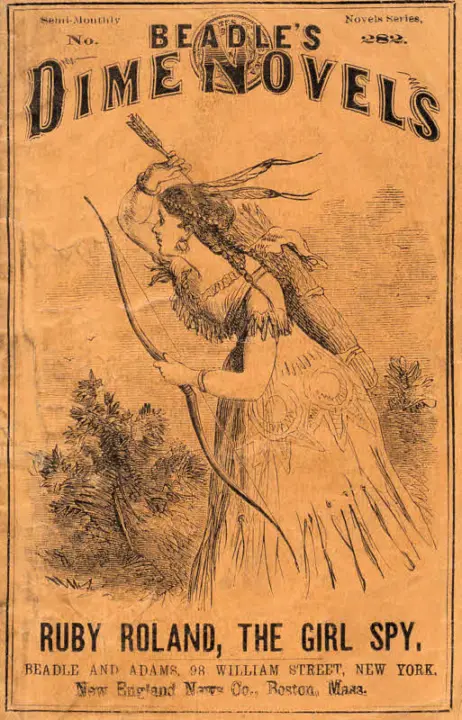
THE CLASSIC COLLECTION · 1873
"Ruby Roland, the Girl Spy; or, Simon Kenton’s Protege" by Frederick Whittaker is a historical novel written in the late 19th century. The story is set in the early period of American frontier life and follows the adventures of Ruby Roland, a young girl with ties to Native American tribes, and Simon Kenton, a famed frontiersman and scout. Together, they navigate the dangers of the wilderness, confront hostile forces, and unveil the greater political tensions of the time. The opening of the novel introduces Simon Kenton, who is initially engaged in a cautious maneuver across the Kentucky River while scouting for dangers, highlighting his experience and instincts as a ranger. As he navigates the treacherous landscape, he unexpectedly encounters another scout, leading to a tense moment of mistaken identity, which underscores the perilous nature of their environment. Shortly after, the narrative introduces Ruby Roland, who asserts her agency and bravery, prompting tension as both she and Kenton face the lurking threats of warfare and treachery. The chapter sets a gripping tone, intertwining themes of survival, identity, and the complexities of relationships in a tumultuous era.
Introduction adapted from the source catalogue; source summaries may be automatically generated.
Free to read · English · 35,021 words · No account needed
MAKE TIME FOR A GOOD BOOK
On by default. Untick to stop anonymous reading totals. Each page counts after 10 seconds in view. How this works.
Anonymous counting is on unless you have switched it off.
“Because there are spies round, Billy,” said Boone, boldly. “Who knows but what the British General at Detroit would hear all about his doings, if he divided the secret with a lot of fellows like them?” indicating the camp with a scornful gesture; “so full of whisky--when they can get it, that a child might suck them dry.”
“There are reason in cunnel’s words, Billy,” said Kenton, quietly. “Leastwise there ain’t no use talkin’, till Cunnel Clark comes. See, the head boat’s landin’ on Corn Island, and I guess we’ll hev to foller them into camp there.”
In fact, at this moment, Clark’s boats put in to an island that lay in the center of the river, and proceeded to disembark their crews, in sight of the Kentuckians.
Shortly after, a bark canoe shot out from the island, crossed the shallow belt of water that separated it from the south bank, and landed the same little officer already referred to as Adjutant Frank.
This smart little officer came strutting up to Big Bill Harrod, with a slender rapier clanking at his heels, and asked:
“Where shall I find Captain Bowman, the commandant, sir?”
Harrod looked down, half-contemptuously, at this tiny officer, whose head about reached his breast, and answered with a question:
“And what the Old Nick do you want of Joe Bowman, bubby? He ain’t used to suckin’ ’lasses candy.”
The little officer laughed merrily, without seeming in the least
abashed.
“I see, you’re not Bowman, my man, for I was told he was a gentleman. Captain Kenton, where is Bowman?”
Kenton started.
“Why, how the Old Scratch do you know my name, sonny? I disremember
ever seeing you before.”
“I am Colonel Clark’s adjutant, gentlemen,” said Frank, pulling up with considerable dignity, notwithstanding his small size. “If you’ve no civil answer to give me, I’ll go elsewhere! I carry orders!”
“Captain Bowman is down in camp, with Captain Dillard, sir,” said Daniel Boone, suddenly stepping forward and saluting the other with respect. “Don’t mind these rough fellows, adjutant; it’s their Kentucky way, and they mean no harm. I’ll go to the camp with you.”
“Hold on,” said Harrod, gruffly. “That younker said something about my not bein’ a gentleman. I ain’t goin’ to be talked to that way by none of George Clark’s whipper-snappers.”
In a moment the little officer had wheeled sharp round, and marched up
to the huge borderer.
Your reading position is saved on this browser. Take it to another device with a library code. Reading pages adapt to text, rather than matching a printed edition.
BEHIND THE BOOK
This eBook is for the use of anyone anywhere in the United States and most other parts of the world at no cost and with almost no restrictions whatsoever. You may copy it, give it away or re-use it under the terms of the Project Gutenberg License included with this eBook or online at www.gutenberg.org. If you are not located in the United States, you will have to check the laws of the country where you are located before using this eBook. Read the source licence.
The original source file, including credits and licence, is retained by this library. Request an original-format copy at no charge. Please include the book title and Project Gutenberg identifier #56620.
KEEP YOUR CURIOSITY GOING
Cécile Tormay

Moritz Busch
Coulson Kernahan
John L. Ransom

Maurice Baring
Frances Wright