THE CLASSIC COLLECTION✦Black Nick, the hermit of the hills; or, The expiated crime A story of Burgoyne’s surrenderCLASSIC FREE BOOKS
Black Nick, the hermit of the hills; or, The expiated crime A story of Burgoyne’s surrender
Frederick Whittaker
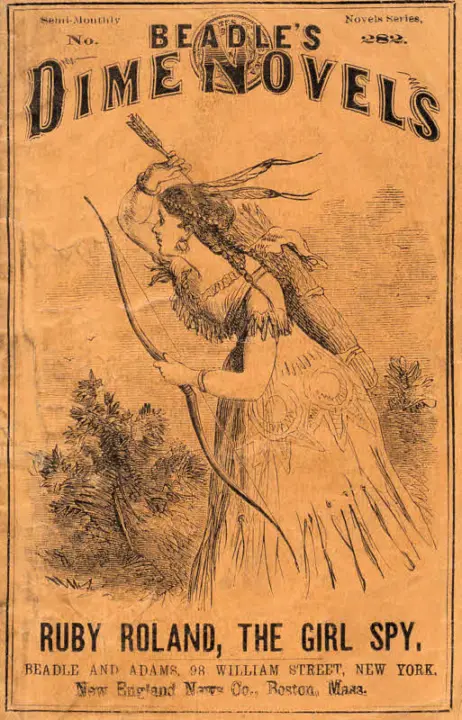
THE CLASSIC COLLECTION · 1873
"Ruby Roland, the Girl Spy; or, Simon Kenton’s Protege" by Frederick Whittaker is a historical novel written in the late 19th century. The story is set in the early period of American frontier life and follows the adventures of Ruby Roland, a young girl with ties to Native American tribes, and Simon Kenton, a famed frontiersman and scout. Together, they navigate the dangers of the wilderness, confront hostile forces, and unveil the greater political tensions of the time. The opening of the novel introduces Simon Kenton, who is initially engaged in a cautious maneuver across the Kentucky River while scouting for dangers, highlighting his experience and instincts as a ranger. As he navigates the treacherous landscape, he unexpectedly encounters another scout, leading to a tense moment of mistaken identity, which underscores the perilous nature of their environment. Shortly after, the narrative introduces Ruby Roland, who asserts her agency and bravery, prompting tension as both she and Kenton face the lurking threats of warfare and treachery. The chapter sets a gripping tone, intertwining themes of survival, identity, and the complexities of relationships in a tumultuous era.
Introduction adapted from the source catalogue; source summaries may be automatically generated.
Free to read · English · 35,021 words · No account needed
MAKE TIME FOR A GOOD BOOK
On by default. Untick to stop anonymous reading totals. Each page counts after 10 seconds in view. How this works.
Anonymous counting is on unless you have switched it off.
Colonel Clark was seated in the great drawing-room of the government house, with Rocheblave near him, a sentry at the open door, and one of the principal inhabitants standing in an humble attitude before him. Clark’s face was stern and cold, for he was yet playing a part, and desired to frighten the people of Kaskaskia to the utmost.
“Well, sir,” he said, sternly, “and so you will not confess who is the principal instigator of these Indian atrocities? Beware, for I can order you out to be shot in one minute.”
“And if you shoot me ten times over, monsieur,” said the other, in a shaking voice, “I could tell no more. I am but a poor dealer in snuff and tobacco, and know nothing of Indian plots. Ask Monsieur Rocheblave. He knows all. There was an Indian embassy came to him only yesterday evening.”
Rocheblave, at the first mention of his name, had been signaling the other to keep quiet, but in vain.
“No, you need not wink at me, monsieur; I shall tell the American General all I know. I will not be shot to please you. There were twelve chiefs from the Wabash, monsieur, with Mademoiselle Rubie, the daughter of the Grand Door, and they were quartered in the old arsenal for the night, if they have not escaped.”
Clark turned grimly on Rocheblave.
“Why did I not know this, sir?”
“Indeed, monsieur le colonel, I meant no harm,” said Rocheblave, hastily; “and, indeed, these fellows are only friends of a cousin of my wife’s, Mademoiselle Rubie Roland.”
“Ruby Roland,” repeated Clark, slowly; “is that the adopted daughter of
old Tabac?”
“The same, monsieur,” said the snuff-merchant, eagerly.
“Then, if she is here, I am glad,” said Clark, quietly. “You can go back home, sir; but do not stop to speak to a soul. The patrol has orders to shoot any citizen standing still in the streets. Go, and remember.”
The snuff-merchant bowed down to the very ground, and backed from the room, just as a tremendous clatter of hoofs outside announced the arrival of Ruby Roland and her cavalcade.
Clark hurried to the window, somewhat startled, and beheld the twelve stalwart Indians and the girl springing off their horses.
The sight of his boy adjutant’s uniform among them reassured him of their intentions, for Clark had grown to feel almost a superstitious confidence in this reckless lad.
He returned to his seat, then, with measured steps, for he knew the importance of preserving dignity before the stately Indians. With perfect patience he remained sitting, waiting for his new guests, while Rocheblave, who felt his position keenly, fidgeted about uneasily in his chair.
Your reading position is saved on this browser. Take it to another device with a library code. Reading pages adapt to text, rather than matching a printed edition.
BEHIND THE BOOK
This eBook is for the use of anyone anywhere in the United States and most other parts of the world at no cost and with almost no restrictions whatsoever. You may copy it, give it away or re-use it under the terms of the Project Gutenberg License included with this eBook or online at www.gutenberg.org. If you are not located in the United States, you will have to check the laws of the country where you are located before using this eBook. Read the source licence.
The original source file, including credits and licence, is retained by this library. Request an original-format copy at no charge. Please include the book title and Project Gutenberg identifier #56620.
KEEP YOUR CURIOSITY GOING
Cécile Tormay

Moritz Busch
Coulson Kernahan
John L. Ransom

Maurice Baring
Frances Wright