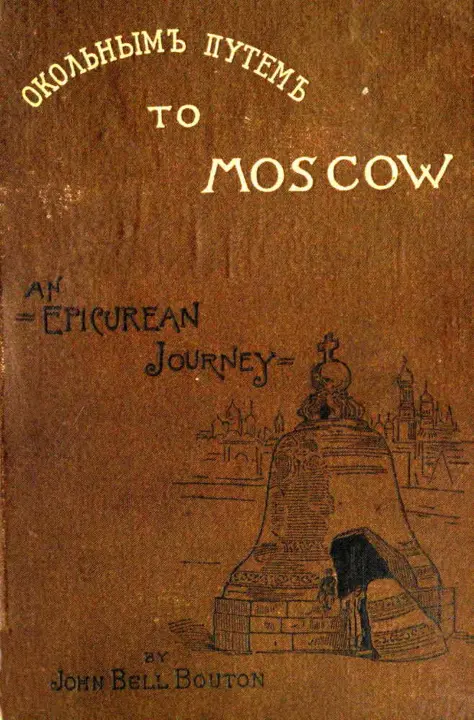
Roundabout to Moscow: An Epicurean Journey
John Bell Bouton
THE CLASSIC COLLECTION · 1864
"Round the Block: An American Novel" by John Bell Bouton is a fictional work likely written in the mid-19th century. The narrative begins by vividly depicting a neighborhood characterized by contrasting settings—posh, seemingly empty brownstone houses on one side and lively, bustling shops and homes for working-class families on the opposite. The story primarily revolves around three bachelors, Marcus Wilkeson, Fayette Overtop, and Matthew Maltboy, who embark on a series of social interactions within their block, exploring themes of neighborliness and community amidst their varied daily lives. The opening of the novel introduces readers to the ornate yet lifeless dwellings on the east side of the block and the contrasting vibrancy on the west side. As the three bachelors settle into their shared home, Overtop proposes an experiment in socializing, advocating for engaging with their neighbors to better understand their community. This leads to humorous exchanges and the deepening relationships between the protagonists as they navigate social calls, interactions with their eccentric neighbors, and the pursuit of companionship, all while their personal quirks and backgrounds unfold. The narrative sets a lively tone that promises both comedic moments and reflections on human interaction in a densely populated urban setting.
Introduction adapted from the source catalogue; source summaries may be automatically generated.
Free to read · English · 151,552 words · No account needed
MAKE TIME FOR A GOOD BOOK
On by default. Untick to stop anonymous reading totals. Each page counts after 10 seconds in view. How this works.
Anonymous counting is on unless you have switched it off.
"It has been a horrid, dreary winter, has it not, Mr. Maltboy?" said she, in a tone that invited sympathy and confidence.
Mr. Maltboy, supposing that she alluded to the prevalent snow and ice of the season, said that it certainly had.
"No balls, no opera--or none to speak of--no parties, no anything. You will hardly believe it, Mr. Maltboy, but I declare I haven't been to twenty parties this winter--have I, Gusty?"
"To only two that I know of," responded Mrs. Frump, in a winning voice.
"You provoking creature," said Miss Whedell, "to talk so, when you know that I have been to at least eighteen parties!" Miss Whedell scowled charmingly as she spoke, and then added, with a pleasant smile, for the benefit of Mr. Maltboy: "She's a gay young widow; and you know what widows are."
Mr. Maltboy's knowledge of that species of the human family was extensive and exact. He nodded, to signify that he knew something of them, and felt forearmed, from that moment, against the charms of Mrs. Frump.
Mrs. Frump told Miss Whedell that she thanked her very much for the compliment, and laughed so prettily, that Fayette Overtop determined to apply some of his grand tests for the discovery of sensible women.
Abandoning the vein of commonplace conversation which he had worked during the five minutes since his arrival, he remarked:
"It really makes us feel young again--does it not, Mrs. Frump?--to renew this charming custom of receiving and making calls."
Mr. Overtop spoke in general terms, like a philosopher; whereas Mrs. Frump made a personal application of the remark to herself, and replied, rather coldly: "I have no doubt that it makes old persons feel younger," and then she looked at Matthew Maltboy, and seemed to be listening to the conversation between him and Miss Whedell.
Mr. Overtop paused a moment, and tried again: "Is it not pleasant, though sad, Mrs. Frump, to think of the friends whom we knew many, many years ago, who no longer live to greet us on this festal day?" The speaker alluded to mankind at large.
Mrs. Frump responded tartly, that she could not speak from experience, of course, but she presumed that Mr. Overtop's opinion was correct. And again she glanced at Maltboy.
Mr. Overtop briefly rested, and then remarked:
"It may be merely a poetical conceit of mine, but it seems to me that the horses prance higher, and shake their bells more merrily on New Year's than any other day, as if they partook in our enjoyment of the occasion. May not the horse, by some mysterious instinct, know that it is the beginning of the year?"
Your reading position is saved on this browser. Take it to another device with a library code. Reading pages adapt to text, rather than matching a printed edition.
John Bell Bouton
BEHIND THE BOOK
This eBook is for the use of anyone anywhere in the United States and most other parts of the world at no cost and with almost no restrictions whatsoever. You may copy it, give it away or re-use it under the terms of the Project Gutenberg License included with this eBook or online at www.gutenberg.org. If you are not located in the United States, you will have to check the laws of the country where you are located before using this eBook. Read the source licence.
The original source file, including credits and licence, is retained by this library. Request an original-format copy at no charge. Please include the book title and Project Gutenberg identifier #12243.
KEEP YOUR CURIOSITY GOING
Coulson Kernahan

Maurice Baring
Frances Wright
Cécile Tormay

Frederic Jesup Stimson

W. H. P. (William Henry Pope) Jarvis