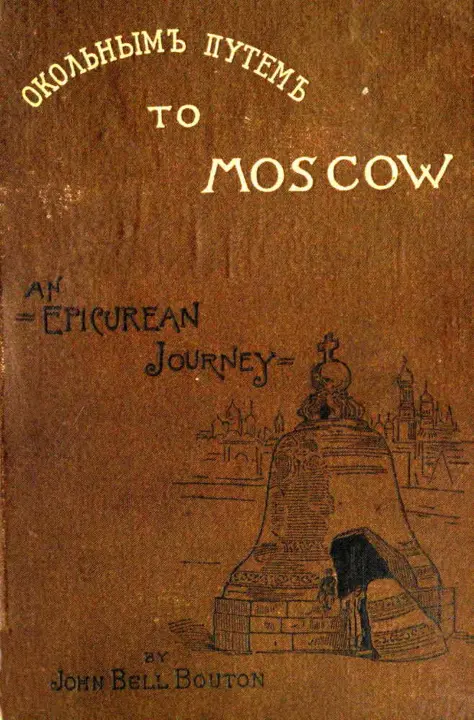
Roundabout to Moscow: An Epicurean Journey
John Bell Bouton
THE CLASSIC COLLECTION · 1864
"Round the Block: An American Novel" by John Bell Bouton is a fictional work likely written in the mid-19th century. The narrative begins by vividly depicting a neighborhood characterized by contrasting settings—posh, seemingly empty brownstone houses on one side and lively, bustling shops and homes for working-class families on the opposite. The story primarily revolves around three bachelors, Marcus Wilkeson, Fayette Overtop, and Matthew Maltboy, who embark on a series of social interactions within their block, exploring themes of neighborliness and community amidst their varied daily lives. The opening of the novel introduces readers to the ornate yet lifeless dwellings on the east side of the block and the contrasting vibrancy on the west side. As the three bachelors settle into their shared home, Overtop proposes an experiment in socializing, advocating for engaging with their neighbors to better understand their community. This leads to humorous exchanges and the deepening relationships between the protagonists as they navigate social calls, interactions with their eccentric neighbors, and the pursuit of companionship, all while their personal quirks and backgrounds unfold. The narrative sets a lively tone that promises both comedic moments and reflections on human interaction in a densely populated urban setting.
Introduction adapted from the source catalogue; source summaries may be automatically generated.
Free to read · English · 151,552 words · No account needed
MAKE TIME FOR A GOOD BOOK
On by default. Untick to stop anonymous reading totals. Each page counts after 10 seconds in view. How this works.
Anonymous counting is on unless you have switched it off.
As Bog was resting against the hydrant, absorbed in this delicious revery, and totally indifferent to the consequences, he was startled by a slight tap on the shoulder. He turned quickly, and saw--the man he hated--the man who pretended (Bog would never admit that it was more than a pretence) to save Pet from the falling boards.
"Well," said Bog, looking on this man as his mortal enemy, "What do you want of me?" He spoke in the gruff, defiant manner peculiar to children of the city.
The man's livid face and lead-colored eyes and white teeth all combined in a reassuring smile. "Nothing," said he, "my good fellow, but to do an errand."
"I say, now, who'd you take me for, hey?" answered Bog, shaking his head at the man, and feeling a tremendous desire to knock his shining hat off.
The man looked up and down Bog's cheap gray suit, and at his neatly polished shoes and his clean slouching cap, and then said:
"No offence meant, my lad. But I thought you wouldn't object to earning a quarter. You're only to deliver a letter at that house; that's all." He pointed to Miss Pillbody's.
"Hey--what house?" asked Bog, turning pale, with a strange and jarring combination of rage, jealousy, envy, and insulted dignity.
"The one with the bright doorplate, green curtains and gold borders. I thought you were looking at it as I came up."
"N-no, I wasn't. And what if I was, hey?"
"It strikes me you're rather touchy, my young friend," said the man, with his conciliatory smile. "Here's the letter, now, and a quarter. It's only a few steps. No answer required."
As Bog caught sight of the letter, done up in the long, rakish envelope which had just begun to come into fashion, and faintly perfumed, a lucky thought occurred to him.
The man saw that he wavered. "Only a step," said he. "And here is the quarter." He offered it to Bog between a thumb and finger.
"Why don't you deliver the letter yourself?" asked Bog.
"Oh! oh! for family reasons," answered the man, hesitating. "Miss Pillbody there is my aunt, and the lady to whom this letter is addressed is my cousin. The old woman and I have had a sort of falling out about the young one, you see. These little difficulties will occur in the best-regulated families. Come, take the letter. I'm in a hurry."
Your reading position is saved on this browser. Take it to another device with a library code. Reading pages adapt to text, rather than matching a printed edition.
John Bell Bouton
BEHIND THE BOOK
This eBook is for the use of anyone anywhere in the United States and most other parts of the world at no cost and with almost no restrictions whatsoever. You may copy it, give it away or re-use it under the terms of the Project Gutenberg License included with this eBook or online at www.gutenberg.org. If you are not located in the United States, you will have to check the laws of the country where you are located before using this eBook. Read the source licence.
The original source file, including credits and licence, is retained by this library. Request an original-format copy at no charge. Please include the book title and Project Gutenberg identifier #12243.
KEEP YOUR CURIOSITY GOING
Coulson Kernahan

Maurice Baring
Frances Wright
Cécile Tormay

Frederic Jesup Stimson

W. H. P. (William Henry Pope) Jarvis