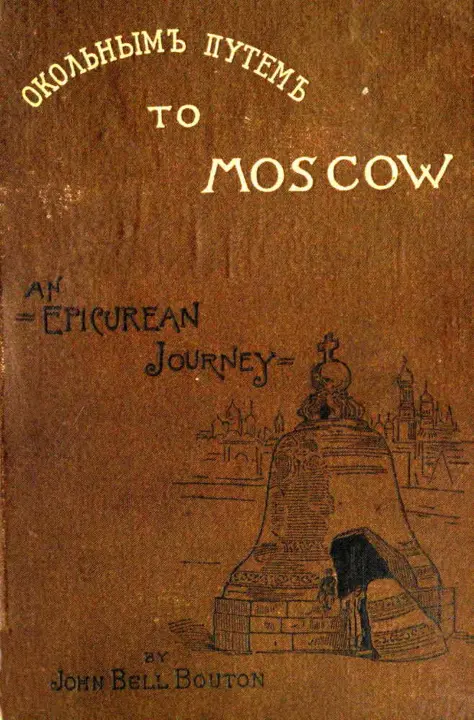
Roundabout to Moscow: An Epicurean Journey
John Bell Bouton
THE CLASSIC COLLECTION · 1864
"Round the Block: An American Novel" by John Bell Bouton is a fictional work likely written in the mid-19th century. The narrative begins by vividly depicting a neighborhood characterized by contrasting settings—posh, seemingly empty brownstone houses on one side and lively, bustling shops and homes for working-class families on the opposite. The story primarily revolves around three bachelors, Marcus Wilkeson, Fayette Overtop, and Matthew Maltboy, who embark on a series of social interactions within their block, exploring themes of neighborliness and community amidst their varied daily lives. The opening of the novel introduces readers to the ornate yet lifeless dwellings on the east side of the block and the contrasting vibrancy on the west side. As the three bachelors settle into their shared home, Overtop proposes an experiment in socializing, advocating for engaging with their neighbors to better understand their community. This leads to humorous exchanges and the deepening relationships between the protagonists as they navigate social calls, interactions with their eccentric neighbors, and the pursuit of companionship, all while their personal quirks and backgrounds unfold. The narrative sets a lively tone that promises both comedic moments and reflections on human interaction in a densely populated urban setting.
Introduction adapted from the source catalogue; source summaries may be automatically generated.
Free to read · English · 151,552 words · No account needed
MAKE TIME FOR A GOOD BOOK
On by default. Untick to stop anonymous reading totals. Each page counts after 10 seconds in view. How this works.
Anonymous counting is on unless you have switched it off.
At that moment the door opened, and the venerable form of Myndert Van Quintem appeared before them. Marcus cast a hasty glance, importing silence, at his companions, and rose to receive his old friend.
Mr. Van Quintem's face expressed the tenderest compassion. He clasped
Marcus's hand, and said:
"My young friend, it deeply grieves me to see you here; for I feel--I
may say I know morally--that you are innocent of any part in
this murder."
"Thank you for your confidence," said Marcus. "I hope, when Miss Minford and certain other witnesses are examined to-morrow, to prove my innocence conclusively."
"So you will, I am sure. When I say that I know you are innocent, I found my belief on my short but pleasant acquaintance with you. But I cannot guess, from the evidence at the inquest yesterday and that of to-day--just published in the afternoon papers,--who committed the murder, or what was the motive of it. Have you any clue to the mystery?"
"Yes--yes," replied Marcus. "We think we have a clue; but so slight, that it is hardly worth mentioning. My friends here are going to follow it up."
"And in order that we may do so without any delay," said the lieutenant, "please give us the name of that sneaking letter writer."
Marcus coughed, looked at the lieutenant knowingly, and said, "Oh, that's no consequence. It's a false scent. Depend on it."
The old gentleman, as he entered the room, had caught Marcus Wilkeson's words. "He is the son--" and had observed the slight confusion with which Marcus had stopped saying something. He now noticed the glance enjoining silence, which Marcus had directed at the lieutenant of police.
Mr. Van Quintem turned pale, as a harrowing suspicion came into his mind. "Mr. Wilkeson," he said, in a trembling voice, "will you answer me one question truly?"
"I--I will," replied Marcus.
"Then tell me, in Heaven's name, do you know of anything that connects my son with this monstrous crime? I have had a dreadful presentiment, all along, that he had something to do with it. The end of his wrong career will be the gallows. I have dreamt of it for years. O God! that I should have begotten such a profligate and miscreant into the world!"
The old man made another pause, and then said, with a calmness that surprised his hearers. "Now I am ready to hear all."
"And you shall," said Marcus, "though it pains me, my dear friend, to tell you what we know of your son. I will say, however, that there is no proof directly connecting him with the murder."
Your reading position is saved on this browser. Take it to another device with a library code. Reading pages adapt to text, rather than matching a printed edition.
John Bell Bouton
BEHIND THE BOOK
This eBook is for the use of anyone anywhere in the United States and most other parts of the world at no cost and with almost no restrictions whatsoever. You may copy it, give it away or re-use it under the terms of the Project Gutenberg License included with this eBook or online at www.gutenberg.org. If you are not located in the United States, you will have to check the laws of the country where you are located before using this eBook. Read the source licence.
The original source file, including credits and licence, is retained by this library. Request an original-format copy at no charge. Please include the book title and Project Gutenberg identifier #12243.
KEEP YOUR CURIOSITY GOING
Coulson Kernahan

Maurice Baring
Frances Wright
Cécile Tormay

Frederic Jesup Stimson

W. H. P. (William Henry Pope) Jarvis