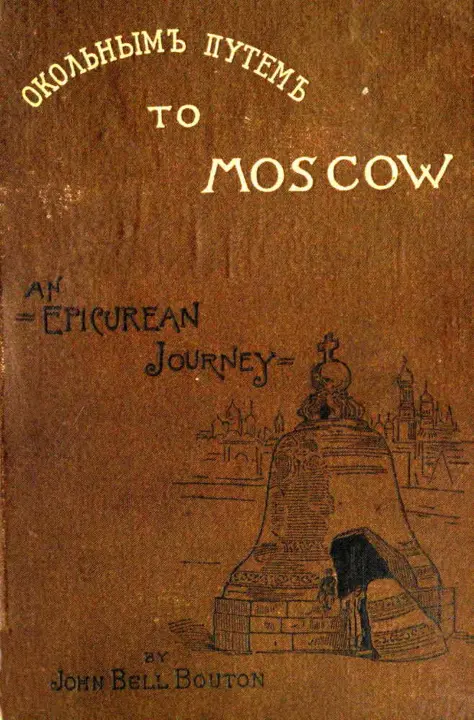
Roundabout to Moscow: An Epicurean Journey
John Bell Bouton
THE CLASSIC COLLECTION · 1864
"Round the Block: An American Novel" by John Bell Bouton is a fictional work likely written in the mid-19th century. The narrative begins by vividly depicting a neighborhood characterized by contrasting settings—posh, seemingly empty brownstone houses on one side and lively, bustling shops and homes for working-class families on the opposite. The story primarily revolves around three bachelors, Marcus Wilkeson, Fayette Overtop, and Matthew Maltboy, who embark on a series of social interactions within their block, exploring themes of neighborliness and community amidst their varied daily lives. The opening of the novel introduces readers to the ornate yet lifeless dwellings on the east side of the block and the contrasting vibrancy on the west side. As the three bachelors settle into their shared home, Overtop proposes an experiment in socializing, advocating for engaging with their neighbors to better understand their community. This leads to humorous exchanges and the deepening relationships between the protagonists as they navigate social calls, interactions with their eccentric neighbors, and the pursuit of companionship, all while their personal quirks and backgrounds unfold. The narrative sets a lively tone that promises both comedic moments and reflections on human interaction in a densely populated urban setting.
Introduction adapted from the source catalogue; source summaries may be automatically generated.
Free to read · English · 151,552 words · No account needed
MAKE TIME FOR A GOOD BOOK
On by default. Untick to stop anonymous reading totals. Each page counts after 10 seconds in view. How this works.
Anonymous counting is on unless you have switched it off.
Mr. Quigg paid the compliments of the season in his neat, settled style, to Miss Whedell--the tall young lady--who received them with marked coldness, and then begged leave to introduce Messrs. Overtop and Maltboy, to whom she smiled graciously, rising slightly from her chair, and sinking back again, without disturbing the symmetrical flow of the silken fountain. With a wave of her jewelled right hand she performed the ceremony of introduction between the three callers and Mrs. Frump--the fat young lady--who also carefully raised herself about two inches from her chair, and lowered herself again, without disarranging a ripple.
In compliance with an invitation from Miss Whedell, the three callers sat down. Mr. Maltboy gravitated by a natural instinct to the side of his charmer. Mr. Overtop was drawn by an irresistible impulse into the vicinity of Mrs. Frump, having detected in her general appearance certain indications of what he called "a sensible woman." Mr. Quigg, feeling that he was one too many, took a "seat equally removed from the two ladies, and commenced playing soft tunes on his hat, and looking vacantly about the room.
"I had begun to wonder, Mr. Maltboy," said Miss Whedell, "what makes our friends so backward to-day. I do declare, we have not had a caller for more than--how long is it, Gusty, since Colonel Bigford dropped in?"
Maltboy thought her voice had a sweet, metallic ring.
"About half an hour," replied Mrs. Frump, after a brief mental
calculation.
"Why, Gusty!" exclaimed Miss Whedell; "how can you sit there and tell such stories? You know it is not five minutes."
"Just as you please, dear," said Mrs. Frump, leaving on the minds of her hearers the impression that her estimate was the correct one.
"I never saw anything so slow," pursued Miss Whedell. "Would you believe it, Mr. Maltboy--here are two hours gone, and we have not had more than--how many callers have we had, Gusty? You keep account of them."
Mrs. Frump drew out a little memorandum book from one of her pockets, and consulted. "Exactly eleven, Clemmy," said she.
"Gusty Frump," returned Miss Whedell, with some warmth, "you ought to be ashamed of yourself! We have had fifty callers, to my certain knowledge."
"I presume you are right," said Mrs. Frump, with a smile that irradiated the whole of her fat face, and again imparted the idea that Miss Whedell was wrong.
"For one," said Matthew Maltboy, improving the opportunity to put in a word, "I should not be surprised to learn that you had a hundred."
Miss Whedell appreciated the delicate compliment, and beamed fascination
upon him.
Your reading position is saved on this browser. Take it to another device with a library code. Reading pages adapt to text, rather than matching a printed edition.
John Bell Bouton
BEHIND THE BOOK
This eBook is for the use of anyone anywhere in the United States and most other parts of the world at no cost and with almost no restrictions whatsoever. You may copy it, give it away or re-use it under the terms of the Project Gutenberg License included with this eBook or online at www.gutenberg.org. If you are not located in the United States, you will have to check the laws of the country where you are located before using this eBook. Read the source licence.
The original source file, including credits and licence, is retained by this library. Request an original-format copy at no charge. Please include the book title and Project Gutenberg identifier #12243.
KEEP YOUR CURIOSITY GOING
Coulson Kernahan

Maurice Baring
Frances Wright
Cécile Tormay

Frederic Jesup Stimson

W. H. P. (William Henry Pope) Jarvis