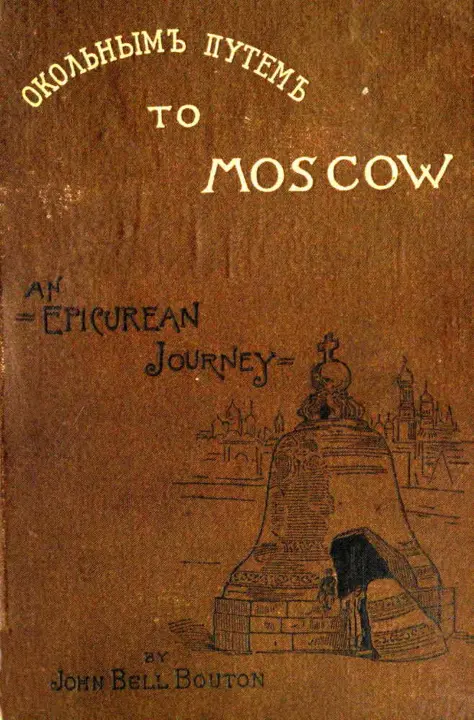
Roundabout to Moscow: An Epicurean Journey
John Bell Bouton
THE CLASSIC COLLECTION · 1864
"Round the Block: An American Novel" by John Bell Bouton is a fictional work likely written in the mid-19th century. The narrative begins by vividly depicting a neighborhood characterized by contrasting settings—posh, seemingly empty brownstone houses on one side and lively, bustling shops and homes for working-class families on the opposite. The story primarily revolves around three bachelors, Marcus Wilkeson, Fayette Overtop, and Matthew Maltboy, who embark on a series of social interactions within their block, exploring themes of neighborliness and community amidst their varied daily lives. The opening of the novel introduces readers to the ornate yet lifeless dwellings on the east side of the block and the contrasting vibrancy on the west side. As the three bachelors settle into their shared home, Overtop proposes an experiment in socializing, advocating for engaging with their neighbors to better understand their community. This leads to humorous exchanges and the deepening relationships between the protagonists as they navigate social calls, interactions with their eccentric neighbors, and the pursuit of companionship, all while their personal quirks and backgrounds unfold. The narrative sets a lively tone that promises both comedic moments and reflections on human interaction in a densely populated urban setting.
Introduction adapted from the source catalogue; source summaries may be automatically generated.
Free to read · English · 151,552 words · No account needed
MAKE TIME FOR A GOOD BOOK
On by default. Untick to stop anonymous reading totals. Each page counts after 10 seconds in view. How this works.
Anonymous counting is on unless you have switched it off.
Cries of "Hallo!" "What's the row?" "Hush!" and "For shame!" rose from all parts of the room, and the two musical gentlemen, conscious that they had grossly misconducted themselves, stepped back a yard from each other, and were immediately surrounded by several friends, and kindly told that they were a pair of fools.
Mrs. Slapman and Overtop rushed to the spot. The latter measured the two combatants with his eye, to see if he could safely undertake to pitch both, or either of them, out of the room, if requested so to do by the widow, and concluded that he could not.
Mrs. Slapman was much embarrassed by this painful outbreak. It was only three weeks ago that M. Bartin had dedicated a new quadrille to her; and but a fortnight since Signor Mancussi had sung four operatic airs gratuitously at one of her musical and dramatic soirées. But respect for herself and for her guests--especially for Mr. Overtop, of whose talents she had formed an exalted opinion--pointed out her path of duty, and she followed it. She stepped between the two disputants, and cast a look of surprise and regret at each.
"I was hasty," said Signor Mancussi.
"And I was too impulsive," said M. Bartin.
"Then, gentlemen, if you would merit my continued friendship, please make up your little difference, by shaking hands."
They recoiled from the proposition a moment, but, being pushed together by their respective friends from behind, took each other's right hand, shook it once feebly, and said distinctly, with their eyes, "We shall meet again!"
"Very well done," said Mrs. Slapman, with the air of an empress, tempered by a charming smile. "And let us hope that is the end of it. Now, Mr. Overtop, allow me to offer you some refreshment."
Mrs. Slapman was in the act of handing a glass of champagne to the favored Overtop, when an unearthly shriek was heard, which startled the steadiest nerves. This shriek was repeated three times in quick succession, and seemed to come from the sidewalk in front of the house. There was a general rush to the window; but Wilkeson, Overtop, Maltboy, and Quigg ran for the street at once, surmising the source of the cry.
There stood Captain Tonkins, in the sleigh, leaning against the dashboard, holding in one hand an empty jug, and in the other his whip. Around the sleigh were a dozen men and boys, who had been convoked by the cry of "FELL' CITIZENS!" More men and more boys were seen coming in the distance.
As the four lessees of the sleigh approached him, the Captain again
yelled, "FELL' CITIZENS!"
"For heaven's sake, stop, Captain!" cried Quigg.
Your reading position is saved on this browser. Take it to another device with a library code. Reading pages adapt to text, rather than matching a printed edition.
John Bell Bouton
BEHIND THE BOOK
This eBook is for the use of anyone anywhere in the United States and most other parts of the world at no cost and with almost no restrictions whatsoever. You may copy it, give it away or re-use it under the terms of the Project Gutenberg License included with this eBook or online at www.gutenberg.org. If you are not located in the United States, you will have to check the laws of the country where you are located before using this eBook. Read the source licence.
The original source file, including credits and licence, is retained by this library. Request an original-format copy at no charge. Please include the book title and Project Gutenberg identifier #12243.
KEEP YOUR CURIOSITY GOING
Coulson Kernahan

Maurice Baring
Frances Wright
Cécile Tormay

Frederic Jesup Stimson

W. H. P. (William Henry Pope) Jarvis