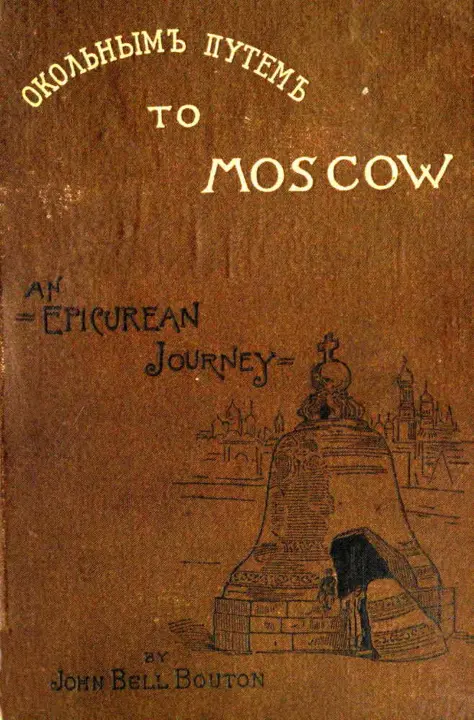
Roundabout to Moscow: An Epicurean Journey
John Bell Bouton
THE CLASSIC COLLECTION · 1864
"Round the Block: An American Novel" by John Bell Bouton is a fictional work likely written in the mid-19th century. The narrative begins by vividly depicting a neighborhood characterized by contrasting settings—posh, seemingly empty brownstone houses on one side and lively, bustling shops and homes for working-class families on the opposite. The story primarily revolves around three bachelors, Marcus Wilkeson, Fayette Overtop, and Matthew Maltboy, who embark on a series of social interactions within their block, exploring themes of neighborliness and community amidst their varied daily lives. The opening of the novel introduces readers to the ornate yet lifeless dwellings on the east side of the block and the contrasting vibrancy on the west side. As the three bachelors settle into their shared home, Overtop proposes an experiment in socializing, advocating for engaging with their neighbors to better understand their community. This leads to humorous exchanges and the deepening relationships between the protagonists as they navigate social calls, interactions with their eccentric neighbors, and the pursuit of companionship, all while their personal quirks and backgrounds unfold. The narrative sets a lively tone that promises both comedic moments and reflections on human interaction in a densely populated urban setting.
Introduction adapted from the source catalogue; source summaries may be automatically generated.
Free to read · English · 151,552 words · No account needed
MAKE TIME FOR A GOOD BOOK
On by default. Untick to stop anonymous reading totals. Each page counts after 10 seconds in view. How this works.
Anonymous counting is on unless you have switched it off.
Clementina, having found what she sought, glided to the chair which her father had relinquished, and said, coquettishly, "Now I have come to entertain you, Mr. Chiffield. You were speaking of Niagara Falls, the other day. Here are some photographs of them, taken for me on the spot." She handed the pictures to Mr. Chiffield. That gentleman took them with a profound bow, glanced over them, and said, "How elegant!" "What rich scenery!" "How tasty they are got up, a'n't they?" "This is the showiest picture;" "Here's a neat one," &c., &c., &c. Mr. Chiffield had contracted the use of a certain class of highly descriptive adjectives in selling dry goods. Clementina watched him narrowly, and thought how nicely she could manage this heavy fellow.
"How many times have you been to the Falls?" she asked, when Chiffield had shuffled through the photographs twice.
"Three times," said Chiffield, telling a white lie; for he had seen them at morning, noon, and evening on the same day. "And how often have you visited them, Miss Whedell?"
"Oh! so often I can't remember. My last visit was early last autumn. Oh! pa, did we go to Niagara Falls before or after our trip to the White Mountains?"
"After it, my child," replied the father, who maintained a cocked ear toward his child. "Don't you recollect we went from the Falls to Lake George, and stayed there till the first week in November? That was the year we omitted Newport and Saratoga, for a wonder," he added, conveying the idea, in a look to Mr. Chiffield, that such an omission was a marvel in their annual experiences.
"You love the Falls, I suppose?" said Mr. Chiffield.
"Oh! not much. I think they're dreadfully overrated." Clementina was determined not to be won too cheaply.
"So I think," said Chiffield, delighted to speak his real sentiments this time; "though everybody is obliged to praise 'em, because that's the fashion."
"But, though the Falls a'n't much, I must say the balls and hops are delightful. The fresh air there seems to give one strength to dance all night without a bit of fatigue. I bought these pictures because they show the hotels and other places where I have had such delicious dances."
Chiffield execrated dancing, because he had large feet, and legs slightly bowed. He moved in the cotillon or waltz with a certain elephantine ponderousness and sagacity. Therefore she tantalized him with these reminiscences.
"You see the Clifton House, there, on the Canada side? One night I danced eight waltzes, six polkas, four quadrilles, three fancy dances, and wound up, at five o'clock, with the German."
"Wonderful!" observed Chiffield, not knowing what else to say.
Your reading position is saved on this browser. Take it to another device with a library code. Reading pages adapt to text, rather than matching a printed edition.
John Bell Bouton
BEHIND THE BOOK
This eBook is for the use of anyone anywhere in the United States and most other parts of the world at no cost and with almost no restrictions whatsoever. You may copy it, give it away or re-use it under the terms of the Project Gutenberg License included with this eBook or online at www.gutenberg.org. If you are not located in the United States, you will have to check the laws of the country where you are located before using this eBook. Read the source licence.
The original source file, including credits and licence, is retained by this library. Request an original-format copy at no charge. Please include the book title and Project Gutenberg identifier #12243.
KEEP YOUR CURIOSITY GOING
Coulson Kernahan

Maurice Baring
Frances Wright
Cécile Tormay

Frederic Jesup Stimson

W. H. P. (William Henry Pope) Jarvis