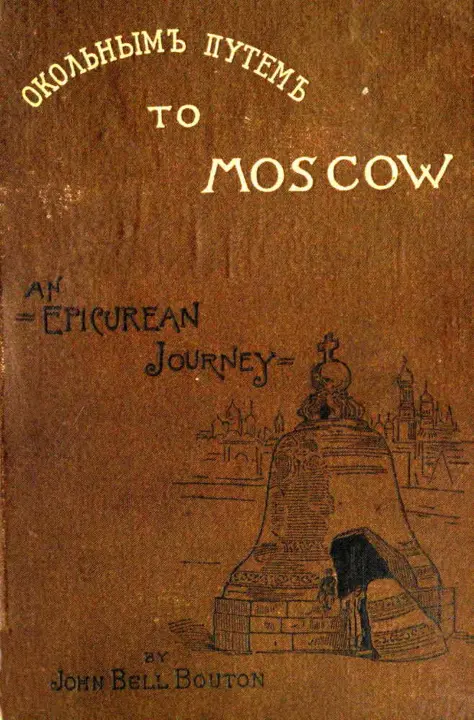
Roundabout to Moscow: An Epicurean Journey
John Bell Bouton
THE CLASSIC COLLECTION · 1864
"Round the Block: An American Novel" by John Bell Bouton is a fictional work likely written in the mid-19th century. The narrative begins by vividly depicting a neighborhood characterized by contrasting settings—posh, seemingly empty brownstone houses on one side and lively, bustling shops and homes for working-class families on the opposite. The story primarily revolves around three bachelors, Marcus Wilkeson, Fayette Overtop, and Matthew Maltboy, who embark on a series of social interactions within their block, exploring themes of neighborliness and community amidst their varied daily lives. The opening of the novel introduces readers to the ornate yet lifeless dwellings on the east side of the block and the contrasting vibrancy on the west side. As the three bachelors settle into their shared home, Overtop proposes an experiment in socializing, advocating for engaging with their neighbors to better understand their community. This leads to humorous exchanges and the deepening relationships between the protagonists as they navigate social calls, interactions with their eccentric neighbors, and the pursuit of companionship, all while their personal quirks and backgrounds unfold. The narrative sets a lively tone that promises both comedic moments and reflections on human interaction in a densely populated urban setting.
Introduction adapted from the source catalogue; source summaries may be automatically generated.
Free to read · English · 151,552 words · No account needed
MAKE TIME FOR A GOOD BOOK
On by default. Untick to stop anonymous reading totals. Each page counts after 10 seconds in view. How this works.
Anonymous counting is on unless you have switched it off.
"Oh! never mind the details. I hate the jargon of Art. I only wished to assure myself that I am not to be imposed on. Well, I think I will risk it, and go in. You can put us on a front seat, I suppose?"
"First come, first served," said Tiffles, amiably, for he had reckoned up, and found that this party brought him a dollar and a quarter, counting the children as half prices, and the baby free.
"Under these circumstances we will go in, though I must confess I expect to be disappointed. You will excuse my plain speaking." The thick-set gentleman thereupon thrust a hand into a pocket, and produced--not a huge roll of bank bills, or a half pint of silver, as Marcus, who eyed him sharply through the pigeon hole, had expected, but--a card, which he poked at Tiffles.
Tiffles recognized it at the first glance. It was one of thirty complimentary tickets that he had caused to be distributed among the leading men of the village that morning, by advice of the landlord; and it bore the name of "C. Skimmerhorn, Esq."
"Welcome, sir, welcome!" said Tiffles, as he observed the dollar and a quarter disappear from his mental horizon, and felt that, but for his indomitable good nature, he would like to kick C. Skimmerhorn, Esq., down stairs. And Tiffles, nobly concealing his disappointment, showed C. Skimmerhorn, Esq., and his domestic caravan to the best front seat. As he turned back to the door, he heard that gentleman say to his spouse, "That fellow looks like a humbug."
A stream of people on the stairs gladdened his eyes. In one sweeping survey, he figured up three dollars. But they proved to be three clergymen, with faded wives, large families, and female relatives stopping with them. Each of the clergymen graciously informed Tiffles, on delivering up his family ticket, that a panorama was one of the few secular entertainments that he could consent to patronize. They doubted very much whether they could have been persuaded to come, but for the recommendation of their evangelical brethren in the city.
Tiffles bowed acknowledgment of the empty honor, and ushered the three clergymen and families to the front row of seats, of which C. Skimmerhorn, Esq., and his train, occupied as much as they could cover by spreading out. Mr. Skimmerhorn recognized, in one of the clergymen, his beloved pastor, and proceeded, in a pleasant, off-hand manner, and a loud voice, to give a few of the reasons which inclined him to pronounce the panorama a humbug.
"Being deadheads," sarcastically observed Tiffles to Marcus Wilkeson, "of course they come early, and take the best seats."
Your reading position is saved on this browser. Take it to another device with a library code. Reading pages adapt to text, rather than matching a printed edition.
John Bell Bouton
BEHIND THE BOOK
This eBook is for the use of anyone anywhere in the United States and most other parts of the world at no cost and with almost no restrictions whatsoever. You may copy it, give it away or re-use it under the terms of the Project Gutenberg License included with this eBook or online at www.gutenberg.org. If you are not located in the United States, you will have to check the laws of the country where you are located before using this eBook. Read the source licence.
The original source file, including credits and licence, is retained by this library. Request an original-format copy at no charge. Please include the book title and Project Gutenberg identifier #12243.
KEEP YOUR CURIOSITY GOING
Coulson Kernahan

Maurice Baring
Frances Wright
Cécile Tormay

Frederic Jesup Stimson

W. H. P. (William Henry Pope) Jarvis