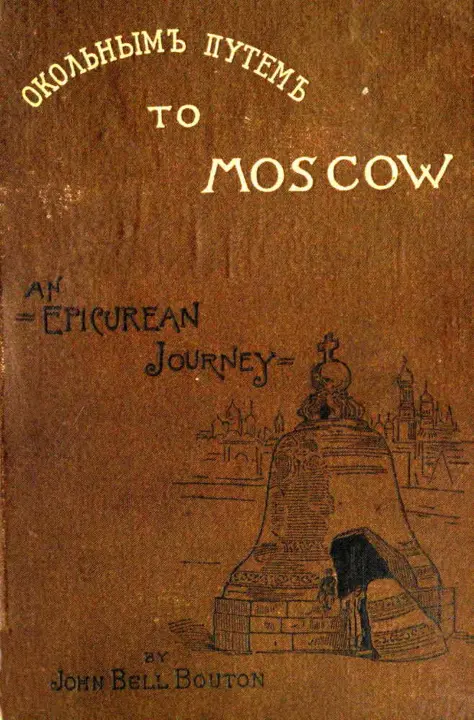
Roundabout to Moscow: An Epicurean Journey
John Bell Bouton
THE CLASSIC COLLECTION · 1864
"Round the Block: An American Novel" by John Bell Bouton is a fictional work likely written in the mid-19th century. The narrative begins by vividly depicting a neighborhood characterized by contrasting settings—posh, seemingly empty brownstone houses on one side and lively, bustling shops and homes for working-class families on the opposite. The story primarily revolves around three bachelors, Marcus Wilkeson, Fayette Overtop, and Matthew Maltboy, who embark on a series of social interactions within their block, exploring themes of neighborliness and community amidst their varied daily lives. The opening of the novel introduces readers to the ornate yet lifeless dwellings on the east side of the block and the contrasting vibrancy on the west side. As the three bachelors settle into their shared home, Overtop proposes an experiment in socializing, advocating for engaging with their neighbors to better understand their community. This leads to humorous exchanges and the deepening relationships between the protagonists as they navigate social calls, interactions with their eccentric neighbors, and the pursuit of companionship, all while their personal quirks and backgrounds unfold. The narrative sets a lively tone that promises both comedic moments and reflections on human interaction in a densely populated urban setting.
Introduction adapted from the source catalogue; source summaries may be automatically generated.
Free to read · English · 151,552 words · No account needed
MAKE TIME FOR A GOOD BOOK
On by default. Untick to stop anonymous reading totals. Each page counts after 10 seconds in view. How this works.
Anonymous counting is on unless you have switched it off.
At precisely forty-seven minutes past six, the first man made his appearance. He was a thick-set, pompous individual, with a gold-headed cane and gold spectacles, and climbed up the stairs with dignity and difficulty. He was followed by a pale little woman, four small children, and a stout, red-haired nurse, bearing in her arms a baby, which was laboring under an attack of the intermittent squalls. Marcus reconnoitred the party through his pigeon hole, and nervously jingled the seventy-five cents in his hand. Tiffles stepped forward to the head of the stairs, in order that he might not be wanting in personal respect to his first patron.
As this thick-set man ascended the stairs, the boys hushed their voices; but Tiffles distinctly heard several of them say, "It's the Square." Though apparently awestruck in his presence, the boys did not forget to play a few practical jokes on "the Square's" children, such as slapping them, and pinching their legs as they clambered wearily up. A peal of cries from his tortured offspring, particularly the baby, who received a pin in a sensitive part of its little person, so enraged "the Square," that he would have beaten all the boys with his gold-headed cane, had they not jumped away, laughing, and got safely out of the building, only to be back again the next minute.
"You should not allow these boys to hang around the stairs, sir," said the pompous man, planting his foot on the topmost step, and bringing down his cane on the floor with the ring of a watchman's club. "It's trouble enough to come to your panorama, without being annoyed by all the young vagabonds in the village."
"I'm sorry, sir," replied Tiffles, inwardly laughing, "but it would take six strong men to regulate the little rascals."
"Then you ought to employ six strong men, sir. It's your business to see that your patrons are not insulted."
Tiffles could only smile deprecatingly.
"Every exhibition in this hall, for a year past," continued the man, "has been a humbug--an outrage on the common sense of mankind. Perhaps yours is an exception, though, to be candid, I have my doubts of it. Do I understand, sir, that you have travelled in Africa?"
Tiffles indulged in the unjustifiable deception of nodding his head.
"And you mean to say that the sketches for this panorama were taken on
the spot?"
"Yes, sir; on the spot--in a horn."
"In a horn! What's that?"
"A technical phrase, sir, which it is hardly worth while to explain at length. Briefly, however, I may say, that no more ingenious or satisfactory mode of taking sketches has been invented."
Your reading position is saved on this browser. Take it to another device with a library code. Reading pages adapt to text, rather than matching a printed edition.
John Bell Bouton
BEHIND THE BOOK
This eBook is for the use of anyone anywhere in the United States and most other parts of the world at no cost and with almost no restrictions whatsoever. You may copy it, give it away or re-use it under the terms of the Project Gutenberg License included with this eBook or online at www.gutenberg.org. If you are not located in the United States, you will have to check the laws of the country where you are located before using this eBook. Read the source licence.
The original source file, including credits and licence, is retained by this library. Request an original-format copy at no charge. Please include the book title and Project Gutenberg identifier #12243.
KEEP YOUR CURIOSITY GOING
Coulson Kernahan

Maurice Baring
Frances Wright
Cécile Tormay

Frederic Jesup Stimson

W. H. P. (William Henry Pope) Jarvis