THE CLASSIC COLLECTION✦Shadows and sunbeams: Being a second series of Fern leaves from Fanny’s portfolioCLASSIC FREE BOOKS
Shadows and sunbeams: Being a second series of Fern leaves from Fanny’s portfolio
Fanny Fern
THE CLASSIC COLLECTION · 1856
"Rose Clark" by Fanny Fern is a novel written in the mid-19th century. The story follows the life of Rose, a young orphan girl who faces hardship and mistreatment in a charity school run by a harsh matron named Mrs. Markham. As Rose navigates her struggles for basic dignity and love, the novel explores themes of childhood, abuse, and the complexities of adult relationships. The opening of the novel introduces Rose to the orphan asylum where she is brought after the death of her mother. Mrs. Markham, the matron, displays a cold and contemptuous attitude toward Rose, labeling her as just another beggar. The scene depicts Rose's distress and vulnerability as she is forcibly stripped of her clothing and her identity by Mrs. Markham, who seeks to break her spirit. Through Rose's interactions with both the matron and another caregiver, Timmins, we are treated to a glimpse of her deep longing for maternal affection and her past experiences of sorrow. This stark contrast lays the groundwork for the emotional journey that awaits Rose as she seeks to overcome her adversities.
Introduction adapted from the source catalogue; source summaries may be automatically generated.
Free to read · English · 91,366 words · No account needed
MAKE TIME FOR A GOOD BOOK
On by default. Untick to stop anonymous reading totals. Each page counts after 10 seconds in view. How this works.
Anonymous counting is on unless you have switched it off.
"I am so tired," groaned Mrs. Howe, at length; "if I am stupid, my dear creature, you really must pardon me, for I have been at Du Pont's all the morning. I bought a few trifles of her, this pelerine, only forty dollars, and this cheap bracelet for fifty. Du Pont never is easy till I give her my opinion of her new millinery."
"She prefers the opinion of one qualified, by experience, to be a
judge," said the vexed Flynn, alluding to Dolly's former chrysalis
state.
Mrs. Howe bit her lip, and pulling the mouchoir from her pocket, said, "I forgot to show you this seventy-five dollar handkerchief. I did not need any common handkerchiefs, but I bought this to please Du Pont."
"I fancied I had seen that, as well as your pelerine and bracelet at Mrs. Gardiner's party last winter," said the fibbing, irritating Flynn.
"Last winter!"--screamed Mrs. Howe--"my dear creature, I wouldn't wear the same garter two winters."
"O, I must have been thinking of somebody else; pardon me, dear, my memory is so bad. What kind of servants have you, dear? I am so plagued with servants."
"I have no trouble," replied Mrs. Howe, folding her hands complacently over her pelerine, "for I always pay the highest prices." The rising flush on Flynn's face announced this to be a dead shot.
Taking breath again, however, she came gallantly to the rescue.
"Yes my dear creature, but they are all alike about gossiping; now our Margy, came to me with a long story about a baby which she declares she saw up in your attic, and a young girl, beautiful as an angel, tending it, and an old woman, and a young doctor, and goodness knows what. I told her it was all nonsense, sheer nonsense, for of course you would have spoken of it had there been a baby in your house; did you ever hear such stuff?" asked Flynn, with a triumphant air.
"Never," replied the exasperated Mrs. Howe, stooping to settle her bracelet to conceal her vexation; "I never heed what they say."
"Of course not," said Flynn, who having accomplished her mission, was now ready to depart, before the enemy rallied sufficiently to charge back. "Call and see me, my dear creature; intimate friends like us should not stand upon ceremony. O, I forgot to tell you Finels called on me yesterday. Bon jour;" and Flynn made good her retreat with flying colors.
Your reading position is saved on this browser. Take it to another device with a library code. Reading pages adapt to text, rather than matching a printed edition.
Fanny Fern
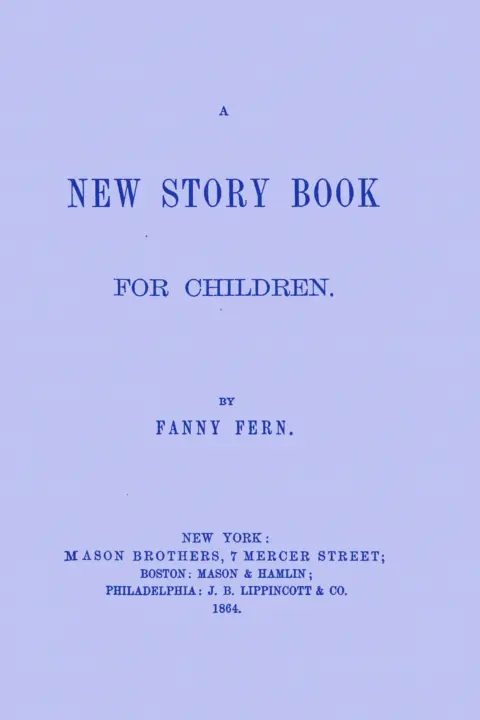
Fanny Fern

Fanny Fern
Fanny Fern
BEHIND THE BOOK
This eBook is for the use of anyone anywhere in the United States and most other parts of the world at no cost and with almost no restrictions whatsoever. You may copy it, give it away or re-use it under the terms of the Project Gutenberg License included with this eBook or online at www.gutenberg.org. If you are not located in the United States, you will have to check the laws of the country where you are located before using this eBook. Read the source licence.
The original source file, including credits and licence, is retained by this library. Request an original-format copy at no charge. Please include the book title and Project Gutenberg identifier #41542.
KEEP YOUR CURIOSITY GOING
Coulson Kernahan

Maurice Baring
Frances Wright
Cécile Tormay

Frederic Jesup Stimson

W. H. P. (William Henry Pope) Jarvis