THE CLASSIC COLLECTION✦Shadows and sunbeams: Being a second series of Fern leaves from Fanny’s portfolioCLASSIC FREE BOOKS
Shadows and sunbeams: Being a second series of Fern leaves from Fanny’s portfolio
Fanny Fern
THE CLASSIC COLLECTION · 1856
"Rose Clark" by Fanny Fern is a novel written in the mid-19th century. The story follows the life of Rose, a young orphan girl who faces hardship and mistreatment in a charity school run by a harsh matron named Mrs. Markham. As Rose navigates her struggles for basic dignity and love, the novel explores themes of childhood, abuse, and the complexities of adult relationships. The opening of the novel introduces Rose to the orphan asylum where she is brought after the death of her mother. Mrs. Markham, the matron, displays a cold and contemptuous attitude toward Rose, labeling her as just another beggar. The scene depicts Rose's distress and vulnerability as she is forcibly stripped of her clothing and her identity by Mrs. Markham, who seeks to break her spirit. Through Rose's interactions with both the matron and another caregiver, Timmins, we are treated to a glimpse of her deep longing for maternal affection and her past experiences of sorrow. This stark contrast lays the groundwork for the emotional journey that awaits Rose as she seeks to overcome her adversities.
Introduction adapted from the source catalogue; source summaries may be automatically generated.
Free to read · English · 91,366 words · No account needed
MAKE TIME FOR A GOOD BOOK
On by default. Untick to stop anonymous reading totals. Each page counts after 10 seconds in view. How this works.
Anonymous counting is on unless you have switched it off.
It was the day for the committee to make their stated visit of examination at the Asylum. Timmins had swept the school-room floor very carefully, scoured off the black-board, dusted the benches, and placed a bunch of flowers on Mrs. Markham's desk, just as that lady entered on her tour of inspection.
"How on earth came that green trash on my desk?" asked the offended
matron.
"I did it, ma'am, to make it look kind o' cheerful like;" said Timmins, a little abashed at exhibiting such a weakness in such an august presence. "It looks so dry and hard here, and children, poor things, is fond of flowers," and Timmins sighed as she thought of poor Tibbie.
"Are you in your dotage, Timmins, to bring such a frivolous thing as a bouquet into a school-room? who ever heard of such a folly?" and Mrs. Markham sent it spinning through the nearest window.
Timmins sighed again, and rubbed off one of the benches with a corner of her apron; then, looking up as if a bright thought had struck her, she said:
"They say, ma'am, that this world is nothing but a school for us, and yet God has strewn flowers all over it. He must have done it for something."
"Pshaw!" exclaimed Mrs. Markham, in extreme disgust; "go, bring in the chairs for the committee, and then ring the bell for the children."
Clang--clang--clang went the bell, and in wound the mournful procession; all habited alike, all with the same listless air, flabby-looking limbs, and leaden complexions.
"Seems to me you look uncommonly stupid," remarked the matron, by way of encouragement to the children; "see if you can't throw a little animation into your faces."
The poor little victims stared open their eyes, and made an ineffectual attempt at a smile, more painful to witness than their former listlessness.
"Stand up straighter, can't you?"
The little crooked spines made a feeble and ineffectual attempt to remedy the irreparable injury Mrs. Markham had inflicted upon them.
"Now, let every toe touch that crack on the floor.
"Now, cross your arms behind, every one of you.
"There--don't you stir a hair till the committee come in; it is now eleven; they will be here at quarter before twelve; now mind what I tell you about throwing a little animation into your faces;" and Mrs. Markham having laid the ferule in sight, seated herself in an easy position in a very comfortable chair, put a checkerberry lozenge in her mouth, and prepared herself to punish the first child whose overstrained limbs relaxed from weariness.
Your reading position is saved on this browser. Take it to another device with a library code. Reading pages adapt to text, rather than matching a printed edition.
Fanny Fern
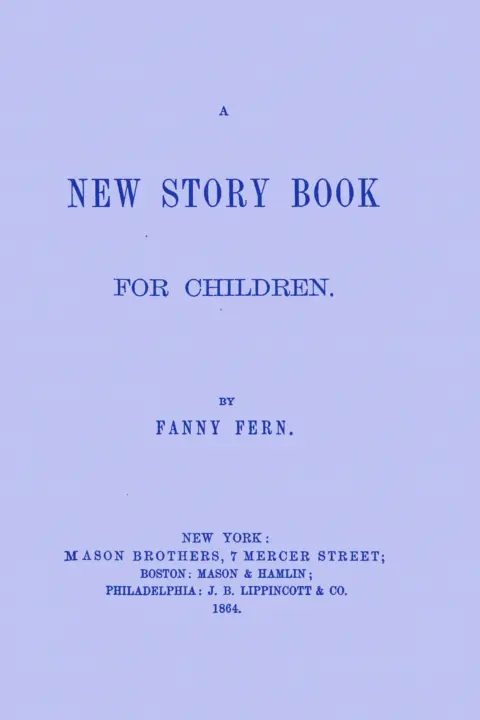
Fanny Fern

Fanny Fern
Fanny Fern
BEHIND THE BOOK
This eBook is for the use of anyone anywhere in the United States and most other parts of the world at no cost and with almost no restrictions whatsoever. You may copy it, give it away or re-use it under the terms of the Project Gutenberg License included with this eBook or online at www.gutenberg.org. If you are not located in the United States, you will have to check the laws of the country where you are located before using this eBook. Read the source licence.
The original source file, including credits and licence, is retained by this library. Request an original-format copy at no charge. Please include the book title and Project Gutenberg identifier #41542.
KEEP YOUR CURIOSITY GOING
Coulson Kernahan

Maurice Baring
Frances Wright
Cécile Tormay

Frederic Jesup Stimson

W. H. P. (William Henry Pope) Jarvis