THE CLASSIC COLLECTION✦Shadows and sunbeams: Being a second series of Fern leaves from Fanny’s portfolioCLASSIC FREE BOOKS
Shadows and sunbeams: Being a second series of Fern leaves from Fanny’s portfolio
Fanny Fern
THE CLASSIC COLLECTION · 1856
"Rose Clark" by Fanny Fern is a novel written in the mid-19th century. The story follows the life of Rose, a young orphan girl who faces hardship and mistreatment in a charity school run by a harsh matron named Mrs. Markham. As Rose navigates her struggles for basic dignity and love, the novel explores themes of childhood, abuse, and the complexities of adult relationships. The opening of the novel introduces Rose to the orphan asylum where she is brought after the death of her mother. Mrs. Markham, the matron, displays a cold and contemptuous attitude toward Rose, labeling her as just another beggar. The scene depicts Rose's distress and vulnerability as she is forcibly stripped of her clothing and her identity by Mrs. Markham, who seeks to break her spirit. Through Rose's interactions with both the matron and another caregiver, Timmins, we are treated to a glimpse of her deep longing for maternal affection and her past experiences of sorrow. This stark contrast lays the groundwork for the emotional journey that awaits Rose as she seeks to overcome her adversities.
Introduction adapted from the source catalogue; source summaries may be automatically generated.
Free to read · English · 91,366 words · No account needed
MAKE TIME FOR A GOOD BOOK
On by default. Untick to stop anonymous reading totals. Each page counts after 10 seconds in view. How this works.
Anonymous counting is on unless you have switched it off.
Arrived at John's lodgings, he ushered the stranger into Gertrude's studio, of which she had given him the key when they parted, as she intended riding out with Rose. Motioning him to a seat, and adding that he would rejoin him presently, John left him there alone.
The stranger looked around; there were landscape, game, fruit, cattle, and flower pieces, and all so exquisitely painted that any other moment each would have been a study to him--now heart and brain were both pre-occupied. What was in store for him? He felt this to be a turning-point in his life.
A slight jar, and a picture, which stands with the back toward him, falls over. The stranger rises, and stoops to replace it!
Ah!--why that suppressed cry of joy? Why those passionate kisses on the insensible canvas? Why those fast-falling tears, and heart-beaming smiles?
"It is not your mamma--it is my mamma," said Charley, stepping up between the picture and the stranger.
"His own eyes! his own brow! and Rose's sweet mouth! his own, and
Rose's child!
"My God, I thank thee!" he murmured; but the thin arms that were outstretched to clasp his new found treasure, fell powerless at his side. To sorrow he had become inured; he could not bear the out-gushing fountain of joy.
John, who had been an unseen spectator, had not looked for this tragic termination of his test. On his kind heart his rival's head was pillowed, his hand bathed his cold temples, his voice assisted returning consciousness.
"Who is he?" whispered Charley, tiptoeing up to John.
"Ask him," whispered John, as the stranger slowly opened his eyes.
Charley advanced, then retreated a step--then, won by the beaming smile which irradiated the stranger's face, he asked,
"Did you come here to see my Aunt Gertrude's pictures?"
"No," replied the stranger, with the same bright smile.
"Did you come to see John?"
"No, my dear."
"Did you come to see me?"
"Yes."
"What did you come to see me, for?"
Drawing him closer to his heart, and kissing his brow, the stranger said, "See if you can not guess."
Charley looked at Cousin John, but the conflicting expressions which flitted over his face gave him no clew. He looked at the stranger--his dark eyes were brimming with tears, but the same smile still played upon his lips. Charley stood for a moment irresolute, then, with another timid look into his face, he said, "I don't know--certainly--who you are, but--"
"But what, my dear?"
"Perhaps--you are my own papa come home."
Your reading position is saved on this browser. Take it to another device with a library code. Reading pages adapt to text, rather than matching a printed edition.
Fanny Fern
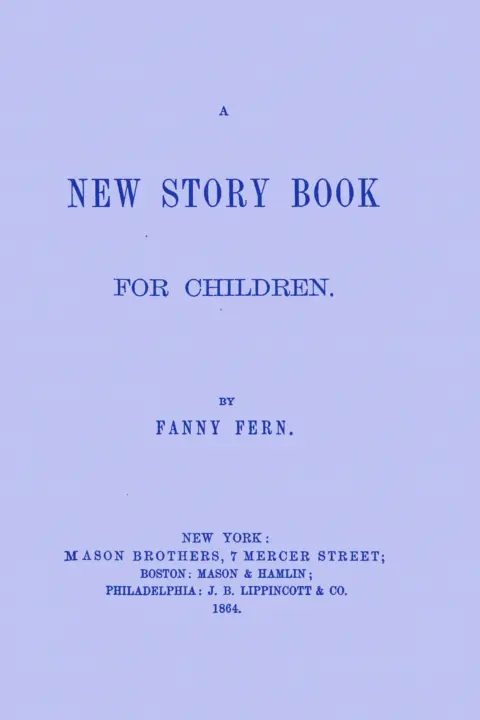
Fanny Fern

Fanny Fern
Fanny Fern
BEHIND THE BOOK
This eBook is for the use of anyone anywhere in the United States and most other parts of the world at no cost and with almost no restrictions whatsoever. You may copy it, give it away or re-use it under the terms of the Project Gutenberg License included with this eBook or online at www.gutenberg.org. If you are not located in the United States, you will have to check the laws of the country where you are located before using this eBook. Read the source licence.
The original source file, including credits and licence, is retained by this library. Request an original-format copy at no charge. Please include the book title and Project Gutenberg identifier #41542.
KEEP YOUR CURIOSITY GOING
Coulson Kernahan

Maurice Baring
Frances Wright
Cécile Tormay

Frederic Jesup Stimson

W. H. P. (William Henry Pope) Jarvis