THE CLASSIC COLLECTION✦Shadows and sunbeams: Being a second series of Fern leaves from Fanny’s portfolioCLASSIC FREE BOOKS
Shadows and sunbeams: Being a second series of Fern leaves from Fanny’s portfolio
Fanny Fern
THE CLASSIC COLLECTION · 1856
"Rose Clark" by Fanny Fern is a novel written in the mid-19th century. The story follows the life of Rose, a young orphan girl who faces hardship and mistreatment in a charity school run by a harsh matron named Mrs. Markham. As Rose navigates her struggles for basic dignity and love, the novel explores themes of childhood, abuse, and the complexities of adult relationships. The opening of the novel introduces Rose to the orphan asylum where she is brought after the death of her mother. Mrs. Markham, the matron, displays a cold and contemptuous attitude toward Rose, labeling her as just another beggar. The scene depicts Rose's distress and vulnerability as she is forcibly stripped of her clothing and her identity by Mrs. Markham, who seeks to break her spirit. Through Rose's interactions with both the matron and another caregiver, Timmins, we are treated to a glimpse of her deep longing for maternal affection and her past experiences of sorrow. This stark contrast lays the groundwork for the emotional journey that awaits Rose as she seeks to overcome her adversities.
Introduction adapted from the source catalogue; source summaries may be automatically generated.
Free to read · English · 91,366 words · No account needed
MAKE TIME FOR A GOOD BOOK
On by default. Untick to stop anonymous reading totals. Each page counts after 10 seconds in view. How this works.
Anonymous counting is on unless you have switched it off.
Mrs. Clifton was going down street, as Miss Tufts had said; going to "the baby's" grave, for she could bear the deserted nursery and empty cradle no longer. It was something to be near the little form, though the spirit which shone through the sweet eyes had winged its way to Him who gave it; and so she passes the little wicket-gate, and winds her way among other graves, over which other mothers, like her, have wept. Some of them, carefully kept, others overrun with briars and nettles; seas perhaps, rolling between some babe and her under whose heart it once stirred with embryo life; or, far away, perhaps, the mother too, may be sleeping, waiting, as does her solitary babe, for that day when the dead who are in their graves, shall hear His voice, and come forth!
Mrs. Clifton nears her baby's grave. A little form is bending over it, a slender, delicate child, whose clustering curls, as she stoops, quite hide her sweet face. Somebody else loves "the baby," for the little grave is dotted over with flowers, simple enough, indeed, but love's own offering. The mother draws nearer, smiling through her tears the while--the child looks up; it is Rose.
"Bless you! bless you, my darling," Mrs. Clifton murmurs, and draws her
to her bosom.
"Why did you strew flowers on my baby, dear?" asked Mrs. Clifton, wiping
her eyes.
"Because I was so sorry for you," said Rose, timidly, "I thought perhaps it would make you happy, when you came here, to see them."
"Did any one ever die whom you loved?" asked Mary.
Rose's lip quivered, the tears gathered slowly in her eyes, and hung trembling on her lashes, as she nodded her little head.
"Who, my darling?" asked Mary, drawing the child nearer to her.
"My mother, my own dear mother!" said the weeping child, drawn to her kind questioner by the mutual sympathy of sorrow.
"Rose--Rose--Rose!" screamed the shrill voice of Dolly from over the
wall.
"Oh, I must go! indeed I must; please don't tell, please don't say any thing," and Rose, hastily wiping away her tears, ran breathlessly toward the little wicket-gate.
"Now I'd just like to know, miss, where you have been without leave?"
asked Dolly.
"Daffy told me you wanted me to go out of sight till after the company was gone," said Rose, "and I thought I would just step over into the church-yard, and put some daisies on the baby's grave."
"Ridikilis!" exclaimed Dolly; "just as if that baby knew what was top of it; it is perfectly disgusting--you are just like your mother exactly. Now go along into the house."
Your reading position is saved on this browser. Take it to another device with a library code. Reading pages adapt to text, rather than matching a printed edition.
Fanny Fern
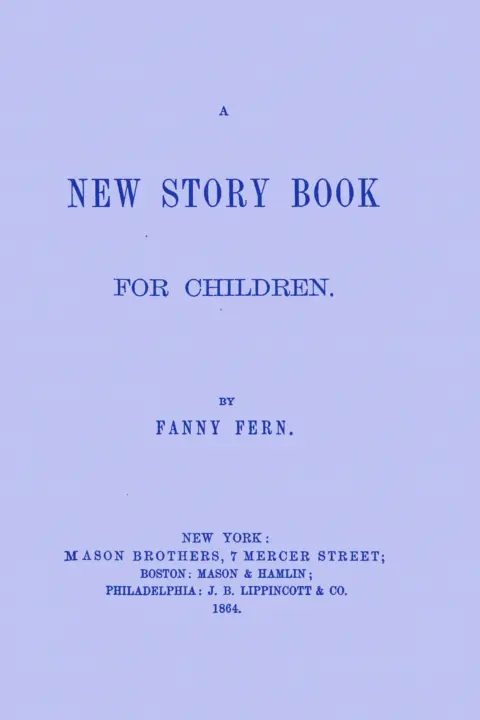
Fanny Fern

Fanny Fern
Fanny Fern
BEHIND THE BOOK
This eBook is for the use of anyone anywhere in the United States and most other parts of the world at no cost and with almost no restrictions whatsoever. You may copy it, give it away or re-use it under the terms of the Project Gutenberg License included with this eBook or online at www.gutenberg.org. If you are not located in the United States, you will have to check the laws of the country where you are located before using this eBook. Read the source licence.
The original source file, including credits and licence, is retained by this library. Request an original-format copy at no charge. Please include the book title and Project Gutenberg identifier #41542.
KEEP YOUR CURIOSITY GOING
Coulson Kernahan

Maurice Baring
Frances Wright
Cécile Tormay

Frederic Jesup Stimson

W. H. P. (William Henry Pope) Jarvis