THE CLASSIC COLLECTION✦Shadows and sunbeams: Being a second series of Fern leaves from Fanny’s portfolioCLASSIC FREE BOOKS
Shadows and sunbeams: Being a second series of Fern leaves from Fanny’s portfolio
Fanny Fern
THE CLASSIC COLLECTION · 1856
"Rose Clark" by Fanny Fern is a novel written in the mid-19th century. The story follows the life of Rose, a young orphan girl who faces hardship and mistreatment in a charity school run by a harsh matron named Mrs. Markham. As Rose navigates her struggles for basic dignity and love, the novel explores themes of childhood, abuse, and the complexities of adult relationships. The opening of the novel introduces Rose to the orphan asylum where she is brought after the death of her mother. Mrs. Markham, the matron, displays a cold and contemptuous attitude toward Rose, labeling her as just another beggar. The scene depicts Rose's distress and vulnerability as she is forcibly stripped of her clothing and her identity by Mrs. Markham, who seeks to break her spirit. Through Rose's interactions with both the matron and another caregiver, Timmins, we are treated to a glimpse of her deep longing for maternal affection and her past experiences of sorrow. This stark contrast lays the groundwork for the emotional journey that awaits Rose as she seeks to overcome her adversities.
Introduction adapted from the source catalogue; source summaries may be automatically generated.
Free to read · English · 91,366 words · No account needed
MAKE TIME FOR A GOOD BOOK
On by default. Untick to stop anonymous reading totals. Each page counts after 10 seconds in view. How this works.
Anonymous counting is on unless you have switched it off.
In a private parlor of one of our great Southern cities sat two young men, in dressing-gowns, smoking-caps, and slippers. On a table between them stood a silver cigar-stand, a bottle of wine covered with cobwebs, and two empty glasses. The room was exquisitely furnished, with the exception of some questionable drawings upon the walls, and the young men themselves were what boarding-school misses would have called "perfect loves." Their hands were very white, their whiskers in a high state of cultivation, their cravats were quite miraculous, and their diamond rings of the purest water.
"Is this your last trophy?" asked Grey, poising a slipper of Cinderella dimensions on the palm of his hand.
"That? not by a score," carelessly answered Vincent, changing his diamond ring to the other hand; "that belongs to the pretty boarding-school girl. I really had quite forgotten her. I wonder what ever became of her? She was a perfect little Hebe, effervescent as Champagne, quite worth a three months' siege."
"And believed herself married to you, I suppose?" asked Grey.
"Of course," said Vincent, laughing; "she was the most trusting little thing you ever saw, primevally innocent in fact; it was quite refreshing. How's the wine, Grey?"
"Capital," answered his friend, refilling his glass and holding it up to the light with the gusto of a connoisseur. "Capital; but, Vincent, you are a wicked dog."
"Think so?" drawled Vincent quite proudly, surveying his handsome face
in an opposite mirror.
"Yes," said Grey, "I am bad enough; but shoot me if I could be the first to lead a woman astray."
"You sneaking poltroon," laughed Vincent; "if you did not, somebody else
would."
"That does not follow," answered Grey; "don't you believe that there are
virtuous women?"
"Ha! ha! you ought to have your picture taken now," laughed Vincent. "Propound that question, most innocent Joseph, at our next club-meeting, will you? The explosion of a basket of Champagne corks would be nothing to the fizz it would make. A virtuous woman! no woman, my dear boy, was ever virtuous but for lack of temptation and opportunity."
"I will never subscribe to that," said Grey, with a flushed cheek; "no--not as I honor my mother and my sister."
Vincent's only answer was a slight elevation of the eyebrow, as he pushed the bottle again toward Grey.
"No, thank you; no more for me," answered Grey, in disgust, as he left
the room.
Your reading position is saved on this browser. Take it to another device with a library code. Reading pages adapt to text, rather than matching a printed edition.
Fanny Fern
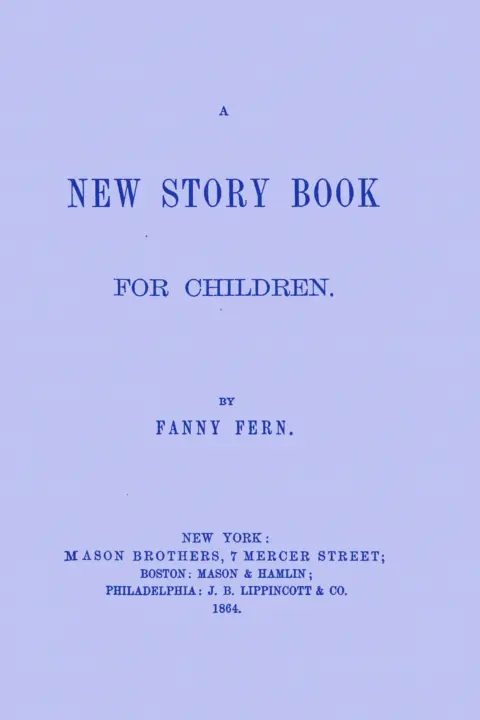
Fanny Fern

Fanny Fern
Fanny Fern
BEHIND THE BOOK
This eBook is for the use of anyone anywhere in the United States and most other parts of the world at no cost and with almost no restrictions whatsoever. You may copy it, give it away or re-use it under the terms of the Project Gutenberg License included with this eBook or online at www.gutenberg.org. If you are not located in the United States, you will have to check the laws of the country where you are located before using this eBook. Read the source licence.
The original source file, including credits and licence, is retained by this library. Request an original-format copy at no charge. Please include the book title and Project Gutenberg identifier #41542.
KEEP YOUR CURIOSITY GOING
Coulson Kernahan

Maurice Baring
Frances Wright
Cécile Tormay

Frederic Jesup Stimson

W. H. P. (William Henry Pope) Jarvis