THE CLASSIC COLLECTION✦Shadows and sunbeams: Being a second series of Fern leaves from Fanny’s portfolioCLASSIC FREE BOOKS
Shadows and sunbeams: Being a second series of Fern leaves from Fanny’s portfolio
Fanny Fern
THE CLASSIC COLLECTION · 1856
"Rose Clark" by Fanny Fern is a novel written in the mid-19th century. The story follows the life of Rose, a young orphan girl who faces hardship and mistreatment in a charity school run by a harsh matron named Mrs. Markham. As Rose navigates her struggles for basic dignity and love, the novel explores themes of childhood, abuse, and the complexities of adult relationships. The opening of the novel introduces Rose to the orphan asylum where she is brought after the death of her mother. Mrs. Markham, the matron, displays a cold and contemptuous attitude toward Rose, labeling her as just another beggar. The scene depicts Rose's distress and vulnerability as she is forcibly stripped of her clothing and her identity by Mrs. Markham, who seeks to break her spirit. Through Rose's interactions with both the matron and another caregiver, Timmins, we are treated to a glimpse of her deep longing for maternal affection and her past experiences of sorrow. This stark contrast lays the groundwork for the emotional journey that awaits Rose as she seeks to overcome her adversities.
Introduction adapted from the source catalogue; source summaries may be automatically generated.
Free to read · English · 91,366 words · No account needed
MAKE TIME FOR A GOOD BOOK
On by default. Untick to stop anonymous reading totals. Each page counts after 10 seconds in view. How this works.
Anonymous counting is on unless you have switched it off.
Herds of cattle; sheep, cows, calves, oxen, and pigs, divided off into little crowded pens, stood bleating and lowing in the blazing sun, half dead with thirst, while their owners were chaffering about prices.
On the opposite side of the street were temporary booths, whose owners were making the most of the day by opening oysters, and uncorking bottles for the ravenous farmers; little boys stood by, greedily devouring the dregs of the glasses whenever they could dodge a boxed ear. A few sickly trees were planted here and there, at the sides of the road, which seemed to have dwindled away in disgust at their location. On a small patch of green, dignified by the name of the Park, an ill-assorted, heterogeneous company were drilling for 'lection, presenting arms, etc., in a manner that would have struck Napoleon dumb.
Dolly's house was on the further side of "the Park," a two story wooden tenement, of a bright red color, planted on a sand bank close to the road side, unornamented with a single green thing, if we may except some gawky boys who were eyeing the tin soldiers and peppermint candy in the milliner's window, and who had been attentively listening to the swearing cattle-dealers and picking up stray lobster-claws which good fortune had thrown in their way.
"That her?" whispered Daffodil (Dolly's factotum), pointing to Rose, as she assisted Dolly to alight. Dolly nodded.
"Why--she'd be a real beauty if she was only a little fatter, and didn't stoop, and her eyes weren't so big, and she wasn't so pale."
"I don't see any beauty," mumbled Dolly, "she looks exactly like her
mother."
"O no--of course she isn't a beauty," said Daffy, retracting her involuntary mistake, "she don't favor you in the least Dolly; I said she would be pretty if--"
"Never mind your ifs now, I'm as hungry as a catamount, give me something to eat, and then I'll talk; some of that cold ham, and warm over some tea; goodness, how faint I am, that young one has tired me all out argufying--she's just like her mother--exactly."
"Shall I set a plate for her too?" asked Daffy.
"Of course not, till I get through; children always cram all before them, there wouldn't be a mortal thing left for me--let her wait till I have done. Rose--here! take off your bonnet, sit down and unpack those boxes, don't break the strings now, untie the knots carefully, the strings may do to use again, and don't litter up the shop floor, and don't----Lord-a-mercy, Daffy, if she ain't undone the wrong boxes, I knew she would."
Your reading position is saved on this browser. Take it to another device with a library code. Reading pages adapt to text, rather than matching a printed edition.
Fanny Fern
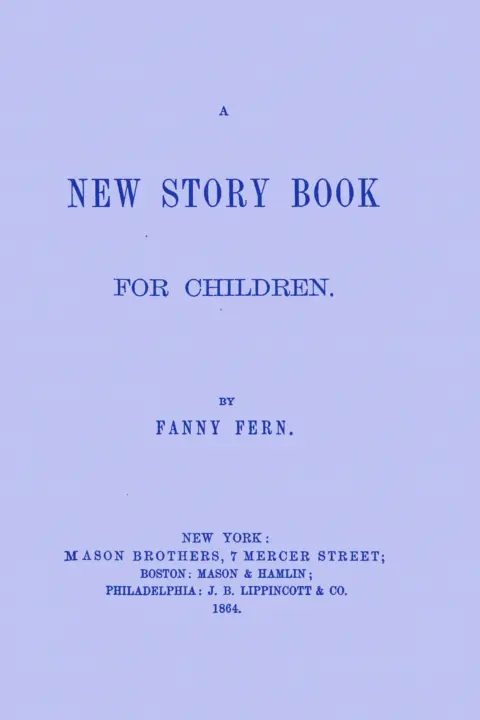
Fanny Fern

Fanny Fern
Fanny Fern
BEHIND THE BOOK
This eBook is for the use of anyone anywhere in the United States and most other parts of the world at no cost and with almost no restrictions whatsoever. You may copy it, give it away or re-use it under the terms of the Project Gutenberg License included with this eBook or online at www.gutenberg.org. If you are not located in the United States, you will have to check the laws of the country where you are located before using this eBook. Read the source licence.
The original source file, including credits and licence, is retained by this library. Request an original-format copy at no charge. Please include the book title and Project Gutenberg identifier #41542.
KEEP YOUR CURIOSITY GOING
Coulson Kernahan

Maurice Baring
Frances Wright
Cécile Tormay

Frederic Jesup Stimson

W. H. P. (William Henry Pope) Jarvis