THE CLASSIC COLLECTION✦An outlaw’s diary: the CommuneCLASSIC FREE BOOKS
An outlaw’s diary: the Commune
Cécile Tormay
THE CLASSIC COLLECTION · 1872
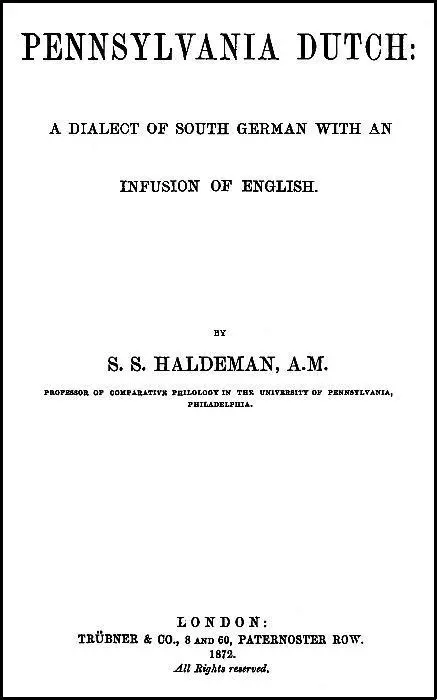
"Pennsylvania Dutch: A Dialect of South German With an Infusion of English" by S. S. Haldeman is a scientific publication written in the late 19th century. The book explores the unique linguistic characteristics of Pennsylvania Dutch, a dialect formed by German-speaking immigrants to Pennsylvania, highlighting its blend of South German roots and English influences. The text delves into various aspects of the dialect, including its phonology, vocabulary, and syntax, making it a valuable resource for those interested in comparative philology and language evolution. The opening of the work introduces the rationale behind studying this dialect, emphasizing its formation over a century within a linguistically diverse community. It describes the historical context of German immigration to Pennsylvania and how various dialects from regions like Rhenish Bavaria and Alsace contributed to the development of Pennsylvania Dutch. The author outlines the influences of limited interactions among the largely agricultural immigrant populations, which led to distinct linguistic changes, thus setting the stage for a detailed examination of phonology, vocabulary, and syntax in subsequent chapters.
Introduction adapted from the source catalogue; source summaries may be automatically generated.
Free to read · English · 27,823 words · No account needed
MAKE TIME FOR A GOOD BOOK
On by default. Untick to stop anonymous reading totals. Each page counts after 10 seconds in view. How this works.
Anonymous counting is on unless you have switched it off.
Compare--O, how this mother swells up toward my heart! Hysterica passio, thou climbing sorrow, Thy element's below.--King Lear, act 2, sc. 4, speech 20, v. 54. --A. J. Ellis.
[74] The German word appears to be gautschen without the n. So Schmeller (Bayerisches Wörterbuch, 2, 87) "gautschen, getschen, schwanken, schaukeln." Adelung (Wörterbuch der hochdeutschen Mundart, 2, 439) explains it as a technical paper-maker's word for taking the sheets out of the mould and laying them upon the press-board, Gautschbret. He adds that a carrying chair was formerly called a Gautsche, and refers it to Kutsche and French coucher.--A. J. E.
[75] Compare Papageno's song in Mozart's Zauberflöte:
Der Vogelfänger bin ich ja
Stets lustig, heisa, hopsasa.--A. J. Ellis.
[76] Known probably throughout England. Known to me, a Londoner, from earliest childhood.--A. J. Ellis.
[77] The geographical names at the close of Chapter I. p. 6, are Kentucky, Safe Harbor, Syracuse, and Pinegrove. The drags are aloes (pronounced as in Latin!), paregoric, citrine ointment, acetic acid, hiera piera, cinnamon, Guiana pepper, gentian, cinchona, opium, hive syrup, senna and manna mixed, sulphate of zink, corrosive sublimate, red precipitate, aniline, logwood, Epsom salts, magnesia, cordial, cubebs, bichromate of potash, valerian (G. Baldrian), laurel berries, cochineal.
[78] Rhymes plaguey, even in English localities.
[79] As if from the plant elder, instead of Swiss halde, a steep or declivity--the name being Swiss.
[80] And Shellabarger, American Minister to Portugal, 1869.
[81] The 'b' and 'v' of the two forms have changed place.
[82] These names, with Rauch, Bucher, the Scotch Cochran, etc., are still pronounced correctly in English speaking localities in Pennsylvania; and at Harrisburg, 'Salade' rhymes holid'y.
[83] The organists Thunder and Rohr gave a concert in Philadelphia some years ago. In New York I have seen the names 'Stone and Flint,' and 'Lay and Hatch,' where the proper name takes precedence.
[84] In the following inscription on a building, 'bei' instead of 'von' shows an English influence. The author knew English well: was a member of the state legislature, had a good collection of English--but not of German books--and yet preferred a German inscription--
Inscriptions are commonly in the roman character, from the difficulty of
cutting the others.
[85] As in 'Chladori' for Chladni, in the American edition of the Westminster Review for July, 1865. The name Slyvons stands on the title-page as the author of a book on Chess (Bruxelles, 1856), which M. Cretaine in a similar work (Paris, 1865) gives as Solvyns. Upon calling Mr. C.'s attention to this point, he produced a letter from the former, signed Solvyns.
Your reading position is saved on this browser. Take it to another device with a library code. Reading pages adapt to text, rather than matching a printed edition.
BEHIND THE BOOK
This eBook is for the use of anyone anywhere in the United States and most other parts of the world at no cost and with almost no restrictions whatsoever. You may copy it, give it away or re-use it under the terms of the Project Gutenberg License included with this eBook or online at www.gutenberg.org. If you are not located in the United States, you will have to check the laws of the country where you are located before using this eBook. Read the source licence.
The original source file, including credits and licence, is retained by this library. Request an original-format copy at no charge. Please include the book title and Project Gutenberg identifier #48417.
KEEP YOUR CURIOSITY GOING
Cécile Tormay

Moritz Busch
John L. Ransom
Frances Wright
Cécile Tormay

Mabel Potter Daggett