THE CLASSIC COLLECTION✦An outlaw’s diary: the CommuneCLASSIC FREE BOOKS
An outlaw’s diary: the Commune
Cécile Tormay
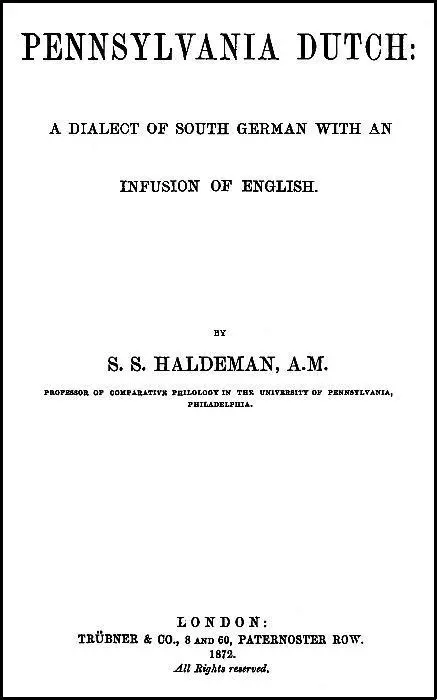
THE CLASSIC COLLECTION · 1872
"Pennsylvania Dutch: A Dialect of South German With an Infusion of English" by S. S. Haldeman is a scientific publication written in the late 19th century. The book explores the unique linguistic characteristics of Pennsylvania Dutch, a dialect formed by German-speaking immigrants to Pennsylvania, highlighting its blend of South German roots and English influences. The text delves into various aspects of the dialect, including its phonology, vocabulary, and syntax, making it a valuable resource for those interested in comparative philology and language evolution. The opening of the work introduces the rationale behind studying this dialect, emphasizing its formation over a century within a linguistically diverse community. It describes the historical context of German immigration to Pennsylvania and how various dialects from regions like Rhenish Bavaria and Alsace contributed to the development of Pennsylvania Dutch. The author outlines the influences of limited interactions among the largely agricultural immigrant populations, which led to distinct linguistic changes, thus setting the stage for a detailed examination of phonology, vocabulary, and syntax in subsequent chapters.
Introduction adapted from the source catalogue; source summaries may be automatically generated.
Free to read · English · 27,823 words · No account needed
MAKE TIME FOR A GOOD BOOK
On by default. Untick to stop anonymous reading totals. Each page counts after 10 seconds in view. How this works.
Anonymous counting is on unless you have switched it off.
It is remarkable that speakers of German often use English forms of baptismal names, as Mary for Marîa, Henry for Heinrich, and John (tschan, shorter than the medial English sound) for Johannes.[84]
Of curious family names without regard to language, the following may be recorded--premising that proper names are especially subject to be made spurious by the accidents of typography.[85]
Ahl, Awl, Ammon, Annĕ, Barndollar, Baud, Bezoar, Bigging, Blades, Bohrer, Boring, Book, Bracken, Bricker (bridger), Buckwalter, Burkholder and Burchhalter (burg-holder), Byler, Candle, Candour, Care, Case, Channell, Chronister, Condit, Cooher, Cumberbus (Smith's Voyage to Guinea, 1744), Curgus or Circus, Dehoof, Dialogue, Ditto, Dosh, Eave, Eldridge (in part for Hildreth), Erb, Eyde, Eyesore (at Lancaster, Pa.), Fassnacht (G. fastnacht shrovetide), Feather, Ferry (for the Walloon name Ferree[86]); Friday, Fornaux, Furnace, Gans (goose, Gansert, Gensemer, Grossgensly), Gift (poison), Ginder, Gruel, Gutmann (good-man) Hag (hedge), Harmany, Hecter, Hepting, Herd, Heard, Hergelrat (rath counsel), Hinderer, Hock, Holzhauer and Holzhower (woodchopper), Honnafusz (G. hahn a cock), Kash, Kitch, Koffer, Landtart, Lawer, Leis, Letz, Licht, Line, Lipp, Löb (lion), Löwr (at St. Louis), Mackrel, Manusmith, Matt, Marrs, Mehl, Mortersteel, Mowrer (G. maur a wall), Napp, Neeper (Niebuhr?), Nohaker, Nophsker, Ochs, Over, Oxworth, Peelman, Penas (in Ohio), Pfund, Popp, Poutch, Quirk, Rathvon (Rodfong, Rautfaung), Road, Rottenstein (in Texas), Rutt, Sangmeister, Scheuerbrand, Schlegelmilch, Schlong (snake), Schöttel, Segar, Seldomridge, Senn, Service (in Indiana), Shaver, Shilling, Shinover, Shock, Shot, Showers, Skats (in Connecticut), Smout, Spoon, Springer, Steer (in Texas), Stern, Stetler, Stormfeltz, Strayer, Stretch, Stridle, Sumption, Surgeon, Swoop (a Suabian), Test, Tise, Tice (Theiss?), Tittles, Towstenberier, Tyzat (at St. Louis), Umble, Venus, Venerich,-rik, Vestal (in Texas), Vinegar('s Ferry, on the Susquehanna), Vogelsang, Wallower, Waltz, Wolfspanier, Wonder, Woolrick (for Wulfrich?), Work, Worst, Yaffe, Yecker, Yeisley, Yordea, Zeh, Zugschwerdt.
Among the following curious, incompatible, or hĭbrid[87] names, titles (except that of 'General') have been mistaken for proper names--Horatio Himmereich, Owen Reich, Caspar Reed, Dennis Loucks, Baltzer Stone, Addison Shelp, Paris Rudisill, Adam Schuh, Erasmus Buckenmeyer, Peter Pence, General Wellington H. Ent, General Don Carlos Buel, Don Alonzo Cushman, Sir Frank Howard, Always Wise (probably for Alŏîs Weiss). In November, 1867, Gilbert Monsieur Marquis de Lafayette Sproul, asked the legislature of Tennessee to cut off all his names but the last two.
[70] Shrove-tide cakes--with the PG. pronunciation, except st.
[71] G. Knochen (bones).
[72] A teacher asked a class--If I were to cut an apple in two, what would you call one of the pieces? "A half." And in four? "A fourth." And if I cut it in eight equal pieces, what would one of them be? "A snit!"
Your reading position is saved on this browser. Take it to another device with a library code. Reading pages adapt to text, rather than matching a printed edition.
BEHIND THE BOOK
This eBook is for the use of anyone anywhere in the United States and most other parts of the world at no cost and with almost no restrictions whatsoever. You may copy it, give it away or re-use it under the terms of the Project Gutenberg License included with this eBook or online at www.gutenberg.org. If you are not located in the United States, you will have to check the laws of the country where you are located before using this eBook. Read the source licence.
The original source file, including credits and licence, is retained by this library. Request an original-format copy at no charge. Please include the book title and Project Gutenberg identifier #48417.
KEEP YOUR CURIOSITY GOING
Cécile Tormay

Moritz Busch
John L. Ransom
Frances Wright
Cécile Tormay

Mabel Potter Daggett