THE CLASSIC COLLECTION✦An outlaw’s diary: the CommuneCLASSIC FREE BOOKS
An outlaw’s diary: the Commune
Cécile Tormay
THE CLASSIC COLLECTION · 1872
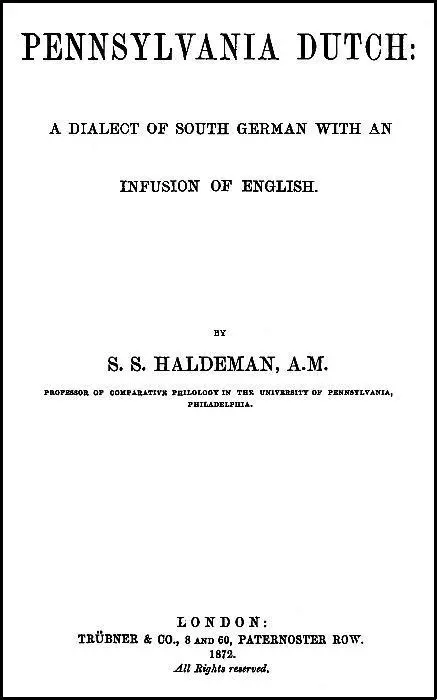
"Pennsylvania Dutch: A Dialect of South German With an Infusion of English" by S. S. Haldeman is a scientific publication written in the late 19th century. The book explores the unique linguistic characteristics of Pennsylvania Dutch, a dialect formed by German-speaking immigrants to Pennsylvania, highlighting its blend of South German roots and English influences. The text delves into various aspects of the dialect, including its phonology, vocabulary, and syntax, making it a valuable resource for those interested in comparative philology and language evolution. The opening of the work introduces the rationale behind studying this dialect, emphasizing its formation over a century within a linguistically diverse community. It describes the historical context of German immigration to Pennsylvania and how various dialects from regions like Rhenish Bavaria and Alsace contributed to the development of Pennsylvania Dutch. The author outlines the influences of limited interactions among the largely agricultural immigrant populations, which led to distinct linguistic changes, thus setting the stage for a detailed examination of phonology, vocabulary, and syntax in subsequent chapters.
Introduction adapted from the source catalogue; source summaries may be automatically generated.
Free to read · English · 27,823 words · No account needed
MAKE TIME FOR A GOOD BOOK
On by default. Untick to stop anonymous reading totals. Each page counts after 10 seconds in view. How this works.
Anonymous counting is on unless you have switched it off.
=Christmas-tree=, a well-known word for a well-known and much used object, but absent from the American dictionaries.
=Bellsnickle=, PG. beltsnikkl (G. Pelz a pelt, skin with hair, as a bear-skin, here used as a disguise, and perhaps associated with peltzen, to pelt,) and Nickel, Nix, in the sense of a demon. (Suab. Pelzmärte, as if based on Martin). A masked and hideously disguised person, who goes from house to house on christmas eve, beating (or pretending to beat) the children and servants, and throwing down nuts and cakes before leaving. A noisy party accompanies him, often with a bell, which has influenced the English name.
These, I suppose, were Christmas mummers, though I heard them
called "Bell-schnickel."--Atlantic Monthly, October, 1869, p.
484.
=Gounsh=, n. and v.i. As to seesaw implies reciprocal motion, so to gounsh is to move up and down, as upon the free end of an elastic board. PG. 'Kumm, mr wellǝ gaunschǝ.' (Come, let us gounsh.) Suab. gautschen; Eng. to jounce.[74]
=Hoopsisaw= (PG. húppsisaa, also provincial German). A rustic or low dance, and a lively tune adapted to it. Inferior lively music is sometimes called 'hoopsisaw music,' 'a hoopsisaw tune.'[75]
=Hoove=, v.i. a command to a horse to back, and used by extension as in "The men hooved (demurred) when required to do more work." Used in both senses in the Swiss hüfen, imperative hüf! and Schmeller (Bayr. Wörterb. 2, 160) gives it as Bavarian.
=Hussling-=, or =Hustling-match=, PG. hossl-mætsch (with English match), a raffle. From the root of hustle, the game being conducted by shaking coins in a hat and counting the resulting heads.
=Sock up=, "to make a man sock up," pay a debt, produce his sack or pouch. This is uncertain, because, were a PG. expression to occur like "Du muscht ufsakkǝ" (you must sock up), it might be borrowed from English.
=Boof=, peach brandy. In Westerwaldish, buff is water-cider,--cider made by wetting the pomace and pressing it a second time.
=Sots=, n. sing. G. satz, home-made 'yeast' as distinguished from
'brewer's-yeast.'
=Sandman=, "The sandman is coming,"--said when children get sleepy about bedtime and indicate it by rubbing the eyes. Used thus in Westerwald and Suabia.[76] Children are warned against touching dirt by the exclamation (bæætschi).
=Snoot=, for snout, a widespread teutonic form.
§ 2. Family Names Modified.
With several concurrent languages, the deterioration of names is an obvious process. Among the mixed population of Baltimore, the name 'Bradley' is to a Frenchman Bras-de-long; for 'Strawberry' (alley) and 'Havre-de-grâce' (in Maryland) the Germans say Strubbel, and Hasel-im-gras; and the Irish make the following changes--
Your reading position is saved on this browser. Take it to another device with a library code. Reading pages adapt to text, rather than matching a printed edition.
BEHIND THE BOOK
This eBook is for the use of anyone anywhere in the United States and most other parts of the world at no cost and with almost no restrictions whatsoever. You may copy it, give it away or re-use it under the terms of the Project Gutenberg License included with this eBook or online at www.gutenberg.org. If you are not located in the United States, you will have to check the laws of the country where you are located before using this eBook. Read the source licence.
The original source file, including credits and licence, is retained by this library. Request an original-format copy at no charge. Please include the book title and Project Gutenberg identifier #48417.
KEEP YOUR CURIOSITY GOING
Cécile Tormay

Moritz Busch
John L. Ransom
Frances Wright
Cécile Tormay

Mabel Potter Daggett