THE CLASSIC COLLECTION✦An outlaw’s diary: the CommuneCLASSIC FREE BOOKS
An outlaw’s diary: the Commune
Cécile Tormay
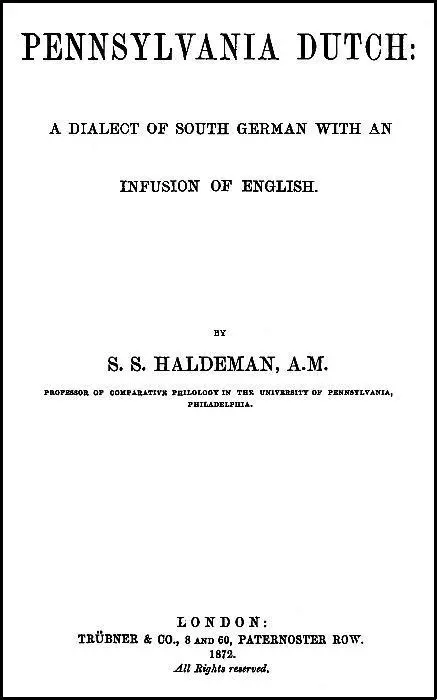
THE CLASSIC COLLECTION · 1872
"Pennsylvania Dutch: A Dialect of South German With an Infusion of English" by S. S. Haldeman is a scientific publication written in the late 19th century. The book explores the unique linguistic characteristics of Pennsylvania Dutch, a dialect formed by German-speaking immigrants to Pennsylvania, highlighting its blend of South German roots and English influences. The text delves into various aspects of the dialect, including its phonology, vocabulary, and syntax, making it a valuable resource for those interested in comparative philology and language evolution. The opening of the work introduces the rationale behind studying this dialect, emphasizing its formation over a century within a linguistically diverse community. It describes the historical context of German immigration to Pennsylvania and how various dialects from regions like Rhenish Bavaria and Alsace contributed to the development of Pennsylvania Dutch. The author outlines the influences of limited interactions among the largely agricultural immigrant populations, which led to distinct linguistic changes, thus setting the stage for a detailed examination of phonology, vocabulary, and syntax in subsequent chapters.
Introduction adapted from the source catalogue; source summaries may be automatically generated.
Free to read · English · 27,823 words · No account needed
MAKE TIME FOR A GOOD BOOK
On by default. Untick to stop anonymous reading totals. Each page counts after 10 seconds in view. How this works.
Anonymous counting is on unless you have switched it off.
"Do isch au kei Plätzle meh, Here is also no spot more, Wu i könnt mi Haupt[58] hinlege, where I might my head repose, Wenn i vun der Arbet geh." when I from my work depart.
The following (Radlof, 2, 92) is also in the Breisgau dialect:
Siehsch de, Kind, de Regeboge,... Seest thou child the rainbow,... Gel, das isch e Pracht vun Farbe,... truly it is a glory of color,... Noeh het jetz mit de Sine Noah has now with (the) his [people] E Johannisfirle g'macht, made a (midsummer) Johannes-fire[59] Un in Herrlikeit un Pracht and in splendor and glory Isch der Herr debi erschine, the Lord (dabei) thereat appeared, Un zum Noeh het er g'sproche: and to Noah has he spoken: Guck, e Zeiche setz i fest, Behold, a sign I firmly set Wil de Fride mit mer hest, whilst thou (hast) keepst peace with me, 's Wort des hab i niemol broche the word--that have I never broken Un de Herr het's Wort au g'halte, and the Lord has the word also kept, Den der Regeboge steht, for the rainbow stands Wenn Gott au im Wetter geht, whenever God goes in the tempest, Un er loszt de Zorn nit walte. and he (läszt) allows not (den) the anger to rule.
[47] G. gelb, Ohg. gelo, Swiss, etc., gäl yellow.
[48] Not PG. ærpsǝ, G. erbsen (peas), but a form of
erdbeere (strawberry).
[49] G. Ich habe nichts lieber gethan. (G. adj. and adv. lieber, adverbialised with -s.) Nothing would I rather have done.
[50] The word is "schwöhl" in the original--probably borrowed from the local English word swale. Wuu, G. wo, where. The author was born in 1816, at Niagara, in a small colony which had emigrated from Lancaster county, Pennsylvania--his father in 1811. The colony received additions about the year 1830.
[51] = at once. Dr. Jones, 1701, gives 'wæns, wænst' as the English pronunciation in Shropshire and some parts of Wales. Buchanan, 1766, gives 'wæns' as correct English.--A. J. Ellis.
[52] Die Sprache der Luxemburger. Luxemburg, 1855.
[53] This word varies to heer, and horch may be used.
[54] Here hii˛ is given for the rhyme, the proper word being G. da, PG. 'doo.' On this account the Rev. D. Ziegler makes the following variation on my version--
Sii noochbǝr was mei, freet iss,
Wann ich im gærtli schtee,
Gærn heer ich frii am sundaak
Dii kærchǝbellǝ geh.
Your reading position is saved on this browser. Take it to another device with a library code. Reading pages adapt to text, rather than matching a printed edition.
BEHIND THE BOOK
This eBook is for the use of anyone anywhere in the United States and most other parts of the world at no cost and with almost no restrictions whatsoever. You may copy it, give it away or re-use it under the terms of the Project Gutenberg License included with this eBook or online at www.gutenberg.org. If you are not located in the United States, you will have to check the laws of the country where you are located before using this eBook. Read the source licence.
The original source file, including credits and licence, is retained by this library. Request an original-format copy at no charge. Please include the book title and Project Gutenberg identifier #48417.
KEEP YOUR CURIOSITY GOING
Cécile Tormay

Moritz Busch
John L. Ransom
Frances Wright
Cécile Tormay

Mabel Potter Daggett