THE CLASSIC COLLECTION✦An outlaw’s diary: the CommuneCLASSIC FREE BOOKS
An outlaw’s diary: the Commune
Cécile Tormay
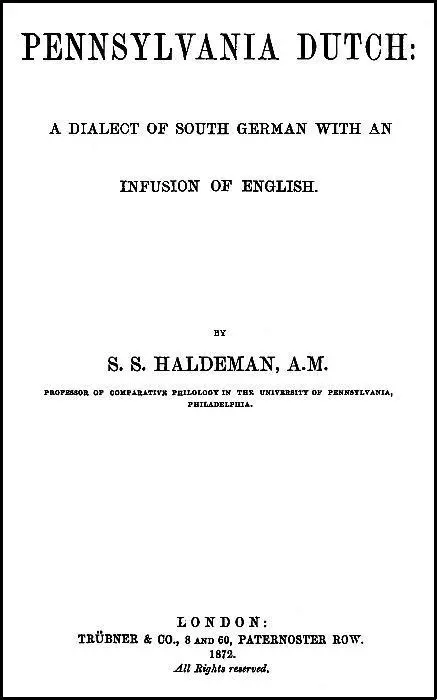
THE CLASSIC COLLECTION · 1872
"Pennsylvania Dutch: A Dialect of South German With an Infusion of English" by S. S. Haldeman is a scientific publication written in the late 19th century. The book explores the unique linguistic characteristics of Pennsylvania Dutch, a dialect formed by German-speaking immigrants to Pennsylvania, highlighting its blend of South German roots and English influences. The text delves into various aspects of the dialect, including its phonology, vocabulary, and syntax, making it a valuable resource for those interested in comparative philology and language evolution. The opening of the work introduces the rationale behind studying this dialect, emphasizing its formation over a century within a linguistically diverse community. It describes the historical context of German immigration to Pennsylvania and how various dialects from regions like Rhenish Bavaria and Alsace contributed to the development of Pennsylvania Dutch. The author outlines the influences of limited interactions among the largely agricultural immigrant populations, which led to distinct linguistic changes, thus setting the stage for a detailed examination of phonology, vocabulary, and syntax in subsequent chapters.
Introduction adapted from the source catalogue; source summaries may be automatically generated.
Free to read · English · 27,823 words · No account needed
MAKE TIME FOR A GOOD BOOK
On by default. Untick to stop anonymous reading totals. Each page counts after 10 seconds in view. How this works.
Anonymous counting is on unless you have switched it off.
The South German dialect of Breisgau has G. er hilft (he helps, PG. ær helft), g'seit (as in Alsatia) for gesagt, PG. 'ksaat,' us for G. and PG. 'aus,' i for ich, herrli for herrlich, (PG. hærrlich), wön for wollen, zît (as in Alsatia) for zeit, aue for augen (eyes, PG. aughǝ, Alsat. auǝ), de for du, gen for gegeben (given, PG. gewwǝ, sometimes suppressing ge-, to which attention has been called). Besides gen, the following Allemanic example (Radlof, 2, 99) contains wore for geworden, and uskratzt for ausgekratzt--
"Se han kurzwilt un Narrethei triebe, un am End isch der Hirt keck wore, un het em Mümmele e Schmützle gen, un se het em seldrum d'Aue nit uskratzt."
They trifled and fooled, and finally the shepherd (ist keck geworden) became bold, and (hat gegeben) gave (dem) to the water nymph a kiss, and she did not (dasselbe darum) on-that-account ('em' for ihm) scratch out his eyes.
In the following examples, the Breisgauish and PG. are probably more nearly allied than might be supposed from a comparison of the spelling. The Alsatian and PG. are in the same alphabet.
German. Breis- Alsace. PG. English.
gau.
regenbogen, regeboge, râjǝbâu-ǝ, reeghǝ- rainbow. booghǝ, wo, von, wu, vun, wuu, fun, wuu, fun, where, of. da, mal, do, mol, doo, mool, doo, mool, here, times. schaf, schof, schoof, schoof, sheep. schlafen, schlofe, schloofǝ, schloofǝ, to sleep. und, gelt, un, gel, un, gel, un, gel, and, truly! wohnen, wuhne, woonǝ, wuunǝ, to reside. kommen, kumme, kummǝ, kummǝ, to come. gesehen, g'sehne, g'sên, kseenǝ, seen. jahr, auch, johr, au, joor, au, joor, aa, year, also. nachbar, nochber, nochbǝr, nochbǝr, neighbor. nicht, nit, nix, net, niks, net, niks, not, nothing. nichts, selbiger, seller, tsellǝr, sellǝr, that one. es ist 's isch ǝs isch jets, s isch jets, it is now. jetzt, jetz, etwas, ebbes, eppǝs, ebbǝs, something. eppǝs, nunmehr, nummee, (nimmǝ), nummi, now. darunter, runter, (nuntǝr), runtǝr, under. als, einem, as, eme, as, ǝmǝ, as, mǝ, as, to a. man kann, mer kann, m'r kann, mǝr kann, one can. sie haben, sie hen, sii haan, sii hen, they have. han, wir sind, mer sin, m'r sin, m'r sin, we are. weiszt, wescht, weischt, weescht, knowest. das, hat, des, het, des, hot, des, hǝt, the, has.
In the next three lines of Breisgauish (Radlof, 2, 95) words which agree more or less with PG. are in italic--
Your reading position is saved on this browser. Take it to another device with a library code. Reading pages adapt to text, rather than matching a printed edition.
BEHIND THE BOOK
This eBook is for the use of anyone anywhere in the United States and most other parts of the world at no cost and with almost no restrictions whatsoever. You may copy it, give it away or re-use it under the terms of the Project Gutenberg License included with this eBook or online at www.gutenberg.org. If you are not located in the United States, you will have to check the laws of the country where you are located before using this eBook. Read the source licence.
The original source file, including credits and licence, is retained by this library. Request an original-format copy at no charge. Please include the book title and Project Gutenberg identifier #48417.
KEEP YOUR CURIOSITY GOING
Cécile Tormay

Moritz Busch
John L. Ransom
Frances Wright
Cécile Tormay

Mabel Potter Daggett