THE CLASSIC COLLECTION✦Hawthorne (English Men of Letters Series)CLASSIC FREE BOOKS
Hawthorne (English Men of Letters Series)
Henry James
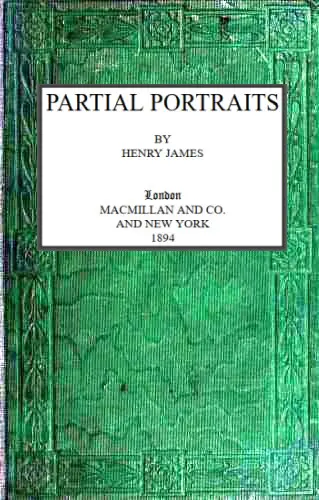
THE CLASSIC COLLECTION · 1888
"Partial Portraits" by Henry James is a collection of literary criticism published in 1888. This influential work gathers James's essays on major English, American, and European writers, exploring their unique artistic visions and techniques. The centerpiece is "The Art of Fiction," James's landmark argument for complete creative freedom in narrative writing. Through penetrating analyses of authors like George Eliot, Maupassant, and Turgenev, James champions each writer's distinctive perspective while establishing fiction's place among the fine arts. His elegant criticism reveals how different novelists view life through their own creative windows.
Introduction adapted from the source catalogue; source summaries may be automatically generated.
Free to read · English · 101,137 words · No account needed
MAKE TIME FOR A GOOD BOOK
On by default. Untick to stop anonymous reading totals. Each page counts after 10 seconds in view. How this works.
Anonymous counting is on unless you have switched it off.
Many people in the United States, and doubtless in other countries, have gathered their knowledge of English life almost entirely from Punch, and it would be difficult to imagine a more abundant, and on the whole a more accurate, informant. The accumulated volumes of this periodical contain evidence on a multitude of points of which there is no mention in the serious works--not even in the novels--of the day. The smallest details of social habit are depicted there, and the oddities of a race of people in whom oddity is strangely compatible with the dominion of convention. That the ironical view of these things is given does not injure the force of the testimony, for the irony of Punch, strangely enough, has always been discreet, even delicate. It is a singular fact that, though taste is not supposed to be the strong point of the English mind, this eminently representative journal has rarely been guilty of a violation of decorum. The taste of Punch, like its good-humour, has known very few lapses. The London Charivari--we remember how difficult it was (in 1853) to arrive at the right pronunciation--has in this respect very little to envy its Parisian original. English comedy is coarse, French comedy is fine--that would be the general assumption, certainly, on the part of a French critic. But a comparison between the back volumes of the Charivari and the back volumes of Punch would make it necessary to modify this formula. English humour is simple, innocent, plain, a trifle insipid, apt to sacrifice to the graces, to the proprieties; but if Punch be our witness English humour is not coarse. We are fortunately not obliged to declare just now what French humour appears to be--in the light of the Charivari, the Journal Amusant, the Journal Pour Rire. A Frenchman may say, in perfect good faith, that (to his sense) English drollery has doubtless every merit but that of being droll. French drollery, he may say, is salient, saltatory; whereas the English comic effort has little freedom of wing. The French, in these matters, like a great deal of salt; whereas the English, who spice their food very highly and have a cluster of sharp condiments on the table, take their caricatures comparatively mild. Punch, in short, is for the family--Punch may be sent up to the nursery. This surely may be admitted; and it is the fact that Punch is for the family that constitutes its high value. The family is, after all, the people; and a satirical sheet which holds up the mirror to this institution can hardly fail to be instructive. “Yes, if it hold the mirror up impartially,” we can imagine the foreign critic to rejoin; “but in these matters the British caricaturist is not to be trusted. He slurs over a great deal--he omits a great deal more. He must, above all things, be proper; and there is a whole side of life which, in spite of his Juvenalian pretensions, he never touches at all.” We must allow the foreign critic his supposed retort, without taking space to answer back--we may imagine him to be a bit of a “naturalist”--and admit that it is perhaps because they are obliged to be proper that Leech and Du Maurier give us, on the whole, such a cleanly, healthy, friendly picture of English manners. Such sustained and inveterate propriety is in itself a great force; it takes in a good deal, as well as leaves out. The general impression that we derive from the long series of Punch is a very cheerful and favourable one; it speaks of a vigorous, good-humoured, much-civilised people. The good-humour is, perhaps, the most striking point--not only the good-humour of the artist who represents the scene, but that of the figures engaged in it. The difference is remarkable in this respect between Punch and the French comic papers. The wonderful Cham, who for so many years contributed to those sheets, had an extraordinary sense of the ludicrous and a boundless stock of facetious invention. He was strangely expressive; he could place a figure before you, in the most violent action, with half a dozen strokes of his pencil. But his people were like wild-cats and scorpions. The temper of the French bourgeoisie, as represented by Cham, is a thing to make one take to one’s heels. They perpetually tear and rend each other, show their teeth and their claws, kick each other down-stairs, and pitch each other from windows. All this is in the highest degree farcical and grotesque; but at bottom it is almost horrible. (It must be admitted that Cham and his wonderful colleague, Daumier, are much more horrible than Gavarni, who was admirably real, and at the same time capable of beauty and grace. Gavarni’s women are charming; those of Cham and Daumier are monsters.) There is nothing, or almost nothing, of the horrible in Punch. The author of these remarks has a friend whom he has heard more than once maintain the too-ingenious thesis that the caricatures of Cham prove the French to be a cruel people; the same induction could, at least, never be made, even in an equal spirit of paradox, from the genial pages of Punch. “If Punch is never horrible, it is because Punch is always superficial, for life is full of the horrible”--so we may imagine our naturalistic objector to go on. However this may be, Punch is fortunate in having fallen on so smooth a surface. English life, as depicted by Leech and Du Maurier, and by that admirable Charles Keene--the best-humoured perhaps of the three, whose talent is so great that we have always wondered why it is not more comprehensive--is a compound of several very wholesome tastes: the love of the country, the love of action, the love of a harmless joke within the limits of due reverence, the love of sport, of horses and dogs, of family life, of children, of horticulture. With this there are a few other tastes of a less innocent kind--the love of ardent spirits, for instance, or of punching people’s heads--or even the love of a lord. In Leech’s drawings, country life plays a great part; his landscapes, in their extreme sketchiness, are often admirable. He gave in a few strokes the look of the hunting-field in winter--the dark damp slopes, the black dense hedges, the low thick sky. He was very general; he touched on everything, sooner or later; but he enjoyed his sporting subjects more than anything else. In this he was thoroughly English. No close observer of that people can fail to perceive that the love of sport is the thing that binds them most closely together, and in which they have the greatest number of feelings in common. Leech depicted, with infinite vividness, the accidents of the chase and of the fishing-season; and his treatment of the horse in especial contributed greatly to his popularity. He understood the animal, he knew him intimately, he loved him; and he drew him as if he knew how to ride as well as to draw. The English forgive a great deal to those who ride well; and this is doubtless why the badness of some of the sporting subjects that have appeared in Punch since Leech’s death has been tolerated: the artist has been presumed to have a good seat. Leech never made a mistake; he did well whatever he did; and it must be remembered that for many years he furnished the political cartoon to Punch, as well as the smaller drawings. He was always amusing, always full of sense and point, always intensely English. His foreigner is always an inferior animal--his Frenchman is the Frenchman of Leicester Square, the Frenchman whom the Exhibition of 1851 revealed to the people of London. His point is perfectly perceptible--it is never unduly fine. His children are models of ruddy, chubby, shy yet sturdy British babyhood; and nothing could be nicer than his young women. The English maiden, in Leech, is emphatically a nice girl; modest and fresh, simple and blooming, and destined evidently for use as much as for ornament. In those early days to which we referred at the beginning of this article we were deeply in love with the young ladies of Leech, and we have never ceased to admire the simple art with which he made these hastily designed creatures conform unerringly to the English type. They have English eyes and English cheeks, English figures, English hands and feet, English ringlets, English petticoats. Leech was extremely observant, but he had not a strong imagination; he had a sufficient, but not a high sense of beauty; his ideal of the beautiful had nothing of the unattainable; it was simply a résumé of the fresh faces he saw about him. The great thing, however, was that he was a natural, though not in the least an analytic or an exact, draughtsman; his little figures live and move; many of his little scenes are stamped on the memory. I have spoken of his representations of the country, but his town-pictures are numerous and capital. He knew his London, and his sketches of the good people of that metropolis are as happy as his episodes in the drawing-room and the hunting-field. He was admirably broad and free; and no one in his line has had more than he the knack of giving what is called a general effect. He conveys at times the look of the London streets--the colour, the temperature, the damp blackness. He does the winter weather to perfection. Long before I had seen it I was acquainted, through his sketches, with the aspect of Baker Street in December. Out of such a multitude of illustrations it is difficult to choose; the two volumes of Sketches of Life and Character, transferred from Punch, are a real museum. But I recall, for instance, the simple little sketch of the worthy man up to his neck in bed on a January morning, to whom, on the other side of the door, the prompt housemaid, with her hammer in her hand, announces that “I have just broken the ice in your bath, sir.” The black cold dawn, the very smell of the early chill, that raw sootiness of the London winter air, the red nose of the housemaid, the unfashionable street seen through the window--impart a peculiar vividness to the small inky-looking woodcut.
Your reading position is saved on this browser. Take it to another device with a library code. Reading pages adapt to text, rather than matching a printed edition.
Henry James
Henry James
Henry James
Henry James
BEHIND THE BOOK
This eBook is for the use of anyone anywhere in the United States and most other parts of the world at no cost and with almost no restrictions whatsoever. You may copy it, give it away or re-use it under the terms of the Project Gutenberg License included with this eBook or online at www.gutenberg.org. If you are not located in the United States, you will have to check the laws of the country where you are located before using this eBook. Read the source licence.
The original source file, including credits and licence, is retained by this library. Request an original-format copy at no charge. Please include the book title and Project Gutenberg identifier #58471.
KEEP YOUR CURIOSITY GOING

David Patterson (Spirit) Hatch

David Patterson (Spirit) Hatch

David Patterson (Spirit) Hatch
Cécile Tormay

Moritz Busch
John L. Ransom