THE CLASSIC COLLECTION✦Hawthorne (English Men of Letters Series)CLASSIC FREE BOOKS
Hawthorne (English Men of Letters Series)
Henry James
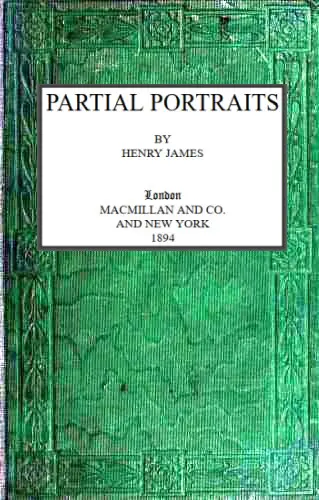
THE CLASSIC COLLECTION · 1888
"Partial Portraits" by Henry James is a collection of literary criticism published in 1888. This influential work gathers James's essays on major English, American, and European writers, exploring their unique artistic visions and techniques. The centerpiece is "The Art of Fiction," James's landmark argument for complete creative freedom in narrative writing. Through penetrating analyses of authors like George Eliot, Maupassant, and Turgenev, James champions each writer's distinctive perspective while establishing fiction's place among the fine arts. His elegant criticism reveals how different novelists view life through their own creative windows.
Introduction adapted from the source catalogue; source summaries may be automatically generated.
Free to read · English · 101,137 words · No account needed
MAKE TIME FOR A GOOD BOOK
On by default. Untick to stop anonymous reading totals. Each page counts after 10 seconds in view. How this works.
Anonymous counting is on unless you have switched it off.
We know not whether the form of infantine nostalgia of which we speak is common, or was then common, among small Americans; but we are sure that, when fortune happens to favour it, it is a very delightful pain. In those days, in America, the manufacture of children’s picture-books was an undeveloped industry; the best things came from London, and brought with them the aroma of a richer civilisation. The covers were so beautiful and shining, the paper and print so fine, the coloured illustrations so magnificent, that it was easy to see that over there the arts were at a very high point. The very name of the publisher on the title-page (the small boy we speak of always looked at that) had a thrilling and mystifying effect. But, above all, the contents were so romantic and delectable! There were things in the English story-books that one read as a child, just as there were things in Punch, that one couldn’t have seen in New York, even if one had been fifty years old. The age had nothing to do with it; one had a conviction that they were not there to be seen--we can hardly say why. It is, perhaps, because the plates in the picture-books were almost always coloured; but it was evident that there was a great deal more colour in that other world. We remember well the dazzling tone of a little Christmas book by Leech, which was quite in the spirit of Punch, only more splendid, for the plates were plastered with blue and pink. It was called Young Troublesome; or, Master Jacky’s Holidays, and it has probably become scarce to-day. It related the mischievous pranks of an Eton school-boy while at home for his Christmas vacation, and the exploit we chiefly recollect was his blacking with a burnt stick the immaculate calves of the footman who is carrying up some savoury dish to the banquet from which (in consequence of his age and his habits), Master Jacky is excluded. Master Jacky was so handsome, so brilliant, so heroic, so regardless of dangers and penalties, so fertile in resources; and those charming young ladies, his sisters, his cousins--the innocent victims of his high spirits--had such golden ringlets, such rosy cheeks, such pretty shoulders, such delicate blue sashes over such fresh muslin gowns. Master Jacky seemed to lead a life all illumined with rosy Christmas fire. A little later came Richard Doyle’s delightful volume, giving the history of Brown, Jones, and Robinson, and it would be difficult to exaggerate the action of these remarkable designs in forming the taste of our fantastic little amateur. They told him, indeed, much less about England than about the cities of the continent; but that was not a drawback, for he could take in the continent too. Moreover, he felt that these three travellers were intensely British; they looked at everything from the London point of view, and it gave him an immense feeling of initiation to be able to share their susceptibilities. Was there not also a delightful little picture at the end, which represented them as restored to British ground, each holding up a tankard of foaming ale, with the boots, behind them, rolling their battered portmanteaux into the inn? This seemed somehow to commemorate one’s own possible arrival in old England, even though it was not likely that overflowing beer would be a feature of so modest an event; just as all the rest of it was a foretaste of Switzerland, of the Rhine, of North Italy, which after this would find one quite prepared. We are sorry to say that when, many years later, we ascended, for the first time, to the roof of Milan Cathedral, what we first thought of was not the “waveless plain of Lombardy” nor the beauty of the edifice, but the “little London snob” whom Brown, Jones, and Robinson saw writing his name on one of the pinnacles of the church. We had our preferences in this genial trio. We adored little Jones, the artist--if memory doesn’t betray us (we haven’t seen the book for twenty years), and Jones was the artist. It is difficult to say why we adored him, but it was certainly the dream of our life at that foolish period to make his acquaintance. We did so, in fact, not very long after. We were taken in due course to Europe, and we met him on a steamboat on the Lake of Geneva. There was no introduction, we had no conversation, but he was the Jones we had prefigured and loved. Thackeray’s Christmas books (The Rose and the Ring apart--it dates from 1854) came before this: we remember them in our earliest years. They, too, were of the family of Punch--which is my excuse for this superfluity of preface--and they were a revelation of English manners. “English manners,” for a child, could of course only mean certain individual English figures--the figures in Our Street, in Doctor Birch and his Young Friends (we were glad we were not of the number), in Mrs. Perkins’s Ball. In the first of these charming little volumes there is a pictorial exposition of the reason why the nurse-maids in Our Street like Kensington Gardens. When in the course of time we were taken to walk in those lovely shades, we looked about us for a simpering young woman and an insinuating soldier on a bench, with a bawling baby sprawling on the path hard by, and we were not slow to discover the group.
Your reading position is saved on this browser. Take it to another device with a library code. Reading pages adapt to text, rather than matching a printed edition.
Henry James
Henry James
Henry James
Henry James
BEHIND THE BOOK
This eBook is for the use of anyone anywhere in the United States and most other parts of the world at no cost and with almost no restrictions whatsoever. You may copy it, give it away or re-use it under the terms of the Project Gutenberg License included with this eBook or online at www.gutenberg.org. If you are not located in the United States, you will have to check the laws of the country where you are located before using this eBook. Read the source licence.
The original source file, including credits and licence, is retained by this library. Request an original-format copy at no charge. Please include the book title and Project Gutenberg identifier #58471.
KEEP YOUR CURIOSITY GOING

David Patterson (Spirit) Hatch

David Patterson (Spirit) Hatch

David Patterson (Spirit) Hatch
Cécile Tormay

Moritz Busch
John L. Ransom