THE CLASSIC COLLECTION✦Hawthorne (English Men of Letters Series)CLASSIC FREE BOOKS
Hawthorne (English Men of Letters Series)
Henry James
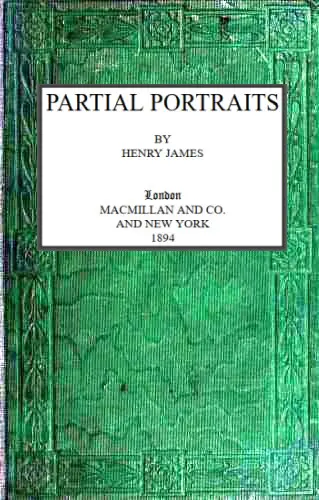
THE CLASSIC COLLECTION · 1888
"Partial Portraits" by Henry James is a collection of literary criticism published in 1888. This influential work gathers James's essays on major English, American, and European writers, exploring their unique artistic visions and techniques. The centerpiece is "The Art of Fiction," James's landmark argument for complete creative freedom in narrative writing. Through penetrating analyses of authors like George Eliot, Maupassant, and Turgenev, James champions each writer's distinctive perspective while establishing fiction's place among the fine arts. His elegant criticism reveals how different novelists view life through their own creative windows.
Introduction adapted from the source catalogue; source summaries may be automatically generated.
Free to read · English · 101,137 words · No account needed
MAKE TIME FOR A GOOD BOOK
On by default. Untick to stop anonymous reading totals. Each page counts after 10 seconds in view. How this works.
Anonymous counting is on unless you have switched it off.
The first of these were slight and simple, and for the most part cheerful; little anecdotes and legends of Provence, impressions of an artist’s holidays in that strange, bare, lovely land, and of wanderings further afield, in Corsica and Algeria; sketches of Paris during the siege; incidents of the invasion, the advent of the Prussian rule in other parts of the country. In all these things there is la note émue, the smile which is only a more synthetic sign of being moved. And then such grace of form, such lightness of touch, such alertness of observation! Some of the chapters of the Lettres de mon Moulin are such perfect vignettes, that the brief treatment of small subjects might well have seemed, at first, Alphonse Daudet’s appointed work. He had almost invented a manner, and it was impossible to do better than he the small piece, or even the passage. Glimpses, reminiscences, accidents, he rendered them with the brilliancy of a violinist improvising on a sudden hint. The Lettres de mon Moulin, moreover, are impregnated with the light, with the fragrance of a Provençal summer; the rosemary and thyme are in the air as we read, the white rocks and the grey foliage stretch away to an horizon of hills--the Alpilles, the little Alps--on which colour is as iridescent as the breast of a dove. The Provence of Alphonse Daudet is a delightful land; even when the mistral blows there it has a music in its whistle. Emile Zola has protested against this; he too is of Provençal race, he passed his youth in the old Languedoc, and he intimates that his fanciful friend throws too much sweetness into the picture. It is beyond contradiction that Daudet, like Tartarin de Tarascon and Numa Roumestan, exaggerates a little; he sees with great intensity, and is very sensitive to agreeable impressions. Le Petit Chose, his first long story, reads to-day like the attempt of a beginner, and of a beginner who had read and enjoyed Dickens. I risk this allusion to the author of Copperfield in spite of a conviction that Alphonse Daudet must be tired of hearing that he imitates him. It is not imitation; there is nothing so gross as imitation in the length and breadth of Daudet’s work; but it is conscious sympathy, for there is plenty of that. There are pages in his tales which seem to say to us that at one moment of his life Dickens had been a revelation to him--pages more particularly in Le Petit Chose, in Fromont Jeune and in Jack. The heroine of the first of these works (a very shadowy personage) is never mentioned but as the “black eyes”; some one else is always spoken of as the dame de grand mérite; the heroine’s father, who keeps a flourishing china-shop, never opens his mouth without saying “C’est le cas de le dire.” These are harmless, they are indeed sometimes very happy, Dickensisms. We make no crime of them to M. Daudet, who must have felt as intelligently as he has felt everything else the fascinating form of the English novelist’s drollery. Fromont Jeune et Risler Aîné is a study of life in the old quarter of the Marais, the Paris of the seventeenth century, whose stately hôtels have been invaded by the innumerable activities of modern trade. When I say a study, I use the word with all those restrictions with which it must be applied to a genius who is truthful without being literal, and who has a pair of butterfly’s wings attached to the back of his observation. If sub-titles were the fashion to-day, the right one for Fromont Jeune would be--or the Dangers of Partnership. The action takes place for the most part in a manufactory of wall-papers, and the persons in whom the author seeks to interest us are engaged in this useful industry. There are delightful things in the book, but, as I intimated at the beginning of these remarks, there are considerable inequalities. The pages that made M. Daudet’s fortune--for it was with Fromont Jeune that his fortune began--are those which relate to the history of M. Delobelle, the superannuated tragedian, his long-suffering wife, and his exquisite lame daughter, who makes butterflies and humming-birds for ladies’ head-dresses. This eccentric and pathetic household was an immense hit, and Daudet has never been happier than in the details of the group. Delobelle himself, who has not had an engagement for ten years, and who never will have one again, but who holds none the less that it is his duty not to leave the stage, “not to give up the theatre,” though his platonic passion is paid for by the weary eyesight of his wife and daughter, who sit up half the night attaching bead-eyes to little stuffed animals--the blooming and sonorous Delobelle, ferociously selfish and fantastically vain, under the genial forms of melodrama, is a beautiful representation of a vulgarly factitious nature. The book revealed a painter; all the descriptive passages, the pictorial touches, had the truest felicity. No one better than Daudet gives what we call the feeling of a place. The story illustrates, among other things, the fact that a pretty little woman who is consumed with the lowest form of vanity, and unimpeded in her operations by the possession of a heart, may inflict an unlimited amount of injury upon people about her, if she only have the opportunity. The case is well demonstrated, and Sidonie Chèbe is an elaborate study of flimsiness; her papery quality, as I may call it, her rustling dryness, are effectively rendered. But I think there is a limit to the interest which the English-speaking reader of French novels can take to-day in the adventures of a lady who leads the life of Madame Sidonie. In the first place he has met her again and again--he knows exactly what she will do and say in every situation; and in the second there always seems to him to be in her vices, her disorders, an element of the conventional. There is a receipt among French novelists for making little high-heeled reprobates. However this may be, he has at least a feeling that at night all cats are grey, and that the particular tint of depravity of a woman whose nature has the shallowness of a sanded floor is not a very important constatation. Daudet has expended much ingenuity in endeavouring to hit the particular tint of Sidonie; he has wished to make her a type--the type of the daughter of small unsuccessful shopkeepers (narrow-minded and self-complacent to imbecility), whose corruption comes from the examples, temptations, opportunities of a great city, as well as from her impure blood and the infection of the meanest associations. But what all this illustrates was not worth illustrating.
Your reading position is saved on this browser. Take it to another device with a library code. Reading pages adapt to text, rather than matching a printed edition.
Henry James
Henry James
Henry James

Henry James
BEHIND THE BOOK
This eBook is for the use of anyone anywhere in the United States and most other parts of the world at no cost and with almost no restrictions whatsoever. You may copy it, give it away or re-use it under the terms of the Project Gutenberg License included with this eBook or online at www.gutenberg.org. If you are not located in the United States, you will have to check the laws of the country where you are located before using this eBook. Read the source licence.
The original source file, including credits and licence, is retained by this library. Request an original-format copy at no charge. Please include the book title and Project Gutenberg identifier #58471.
KEEP YOUR CURIOSITY GOING

David Patterson (Spirit) Hatch

David Patterson (Spirit) Hatch

David Patterson (Spirit) Hatch
Cécile Tormay

Moritz Busch
John L. Ransom