THE CLASSIC COLLECTION✦Hawthorne (English Men of Letters Series)CLASSIC FREE BOOKS
Hawthorne (English Men of Letters Series)
Henry James
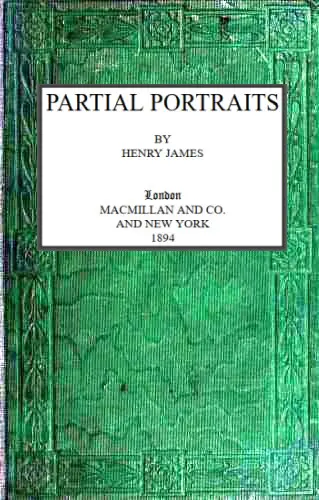
THE CLASSIC COLLECTION · 1888
"Partial Portraits" by Henry James is a collection of literary criticism published in 1888. This influential work gathers James's essays on major English, American, and European writers, exploring their unique artistic visions and techniques. The centerpiece is "The Art of Fiction," James's landmark argument for complete creative freedom in narrative writing. Through penetrating analyses of authors like George Eliot, Maupassant, and Turgenev, James champions each writer's distinctive perspective while establishing fiction's place among the fine arts. His elegant criticism reveals how different novelists view life through their own creative windows.
Introduction adapted from the source catalogue; source summaries may be automatically generated.
Free to read · English · 101,137 words · No account needed
MAKE TIME FOR A GOOD BOOK
On by default. Untick to stop anonymous reading totals. Each page counts after 10 seconds in view. How this works.
Anonymous counting is on unless you have switched it off.
When, a few months ago, Anthony Trollope laid down his pen for the last time, it was a sign of the complete extinction of that group of admirable writers who, in England, during the preceding half century, had done so much to elevate the art of the novelist. The author of The Warden, of Barchester Towers, of Framley Parsonage, does not, to our mind, stand on the very same level as Dickens, Thackeray and George Eliot; for his talent was of a quality less fine than theirs. But he belonged to the same family--he had as much to tell us about English life; he was strong, genial and abundant. He published too much; the writing of novels had ended by becoming, with him, a perceptibly mechanical process. Dickens was prolific, Thackeray produced with a freedom for which we are constantly grateful; but we feel that these writers had their periods of gestation. They took more time to look at their subject; relatively (for to-day there is not much leisure, at best, for those who undertake to entertain a hungry public), they were able to wait for inspiration. Trollope’s fecundity was prodigious; there was no limit to the work he was ready to do. It is not unjust to say that he sacrificed quality to quantity. Abundance, certainly, is in itself a great merit; almost all the greatest writers have been abundant. But Trollope’s fertility was gross, importunate; he himself contended, we believe, that he had given to the world a greater number of printed pages of fiction than any of his literary contemporaries. Not only did his novels follow each other without visible intermission, overlapping and treading on each other’s heels, but most of these works are of extraordinary length. Orley Farm, Can You Forgive Her?, He Knew He Was Right, are exceedingly voluminous tales. The Way We Live Now is one of the longest of modern novels. Trollope produced, moreover, in the intervals of larger labour a great number of short stories, many of them charming, as well as various books of travel, and two or three biographies. He was the great improvvisatore of these latter years. Two distinguished story-tellers of the other sex--one in France and one in England--have shown an extraordinary facility of composition; but Trollope’s pace was brisker even than that of the wonderful Madame Sand and the delightful Mrs. Oliphant. He had taught himself to keep this pace, and had reduced his admirable faculty to a system. Every day of his life he wrote a certain number of pages of his current tale, a number sacramental and invariable, independent of mood and place. It was once the fortune of the author of these lines to cross the Atlantic in his company, and he has never forgotten the magnificent example of plain persistence that it was in the power of the eminent novelist to give on that occasion. The season was unpropitious, the vessel overcrowded, the voyage detestable; but Trollope shut himself up in his cabin every morning for a purpose which, on the part of a distinguished writer who was also an invulnerable sailor, could only be communion with the muse. He drove his pen as steadily on the tumbling ocean as in Montague Square; and as his voyages were many, it was his practice before sailing to come down to the ship and confer with the carpenter, who was instructed to rig up a rough writing-table in his small sea-chamber. Trollope has been accused of being deficient in imagination, but in the face of such a fact as that the charge will scarcely seem just. The power to shut one’s eyes, one’s ears (to say nothing of another sense), upon the scenery of a pitching Cunarder and open them upon the loves and sorrows of Lily Dale or the conjugal embarrassments of Lady Glencora Palliser, is certainly a faculty which could take to itself wings. The imagination that Trollope possessed he had at least thoroughly at his command. I speak of all this in order to explain (in part) why it was that, with his extraordinary gift, there was always in him a certain infusion of the common. He abused his gift, overworked it, rode his horse too hard. As an artist he never took himself seriously; many people will say this was why he was so delightful. The people who take themselves seriously are prigs and bores; and Trollope, with his perpetual “story,” which was the only thing he cared about, his strong good sense, hearty good nature, generous appreciation of life in all its varieties, responds in perfection to a certain English ideal. According to that ideal it is rather dangerous to be explicitly or consciously an artist--to have a system, a doctrine, a form. Trollope, from the first, went in, as they say, for having as little form as possible; it is probably safe to affirm that he had no “views” whatever on the subject of novel-writing. His whole manner is that of a man who regards the practice as one of the more delicate industries, but has never troubled his head nor clogged his pen with theories about the nature of his business. Fortunately he was not obliged to do so, for he had an easy road to success; and his honest, familiar, deliberate way of treating his readers as if he were one of them, and shared their indifference to a general view, their limitations of knowledge, their love of a comfortable ending, endeared him to many persons in England and America. It is in the name of some chosen form that, of late years, things have been made most disagreeable for the novel-reader, who has been treated by several votaries of the new experiments in fiction to unwonted and bewildering sensations. With Trollope we were always safe; there were sure to be no new experiments.
Your reading position is saved on this browser. Take it to another device with a library code. Reading pages adapt to text, rather than matching a printed edition.
Henry James
Henry James
Henry James
Henry James
BEHIND THE BOOK
This eBook is for the use of anyone anywhere in the United States and most other parts of the world at no cost and with almost no restrictions whatsoever. You may copy it, give it away or re-use it under the terms of the Project Gutenberg License included with this eBook or online at www.gutenberg.org. If you are not located in the United States, you will have to check the laws of the country where you are located before using this eBook. Read the source licence.
The original source file, including credits and licence, is retained by this library. Request an original-format copy at no charge. Please include the book title and Project Gutenberg identifier #58471.
KEEP YOUR CURIOSITY GOING

David Patterson (Spirit) Hatch

David Patterson (Spirit) Hatch

David Patterson (Spirit) Hatch
Cécile Tormay

Moritz Busch
John L. Ransom