READ · DISCOVER · ENJOYClassic literature · Always free
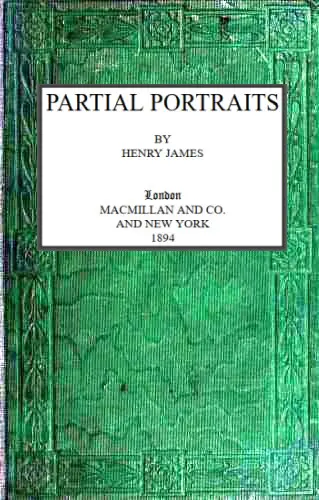
Partial Portraits — digital edition cover

THE CLASSIC COLLECTION · 1888

Partial Portraits

"Partial Portraits" by Henry James is a collection of literary criticism published in 1888. This influential work gathers James's essays on major English, American, and European writers, exploring their unique artistic visions and techniques. The centerpiece is "The Art of Fiction," James's landmark argument for complete creative freedom in narrative writing. Through penetrating analyses of authors like George Eliot, Maupassant, and Turgenev, James champions each writer's distinctive perspective while establishing fiction's place among the fine arts. His elegant criticism reveals how different novelists view life through their own creative windows.

Introduction adapted from the source catalogue; source summaries may be automatically generated.

Start reading ↓

Free to read · English · 101,137 words · No account needed

MAKE TIME FOR A GOOD BOOK

Partial Portraits

On by default. Untick to stop anonymous reading totals. Each page counts after 10 seconds in view. How this works.

Anonymous counting is on unless you have switched it off.

Partial Portraits

As I say, however, these are details, and I have touched them prematurely. Alphonse Daudet is a charmer, and the effect of his brilliant, friendly, indefinable genius is to make it difficult, in speaking of him, to take things in their order or follow a plan. In writing of him some time ago, in another place, I so far lost my head as to remark, with levity, that he was “a great little novelist.” The diminutive epithet then, I must now say, was nothing more than a term of endearment, the result of an irresistible impulse to express a sense of personal fondness. This kind of feeling is difficult to utter in English, and the utterance of it, so far as this is possible, is not thought consistent with the dignity of a critic. If we were talking French, nothing would be simpler than to say that Alphonse Daudet is adorable, and have done with it. But this resource is denied me, and I must arrive at my meaning by a series of circumlocutions. I am not able even to say that he is very “personal”; that epithet, so valuable in the vocabulary of French literary criticism, has, when applied to the talent of an artist, a meaning different from the sense in which we use it. “A novelist so personal and so penetrating,” says Emile Zola, speaking of the author of Numa Roumestan. That phrase, in English, means nothing in particular; so that I must add to it that the charm of Daudet’s talent comes from its being charged to an extraordinary degree with his temperament, his feelings, his instincts, his natural qualities. This, of course, is a charm, in a style, only when nature has been generous. To Alphonse Daudet she has been exceptionally so; she has placed in his hand an instrument of many chords. A delicate, nervous organisation, active and indefatigable in spite of its delicacy, and familiar with emotion of almost every kind, equally acquainted with pleasure and with pain; a light, quick, joyous, yet reflective, imagination, a faculty of seeing images, making images, at every turn, of conceiving everything in the visible form, in the plastic spirit; an extraordinary sensibility to all the impressions of life and a faculty of language which is in perfect harmony with his wonderful fineness of perception--these are some of the qualities of which he is the happy possessor, and which make his equipment for the work he has undertaken exceedingly rich. There are others besides; but enumerations are ponderous, and we should avoid that danger in speaking of a genius whose lightness of touch never belies itself. His elder brother, who has not his talent, has written a little book about him in which the word modernité perpetually occurs. M. Ernest Daudet, in Mon Frère et Moi, insists upon his possession of the qualities expressed by this barbarous substantive, which is so indispensable to the new school. Alphonse Daudet is, in truth, very modern; he has all the newly-developed, the newly-invented, perceptions. Nothing speaks so much to his imagination as the latest and most composite things, the refinements of current civilisation, the most delicate shades of the actual. It is scarcely too much to say that (especially in the Parisian race), modern manners, modern nerves, modern wealth, and modern improvements, have engendered a new sense, a sense not easily named nor classified, but recognisable in all the most characteristic productions of contemporary art. It is partly physical, partly moral, and the shortest way to describe it is to say that it is a more analytic consideration of appearances. It is known by its tendency to resolve its discoveries into pictorial form. It sees the connection between feelings and external conditions, and it expresses such relations as they have not been expressed hitherto. It deserves to win victories, because it has opened its eyes well to the fact that the magic of the arts of representation lies in their appeal to the associations awakened by things. It traces these associations into the most unlighted corners of our being, into the most devious paths of experience. The appearance of things is constantly more complicated as the world grows older, and it needs a more and more patient art, a closer notation, to divide it into its parts. Of this art Alphonse Daudet has a wonderfully large allowance, and that is why I say that he is peculiarly modern. It is very true that his manner is not the manner of patience--though he must always have had a great deal of that virtue in the preparation of his work. The new school of fiction in France is based very much on the taking of notes; the library of the great Flaubert, of the brothers de Goncourt, of Emile Zola, and of the writer of whom I speak, must have been in a large measure a library of memorandum-books. This of course only puts the patience back a stage or two. In composition Daudet proceeds by quick, instantaneous vision, by the happiest divination, by catching the idea as it suddenly springs up before him with a whirr of wings. What he mainly sees is the great surface of life and the parts that lie near the surface. But life is, immensely, a matter of surface, and if our emotions in general are interesting, the form of those emotions has the merit of being the most definite thing about them. Like most French imaginative writers (judged, at least, from the English standpoint), he is much less concerned with the moral, the metaphysical world, than with the sensible. We proceed usually from the former to the latter, while the French reverse the process. Except in politics, they are uncomfortable in the presence of abstractions, and lose no time in reducing them to the concrete. But even the concrete, for them, is a field for poetry, which brings us to the fact that the delightful thing in Daudet’s talent is the inveterate poetical touch. This is what mainly distinguishes him from the other lights of the realistic school--modifies so completely in his case the hardness of consistent realism. There is something very hard, very dry, in Flaubert, in Edmond de Goncourt, in the robust Zola; but there is something very soft in Alphonse Daudet. “Benevolent nature,” says Zola, “has placed him at that exquisite point where poetry ends and reality begins.” That is happily said; Daudet’s great characteristic is this mixture of the sense of the real with the sense of the beautiful. His imagination is constantly at play with his theme; it has a horror of the literal, the limited; it sees an object in all its intermingled relations--on its sentimental, its pathetic, its comical, its pictorial side. Flaubert, in whom Alphonse Daudet would probably recognise to a certain degree a literary paternity, is far from being a simple realist; but he was destitute of this sense of the beautiful, destitute of facility and grace. He had, to take its place, a sense of the strange, the grotesque, to which Salammbo, La Tentation de Saint-Antoine, his indescribable posthumous novel of Bouvard et Pécuchet, abundantly testify. The talent of the brothers Goncourt strikes us as a talent that was associated originally with a sense of beauty; but we receive an impression that this feeling has been perverted and warped. It has ceased to be natural and free; it has become morbid and peevish, has turned mainly to curiosity and mannerism. And these two authors are capable, during a whole book (as in Germinie Lacerteux or La Fille Elisa), of escaping from its influence altogether. No one would probably ever think of accusing Emile Zola of having a perception of the beautiful. He has an illimitable, and at times a very valuable, sense of the ugly, of the unclean; but when he addresses himself to the poetic aspect of things, as in La Faute de l’Abbé Mouret, he is apt to have terrible misadventures.

Your reading position is saved on this browser. Take it to another device with a library code. Reading pages adapt to text, rather than matching a printed edition.

More from this author

BEHIND THE WORDS

About Henry James

Henry James (1843–1916). An American-born novelist whose fiction examines consciousness, social conventions and encounters between American and European lives. Explore Hawthorne (English Men of Letters Series), The Diary of a Man of Fifty, Watch and ward and other works in this collection. These books span biography & memoir, essays & ideas, classic fiction.

Explore this author’s books →

THE READERS’ VERDICT

How did this story stay with you?

Not rated yet
Your rating for Partial Portraits

Be the first to share your verdict.

One rating per browser, which you can change or remove. A necessary browser identifier remembers your vote. How ratings work

A GOOD STORY DESERVES COMPANY

Pass this book along.

A great read is even better when it’s shared.

SEND A LITTLE INSPIRATION

Share this book

BEHIND THE BOOK

Edition & source details.

Title
Partial Portraits
Author
Henry James
First publication (Open Library catalogue match)
1888
Digital edition publisher
Project Gutenberg
Gutenberg release date
2018-12-14
Language
English
Source edition imprint
Not stated in source catalogue
Source identifier
Project Gutenberg #58471
Contributors
No additional named contributors in source metadata

Public-domain source & licence

This eBook is for the use of anyone anywhere in the United States and most other parts of the world at no cost and with almost no restrictions whatsoever. You may copy it, give it away or re-use it under the terms of the Project Gutenberg License included with this eBook or online at www.gutenberg.org. If you are not located in the United States, you will have to check the laws of the country where you are located before using this eBook. Read the source licence.

Full source licence and obtaining an original copy

The original source file, including credits and licence, is retained by this library. Request an original-format copy at no charge. Please include the book title and Project Gutenberg identifier #58471.

the full Project Gutenberg License must appear
prominently whenever any copy of a Project Gutenberg work (any work
on which the phrase “Project Gutenberg” appears, or with which the
phrase “Project Gutenberg” is associated) is accessed, displayed,
performed, viewed, copied or distributed:

This eBook is for the use of anyone anywhere in the United States and most
other parts of the world at no cost and with almost no restrictions
whatsoever. You may copy it, give it away or re-use it under the terms
of the Project Gutenberg™ License included with this eBook or online
at www.gutenberg.org. If you
are not located in the United States, you will have to check the laws
of the country where you are located before using this eBook.

1.E.2. If an individual Project Gutenberg electronic work is
derived from texts not protected by U.S. copyright law (does not
contain a notice indicating that it is posted with permission of the
copyright holder), the work can be copied and distributed to anyone in
the United States without paying any fees or charges. If you are
redistributing or providing access to a work with the phrase “Project
Gutenberg” associated with or appearing on the work, you must comply
either with the requirements of paragraphs 1.E.1 through 1.E.7 or
obtain permission for the use of the work and the Project Gutenberg
trademark as set forth in paragraphs 1.E.8 or 1.E.9.

1.E.3. If an individual Project Gutenberg electronic work is posted
with the permission of the copyright holder, your use and distribution
must comply with both paragraphs 1.E.1 through 1.E.7 and any
additional terms imposed by the copyright holder. Additional terms
will be linked to the Project Gutenberg License for all works
posted with the permission of the copyright holder found at the
beginning of this work.

1.E.4. Do not unlink or detach or remove the full Project Gutenberg
License terms from this work, or any files containing a part of this
work or any other work associated with Project Gutenberg.

1.E.5. Do not copy, display, perform, distribute or redistribute this
electronic work, or any part of this electronic work, without
prominently displaying the sentence set forth in paragraph 1.E.1 with
active links or immediate access to the full terms of the Project
Gutenberg License.

1.E.6. You may convert to and distribute this work in any binary,
compressed, marked up, nonproprietary or proprietary form, including
any word processing or hypertext form. However, if you provide access
to or distribute copies of a Project Gutenberg work in a format
other than “Plain Vanilla ASCII” or other format used in the official
version posted on the official Project Gutenberg website
(www.gutenberg.org), you must, at no additional cost, fee or expense
to the user, provide a copy, a means of exporting a copy, or a means
of obtaining a copy upon request, of the work in its original “Plain
Vanilla ASCII” or other form. Any alternate format must include the
full Project Gutenberg License as specified in paragraph 1.E.1.

1.E.7. Do not charge a fee for access to, viewing, displaying,
performing, copying or distributing any Project Gutenberg works
unless you comply with paragraph 1.E.8 or 1.E.9.

1.E.8. You may charge a reasonable fee for copies of or providing
access to or distributing Project Gutenberg electronic works
provided that:

• You pay a royalty fee of 20% of the gross profits you derive from
the use of Project Gutenberg works calculated using the method
you already use to calculate your applicable taxes. The fee is owed
to the owner of the Project Gutenberg trademark, but he has
agreed to donate royalties under this paragraph to the Project
Gutenberg Literary Archive Foundation. Royalty payments must be paid
within 60 days following each date on which you prepare (or are
legally required to prepare) your periodic tax returns. Royalty
payments should be clearly marked as such and sent to the Project
Gutenberg Literary Archive Foundation at the address specified in
Section 4, “Information about donations to the Project Gutenberg
Literary Archive Foundation.”

• You provide a full refund of any money paid by a user who notifies
you in writing (or by e-mail) within 30 days of receipt that s/he
does not agree to the terms of the full Project Gutenberg™
License. You must require such a user to return or destroy all
copies of the works possessed in a physical medium and discontinue
all use of and all access to other copies of Project Gutenberg™
works.

• You provide, in accordance with paragraph 1.F.3, a full refund of
any money paid for a work or a replacement copy, if a defect in the
electronic work is discovered and reported to you within 90 days of
receipt of the work.

• You comply with all other terms of this agreement for free
distribution of Project Gutenberg™ works.


1.E.9. If you wish to charge a fee or distribute a Project
Gutenberg™ electronic work or group of works on different terms than
are set forth in this agreement, you must obtain permission in writing
from the Project Gutenberg Literary Archive Foundation, the manager of
the Project Gutenberg™ trademark. Contact the Foundation as set
forth in Section 3 below.

1.F.

1.F.1. Project Gutenberg volunteers and employees expend considerable
effort to identify, do copyright research on, transcribe and proofread
works not protected by U.S. copyright law in creating the Project
Gutenberg™ collection. Despite these efforts, Project Gutenberg™
electronic works, and the medium on which they may be stored, may
contain “Defects,” such as, but not limited to, incomplete, inaccurate
or corrupt data, transcription errors, a copyright or other
intellectual property infringement, a defective or damaged disk or
other medium, a computer virus, or computer codes that damage or
cannot be read by your equipment.

1.F.2. LIMITED WARRANTY, DISCLAIMER OF DAMAGES - Except for the “Right
of Replacement or Refund” described in paragraph 1.F.3, the Project
Gutenberg Literary Archive Foundation, the owner of the Project
Gutenberg™ trademark, and any other party distributing a Project
Gutenberg™ electronic work under this agreement, disclaim all
liability to you for damages, costs and expenses, including legal
fees. YOU AGREE THAT YOU HAVE NO REMEDIES FOR NEGLIGENCE, STRICT
LIABILITY, BREACH OF WARRANTY OR BREACH OF CONTRACT EXCEPT THOSE
PROVIDED IN PARAGRAPH 1.F.3. YOU AGREE THAT THE FOUNDATION, THE
TRADEMARK OWNER, AND ANY DISTRIBUTOR UNDER THIS AGREEMENT WILL NOT BE
LIABLE TO YOU FOR ACTUAL, DIRECT, INDIRECT, CONSEQUENTIAL, PUNITIVE OR
INCIDENTAL DAMAGES EVEN IF YOU GIVE NOTICE OF THE POSSIBILITY OF SUCH
DAMAGE.

1.F.3. LIMITED RIGHT OF REPLACEMENT OR REFUND - If you discover a
defect in this electronic work within 90 days of receiving it, you can
receive a refund of the money (if any) you paid for it by sending a
written explanation to the person you received the work from. If you
received the work on a physical medium, you must return the medium
with your written explanation. The person or entity that provided you
with the defective work may elect to provide a replacement copy in
lieu of a refund. If you received the work electronically, the person
or entity providing it to you may choose to give you a second
opportunity to receive the work electronically in lieu of a refund. If
the second copy is also defective, you may demand a refund in writing
without further opportunities to fix the problem.

1.F.4. Except for the limited right of replacement or refund set forth
in paragraph 1.F.3, this work is provided to you ‘AS-IS’, WITH NO
OTHER WARRANTIES OF ANY KIND, EXPRESS OR IMPLIED, INCLUDING BUT NOT
LIMITED TO WARRANTIES OF MERCHANTABILITY OR FITNESS FOR ANY PURPOSE.

1.F.5. Some states do not allow disclaimers of certain implied
warranties or the exclusion or limitation of certain types of
damages. If any disclaimer or limitation set forth in this agreement
violates the law of the state applicable to this agreement, the
agreement shall be interpreted to make the maximum disclaimer or
limitation permitted by the applicable state law. The invalidity or
unenforceability of any provision of this agreement shall not void the
remaining provisions.

1.F.6. INDEMNITY - You agree to indemnify and hold the Foundation, the
trademark owner, any agent or employee of the Foundation, anyone
providing copies of Project Gutenberg™ electronic works in
accordance with this agreement, and any volunteers associated with the
production, promotion and distribution of Project Gutenberg™
electronic works, harmless from all liability, costs and expenses,
including legal fees, that arise directly or indirectly from any of
the following which you do or cause to occur: (a) distribution of this
or any Project Gutenberg work, (b) alteration, modification, or
additions or deletions to any Project Gutenberg work, and (c) any
Defect you cause.

Section 2. Information about the Mission of Project Gutenberg

Project Gutenberg is synonymous with the free distribution of
electronic works in formats readable by the widest variety of
computers including obsolete, old, middle-aged and new computers. It
exists because of the efforts of hundreds of volunteers and donations
from people in all walks of life.

Volunteers and financial support to provide volunteers with the
assistance they need are critical to reaching Project Gutenberg’s
goals and ensuring that the Project Gutenberg collection will
remain freely available for generations to come. In 2001, the Project
Gutenberg Literary Archive Foundation was created to provide a secure
and permanent future for Project Gutenberg and future
generations. To learn more about the Project Gutenberg Literary
Archive Foundation and how your efforts and donations can help, see
Sections 3 and 4 and the Foundation information page at www.gutenberg.org.

Section 3. Information about the Project Gutenberg Literary Archive Foundation

The Project Gutenberg Literary Archive Foundation is a non-profit
501(c)(3) educational corporation organized under the laws of the
state of Mississippi and granted tax exempt status by the Internal
Revenue Service. The Foundation’s EIN or federal tax identification
number is 64-6221541. Contributions to the Project Gutenberg Literary
Archive Foundation are tax deductible to the full extent permitted by
U.S. federal laws and your state’s laws.

The Foundation’s business office is located at 41 Watchung Plaza #516,
Montclair NJ 07042, USA, +1 (862) 621-9288. Email contact links and up
to date contact information can be found at the Foundation’s website
and official page at www.gutenberg.org/contact

Section 4. Information about Donations to the Project Gutenberg
Literary Archive Foundation

Project Gutenberg™ depends upon and cannot survive without widespread
public support and donations to carry out its mission of
increasing the number of public domain and licensed works that can be
freely distributed in machine-readable form accessible by the widest
array of equipment including outdated equipment. Many small donations
($1 to $5,000) are particularly important to maintaining tax exempt
status with the IRS.

The Foundation is committed to complying with the laws regulating
charities and charitable donations in all 50 states of the United
States. Compliance requirements are not uniform and it takes a
considerable effort, much paperwork and many fees to meet and keep up
with these requirements. We do not solicit donations in locations
where we have not received written confirmation of compliance. To SEND
DONATIONS or determine the status of compliance for any particular state
visit www.gutenberg.org/donate.

While we cannot and do not solicit contributions from states where we
have not met the solicitation requirements, we know of no prohibition
against accepting unsolicited donations from donors in such states who
approach us with offers to donate.

International donations are gratefully accepted, but we cannot make
any statements concerning tax treatment of donations received from
outside the United States. U.S. laws alone swamp our small staff.

Please check the Project Gutenberg web pages for current donation
methods and addresses. Donations are accepted in a number of other
ways including checks, online payments and credit card donations. To
donate, please visit: www.gutenberg.org/donate.

Section 5. General Information About Project Gutenberg electronic works

Professor Michael S. Hart was the originator of the Project
Gutenberg concept of a library of electronic works that could be
freely shared with anyone. For forty years, he produced and
distributed Project Gutenberg eBooks with only a loose network of
volunteer support.

Project Gutenberg eBooks are often created from several printed
editions, all of which are confirmed as not protected by copyright in
the U.S. unless a copyright notice is included. Thus, we do not
necessarily keep eBooks in compliance with any particular paper
edition.

Most people start at our website which has the main PG search
facility: www.gutenberg.org.

This website includes information about Project Gutenberg,
including how to make donations to the Project Gutenberg Literary
Archive Foundation, how to help produce our new eBooks, and how to
subscribe to our email newsletter to hear about new eBooks.


KEEP YOUR CURIOSITY GOING

Your next chapter awaits.