THE CLASSIC COLLECTION✦Hawthorne (English Men of Letters Series)CLASSIC FREE BOOKS
Hawthorne (English Men of Letters Series)
Henry James
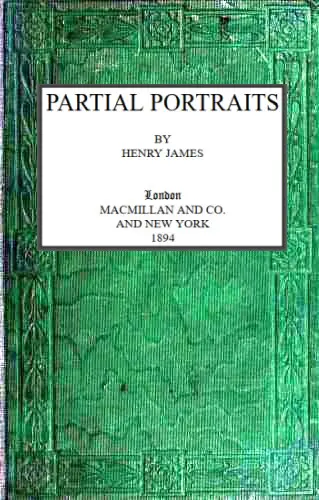
THE CLASSIC COLLECTION · 1888
"Partial Portraits" by Henry James is a collection of literary criticism published in 1888. This influential work gathers James's essays on major English, American, and European writers, exploring their unique artistic visions and techniques. The centerpiece is "The Art of Fiction," James's landmark argument for complete creative freedom in narrative writing. Through penetrating analyses of authors like George Eliot, Maupassant, and Turgenev, James champions each writer's distinctive perspective while establishing fiction's place among the fine arts. His elegant criticism reveals how different novelists view life through their own creative windows.
Introduction adapted from the source catalogue; source summaries may be automatically generated.
Free to read · English · 101,137 words · No account needed
MAKE TIME FOR A GOOD BOOK
On by default. Untick to stop anonymous reading totals. Each page counts after 10 seconds in view. How this works.
Anonymous counting is on unless you have switched it off.
We have said too much about Leech, however, and the purpose of these remarks is not to commemorate his work. Punch, for the last fifteen years, has been, artistically speaking, George du Maurier. (We ought, perhaps, before this, to have said that none of our observations are to be taken as applying to the letterpress of the comic journal, which has probably never been fully appreciated in America.) It has employed other talents than his--notably Charles Keene, who is as broad, as jovial, as English (half his jokes are against Scotchmen) as Leech, but whose sense of the beautiful, the delicate, is inferior even to Leech’s. But for a great many people, certainly in America, Du Maurier has long been, as I say, the successor of Leech, the embodiment of the pictorial spirit of Punch. Shut up in the narrow limits of black and white, without space, without colour, without the larger opportunities, Du Maurier has nevertheless established himself as an exquisite talent and a genuine artist. He is not so much of a laugher as Leech--he deals in the smile rather than the laugh--but he is a much deeper observer, and he carries his drawing infinitely further. He has not Leech’s animal spirits; a want of boyishness, a tendency to reflection, to lowness of tone, as his own Postlethwaite would say, is perhaps his limitation. But his seriousness--if he be too serious--is that of the satirist as distinguished from the simple joker; and if he reflects, he does so in the literal sense of the word--holds up a singularly polished and lucid mirror to the drama of English society. More than twenty years ago, when he began to draw in Once a Week--that not very long-lived periodical which set out on its career with a high pictorial standard--it was apparent that the careful young artist who finished his designs very highly and signed them with a French name, stood very much upon his own feet. The earliest things of his that we know have the quality which has made him distinguished to-day--the union of a great sense of beauty with a great sense of reality. It was apparent from the first that this was not a simple and uniform talent, but a gift that had sprung from a combination of sources. It is important to remember, in speaking of Du Maurier--who is one of the pillars of the British journal par excellence--that he has French blood in his veins. George du Maurier, as we understand his history, was born in England, of a French father and an English mother, but was removed to France in his early years and educated according to the customs of that country. Later, however, he returned to England; and it would not be difficult for a careful student of his drawings to guess that England is the land of his predilection. He has drawn a great many French figures, but he has drawn them as one who knows them rather than as one who loves them. He has perhaps been, as the phrase is, a little hard upon the French; at any rate, he has been decidedly easy for the English. The latter are assuredly a very handsome race; but if we were to construct an image of them from the large majority of Du Maurier’s drawings we should see before us a people of gods and goddesses. This does not alter the fact that there is a very Gallic element in some of Du Maurier’s gifts--his fineness of perception, his remarkable power of specifying types, his taste, his grace, his lightness, a certain refinement of art. It is hard to imagine that a talent so remarkable should not have given early evidences; but in spite of such evidences Du Maurier was, on the threshold of manhood, persuaded by those to whom it was his duty to listen to turn his attention, as Mrs. Micawber says, to chemistry. He pursued this science without enthusiasm, though he had for some time a laboratory of his own. Before long, however, the laboratory was converted into a studio. His talent insisted on its liberty, and he committed himself to the plastic. He studied this charming element in Paris, at Düsseldorf; he began to work in London. This period of his life was marked by a great calamity, which has left its trace on his career and his work, and which it is needful to mention in order to speak with any fairness of these things. Abruptly, without a warning, his eyesight partly forsook him, and his activity was cruelly threatened. It is a great pleasure, in alluding to this catastrophe, to be able to speak of it as a signal example of difficulty vanquished. George du Maurier was condemned to many dark days, at the end of which he learned that he should have to carry on his task for the rest of his life with less than half a man’s portion of the sense most valuable to the artist. The beautiful work that he has produced in such abundance for so many years has been achieved under restrictions of vision which might well have made any work impossible. It is permitted, accordingly, to imagine that if the artist had had the usual resources, we should not at the present moment have to consider him simply as an accomplished draughtsman in black and white. It is impossible to look at many of his drawings without perceiving that they are full of the art of the painter, and that the form they have taken, charming as it has been, is arbitrary and inadequate.
Your reading position is saved on this browser. Take it to another device with a library code. Reading pages adapt to text, rather than matching a printed edition.
Henry James
Henry James
Henry James

Henry James
BEHIND THE BOOK
This eBook is for the use of anyone anywhere in the United States and most other parts of the world at no cost and with almost no restrictions whatsoever. You may copy it, give it away or re-use it under the terms of the Project Gutenberg License included with this eBook or online at www.gutenberg.org. If you are not located in the United States, you will have to check the laws of the country where you are located before using this eBook. Read the source licence.
The original source file, including credits and licence, is retained by this library. Request an original-format copy at no charge. Please include the book title and Project Gutenberg identifier #58471.
KEEP YOUR CURIOSITY GOING

David Patterson (Spirit) Hatch

David Patterson (Spirit) Hatch

David Patterson (Spirit) Hatch
Cécile Tormay

Moritz Busch
John L. Ransom